
Graphics Design
19.Exploring the Importance of Iconography in Modern Design

Exploring the Importance of Iconography in Modern Design
Here’s an overview:
- Introduction to Iconography in Modern Design.
- The Evolution of Iconography in Graphic Design.
- The Impact of Iconography on User Experience.
- Best Practices for Integrating Iconography in Design.
- The Future of Iconography in Modern Design.
• Introduction to Iconography in Modern Design.

Exploring the Importance of Iconography in Modern Design in modern design, technically, iconography is of great importance in guiding the traffic the data flow in a logical way. The icons are far more than just small pictures; they are actually powerful visual instruments that allow a user to perceive an interface within a short time, with ease and without difficulty. Being a good designer and understanding how iconography affects the quality of visuals and user experience is crucial for building products that are both fantastic and easy to use.
Symbolism: Icons are often symbolic items that demonstrate justice, see the picture. Every symbol controls an individual messaging or action, which makes it possible to understand information in a moment when the user just watches the symbols.
Consistency: Using logos regularly will make a fast and global language that will be spread through all the visual design. Standardized icons assists in retaining icons known to the user thus enabling them to easily be part of a new unfamiliar environment.
Universal language: Exploring the importance of iconography in modern design symbolism undoes the boundaries of language by using the common images that can be read by both the people who share and don’t have the same cultural backgrounds. It is effectual instrument for development of the icons that helps to achieve the inclusive designs which supports the people who belong to different community.
Enhanced user experience: Icon mobile app design can be used to increase user understanding of the interface, facilitate navigation, and remove the burden from the memory. Developing the smooth icons and symbols designers could trigger the intuitive and pleasant emotions of the customers.
Exploring the importance of iconography in modern design the realm of the modern design can not exist without a proper knowledge of symbolism. And the reason is that so made images can be quick, visually complex and yet are simple and multifunctional in the same time. Designers can achieve this by strong icons, boosting user experiences and shaping unique brand images with the help of just strong visuals.
• The Evolution of Iconography in Graphic Design-Exploring the Importance of Iconography in Modern Design

Exploring the importance of iconography in modern design what I have witnessed is undeniably the most notable transformation of the Old in the graphic design realm, which is the use of icons. Throughout the centuries, icons have gone from their initial stage as basic pictograms to intricate and convoluted images that relay many messages with a single image.
Simplicity to Complexity: Beginning with, symbols were on the one hand, very simple and basic in their design replying to basic shapes and outlines. Yet, with progresses in newer design tools and methods, icons have become more perfect, which means that not only details but also layers are added to improve their meaning and visual effect.
Symbolism and Metaphors: Exploring the importance of iconography in modern design icons are not simply symbols. Besides, the maintaining and perpetuating of the symbols and metaphors gives meanings to icons. Designers use iconography now to evoke emotions, tell stories, and transude messages efficiently.
Adaptation to Digital Platforms: The digital era has been on the rise and the icons are fully incorporated into the trend. On icons, designers are now targeting scalability aiming at maintaining their clarity and readability across multiple device viewport sizes and screen resolutions.
Personalization and Branding: Likewise, modern iconography is commonly tailored with the guardian of a brand or line. The designers take an icon and work on it in a way that it will be aligned with the brand values and aesthetics, which is an individual element.
Inclusivity and Diversity: Exploring the importance of iconography in modern design contemporary iconography, with respect to public monuments, concentrates much on inclusiveness and diversity. Graphic designers are always looking for the icons which are meant to represent a big mix of cultures, sexes, and themes. The aim is usually to design an iconic language that stands above the crowd and is more representative for everyone.
Exploring the importance of iconography in modern design in the end of this article, achieving a more classier and inventive visual language using the evolving iconography in the graphic design is proven to work well and to be very effective allowing designers to communicate their ideas to the modern design area.
• The Impact of Iconography on User Experience.

Exploring the importance of iconography in modern design according to me, iconography do have a considerable effect on users interface. Here are some key points to consider: Here are some key points to consider:
Visual Communication: There is a chance for global understanding and language barrier crossing using icons that provide a universal language to users to move from one point to another within a website or app easily. Symbols are one of the tools often used to pass information with the limited capacity of the symbols at the disposal.
Cognitive Load: Exploring the importance of iconography in modern design accordingly, the icons that are made well off can significantly decrease cognitive load since they give a visual clue for both actions and information. Users looking for icons can find the information they want very quickly, so the icons don’t need to be accompanied by long text descriptions.
Aesthetics: Icons are among the most vital component in design that contributes to the visual aesthetics of the design. Ultimately, images that are visually appealing icons not only improve the quality of the design but also create a user experience which is much more enjoyable. Nevertheless, unclear or dissimilar symbols may disturb the navigational process and educate user.
Consistency: Exploring the importance of iconography in modern design it is important to maintain uniformity among the icons in order to make the visual hierarchy understandable and for channeling the data according to the design of the interface. The same designed icons provide people with the opportunity to predict chance of finding desired functions or info.
Accessibility: An icon should be developed thinking of the accessibility, in this way, it won’t be only perceivable and understandable but also all users can feel like they are part of the same experience, regardless of their disabilities. Remember to ensure good color contrast, as well as minimum size of the symbols and sign, which should have a symbolic meaning for accessibility purposes.
Exploring the importance of iconography in modern design to summarize, the application of symbolism may play an important role in user experience, which is pronounced through peculiar features such as keeping of communication, reducing cognitive load, increasing aesthetics, protecting consistency, and ensuring accessibility. With the use of right approach, icons can improve navigation anywhere in screen and as a result, they make the design more human.
• Best Practices for Integrating Iconography in Design.

Exploring the importance of iconography in modern design finding the right icons and aligning them properly plays an integral role in the design. Here are some best practices to ensure the effective integration of icons in your designs:Here are some best practices to ensure the effective integration of icons in your designs:
Consistency is Key: Make sure you use the same style, size and color along the scheme to keep the visual connection of the design in harmony.
Simplicity and Clarity: Compare with linking bars of colors and instead stick to simple yet easily recognizable icons that will convey messages to users quickly and correctly.
Meaningful Placement: Incorporate very icons as way markers to users for better users experience.
Consider Accessibility: Make sure that the icons are universally understood within any audience, especially for a multi-cultural audience base.
Opt for Scalable Icons: Maintain standard for each icon by making them vector-based to avoid pixilation that may occur on different device screen sizes.
Balance with Text: Striking a balance between icons with text is very important and one should not try to overwhelm the design or provide the context by too much text.
Aim for Visual Hierarchy: Draw on visual hierarchy with icons by piercing through essential elements in an appealing design.
Test for Usability: Run usability tests to check whether the icons effectively convey user interface and users’ comprehension.
Stay Consistent with Brand Guidelines: Make identity of iconography in sync with the brand’s visual make, so that both can share the brand identity and appear cohesive.
Exploring the importance of iconography in modern design with these guidelines in mind, you will become more capable to rein in the wonderful of iconography and produce user experiences that are exemplary.
• The Future of Iconography in Modern Design.

Exploring the importance of iconography in modern design i did see that creation of emanation is occurring and at the same time become an essential element of current design. Given the fact of how technology continues to progress by introducing digital interfaces into the existing structures the importance of icons as tools to create a better interface and inform the users effectively will increase.
Embracing Minimalism: Exploring the importance of iconography in modern design looking at the future, I can expect that there is a rise in simplified iconography. Icons not only visually simplified and abstract look good together, but they serve a practical purpose of having various user interfaces combined and streamlined.
Enhancing Accessibility: As a rising demand for popular culture to be more inclusive, I too believe that the future of iconography shall prioritize accessibility. Designers must guarantee that symbols are easily identified and that their messages are readily decipherable by people with disabilities. .
Innovating with Animation: Exploring the importance of iconography in modern design the graphic characters which are animated icons would grow in the coming days. Dynamical icons could serve as visual signals, capture user’s attention, and undoubtedly put a wonderful environment to the start use. By designers testing how to apply movements in icon design the result can be awesome.
Exploring the importance of iconography in modern design in retrospective, the importance of such playing in modern design is evident. Fueled by the ability to monitor and engage forward thinking trends and technologies, icon designers can now use icons as a vehicle to make compelling user- friendly and aesthetically sound interfaces with audiences who have a deeper connection.
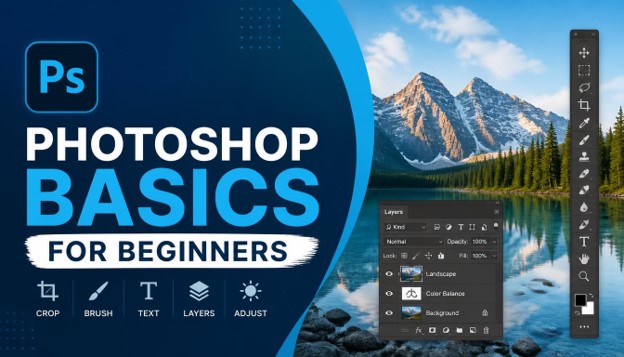
Photoshop Basics for Beginners: 25 Essential Skills You Need to Know (2026)
Learning Photoshop basics can feel overwhelming at first, especially when you open the software and see dozens of panels, tools, and menus staring back at you. But once you understand the core Photoshop basics, everything else becomes much easier to pick up. Whether you want to edit personal photos, design social media graphics, or start a career in digital design, mastering Photoshop basics is the first step toward becoming confident with this powerful tool.
In this guide, we are going to walk through 25 essential skills that make up the foundation of Photoshop basics for 2026. Each section is written in short, easy-to-read paragraphs so you can quickly scan, learn, and apply what you read without getting lost in technical jargon. By the end of this article, you will have a solid understanding of Photoshop basics and feel ready to start editing your own images with confidence.
Let’s dive into the 25 essential Photoshop basics every beginner should know in 2026.
1. Understanding the Photoshop Workspace

Before you touch a single tool, it helps to understand the layout of the software. The workspace is made up of the toolbar on the left, the options bar at the top, and various panels on the right such as Layers, Properties, and Adjustments.
Getting comfortable with this layout is one of the most important Photoshop basics because everything you do inside the program starts here. Spend a few minutes exploring each panel so you know where to find the tools you will use most often.
2. Creating and Managing Documents
Every project starts with a new document. Learning how to set the correct canvas size, resolution, and color mode (RGB for web, CMYK for print) is a core part of Photoshop basics that beginners often overlook.
Getting your document settings right from the start saves you from resizing or quality issues later. This small step is one of the easiest Photoshop basics to learn, but it has a big impact on your final results.
3. Using the Move Tool
The Move Tool lets you reposition layers, selections, and objects within your canvas. It sounds simple, but understanding how it interacts with different layers is an important part of Photoshop basics.
Practice dragging layers around, using arrow keys for precise movement, and holding Shift to constrain motion. These small habits build a strong foundation in Photoshop basics that will speed up your workflow later on.
4. Mastering Selection Tools

Selections are at the heart of almost everything you do in Photoshop. The Marquee Tool, Lasso Tool, and Magic Wand Tool each serve different purposes, and learning when to use each one is essential to Photoshop basics.
The Marquee Tool is great for simple rectangular or elliptical selections. The Lasso Tool allows freehand selections, while the Magic Wand selects areas based on color similarity. Combining these tools is a skill that grows naturally as you practice Photoshop basics.
5. Understanding Layers

Layers are arguably the single most important concept in Photoshop basics. Think of layers as transparent sheets stacked on top of each other, each holding a different part of your image.
Working non-destructively with layers means you can edit one part of your design without affecting the rest. This concept alone separates beginners from more advanced users, which is why it deserves extra attention when learning Photoshop basics.
6. Working with Layer Masks

Layer masks allow you to hide or reveal parts of a layer without permanently deleting pixels. This is one of the most valuable Photoshop basics because it keeps your editing flexible and reversible.
Using black to hide and white to reveal on a mask takes a bit of practice, but once it clicks, you will use this technique in almost every project. Many professional retouching workflows rely heavily on this core piece of Photoshop basics.
7. Using Adjustment Layers
Adjustment layers let you change brightness, contrast, color balance, and more without altering your original image. They sit on top of your layer stack and can be edited or removed at any time.
This non-destructive approach is a defining feature of good Photoshop basics habits. Instead of applying changes directly to pixels, adjustment layers keep your file flexible for future edits.
8. Exploring Blending Modes
Blending modes control how a layer interacts with the layers beneath it. Modes like Multiply, Screen, and Overlay can dramatically change the mood and tone of an image.
Experimenting with blending modes is a fun way to deepen your understanding of Photoshop basics. Try switching between different modes on a sample project to see how each one affects color, contrast, and lighting.
9. Getting Comfortable with the Brush Tool

The Brush Tool is used for painting, retouching, and creating custom effects. Adjusting brush size, hardness, and opacity gives you control over how your strokes appear on the canvas.
Spending time practicing with the Brush Tool builds hand-eye coordination that supports many other Photoshop basics skills, especially when it comes to masking and retouching work later in your learning journey.
10. Learning the Eraser Tool
The Eraser Tool removes pixels from a layer, which can be useful in specific situations, though many professionals prefer layer masks for non-destructive editing. Still, understanding how the Eraser works is a fundamental part of Photoshop basics.
Knowing when to erase versus when to mask is a judgment call that becomes easier with experience and practice.
11. Cropping and Straightening Images

The Crop Tool helps you remove unwanted areas of an image and adjust its composition. It also includes options to straighten tilted photos automatically.
Composition matters a great deal in photography and design, so learning to crop effectively is one of the more practical Photoshop basics skills you will use in almost every project you complete.
12. Using the Text Tool and Typography

Adding text to your designs opens up a world of possibilities, from social media graphics to posters and banners. The Text Tool lets you control font, size, color, spacing, and alignment.
Typography is a skill on its own, but understanding the technical side of the Text Tool is an essential piece of Photoshop basics that every designer needs to know.
13. Working with Shape Tools
Shape Tools allow you to create rectangles, ellipses, polygons, and custom vector shapes. These shapes are scalable without losing quality, which makes them useful for logos, icons, and layout elements.
Combining shapes with layer styles like shadows and gradients is a natural extension of learning Photoshop basics, and it opens the door to more advanced design work down the line.
14. Retouching with the Clone Stamp Tool

The Clone Stamp Tool copies pixels from one area of an image to another. It is commonly used to remove unwanted objects or duplicate parts of a photo.
This tool requires a steady hand and a good eye for detail, but it is a rewarding skill to develop as part of your Photoshop basics toolkit, especially for portrait and product photo editing.
15. Using Healing Brush and Spot Healing Tools
The Healing Brush and Spot Healing Brush automatically blend cloned pixels with the surrounding area, making them ideal for removing blemishes, dust spots, and small imperfections.
These tools are faster and smarter than the Clone Stamp in many situations, and knowing when to use each one rounds out your understanding of retouching within Photoshop basics.
16. Learning the Pen Tool and Paths

The Pen Tool is often considered one of the trickier parts of Photoshop basics to learn, but it is incredibly powerful once mastered. It allows you to create precise vector paths for selections, shapes, and clipping.
Practicing with anchor points and curve handles takes patience, but this skill unlocks professional-level precision in your selections and illustrations.
17. Zooming and Navigating Your Canvas
Efficient navigation saves time and reduces frustration. Learning keyboard shortcuts for zooming in and out, panning around the canvas, and fitting the image to your screen is a small but important part of Photoshop basics.
The Hand Tool and Zoom Tool, combined with shortcuts like Spacebar and Ctrl/Cmd + Plus or Minus, make navigating large documents much smoother.
18. Understanding Undo History and Snapshots
Mistakes happen, and Photoshop makes it easy to recover from them. The History panel keeps track of your recent actions, while snapshots let you save a specific state of your document to return to later.
Knowing how to use these recovery tools confidently is a safety net that every beginner should build into their Photoshop basics routine.
19. Applying Filters and Smart Filters

Filters can blur, sharpen, distort, or stylize your images in creative ways. When applied to a Smart Object, filters become editable and non-destructive, which is a major advantage.
Learning to combine filters with Smart Objects is an intermediate step that builds directly on your Photoshop basics foundation, giving you more creative control over your final output.
20. Color Correction with Levels and Curves

Levels and Curves are two of the most powerful tools for adjusting brightness, contrast, and color balance in your images. They give you precise control that basic brightness sliders simply cannot match.
Understanding how to read a histogram and manipulate curves is a slightly more advanced part of Photoshop basics, but it pays off enormously in the quality of your final edits.
21. Working with Smart Objects
Smart Objects preserve the original quality of an image or file, even after resizing, transforming, or applying filters. They act as containers that protect your source content from destructive changes.
Using Smart Objects consistently is a habit that separates casual users from more serious learners of Photoshop basics, since it keeps every project flexible for future edits.
22. Saving and Exporting Files Correctly

Knowing the difference between file formats like PSD, JPEG, PNG, and TIFF is essential. PSD preserves layers for future editing, while JPEG and PNG are better suited for sharing and web use.
Exporting correctly for the intended platform, whether it’s a website, social media, or print, is a practical skill that ties together everything you have learned about Photoshop basics.
23. Learning Essential Keyboard Shortcuts
Keyboard shortcuts dramatically speed up your workflow once you commit them to memory. Shortcuts for zooming, undoing, switching tools, and toggling panels save you countless hours over time.
Building shortcut habits early is one of the smartest investments you can make while learning Photoshop basics, since it allows you to focus on creativity instead of clicking through menus.
24. Using Guides, Grids, and Rulers
Guides, grids, and rulers help you align objects precisely and maintain consistent spacing throughout your design. They are especially useful for layout work, such as designing social media templates or print materials.
Turning on Smart Guides and snapping options is a simple adjustment that improves accuracy across every project you tackle as part of your Photoshop basics journey.
25. Basic Retouching Techniques
Bringing everything together, basic retouching combines selections, layers, masks, healing tools, and color correction to enhance photos naturally. This final skill ties together nearly everything covered in this guide.
Practicing basic retouching on your own photos is the best way to reinforce every concept in Photoshop basics and start building real, practical experience.
Add Short and Concise Paragraphs for Better Readability and UX
Throughout this article, you may have noticed that each section uses short, focused paragraphs rather than long blocks of text. This approach is intentional and directly tied to good Photoshop basics content writing practices for the web.
Short paragraphs improve readability, reduce bounce rates, and make it easier for readers to scan content on mobile devices. When writing your own tutorials or guides about Photoshop basics, keeping paragraphs concise helps readers stay engaged and find the information they need quickly, which also supports better SEO performance over time.
Final Thoughts on Photoshop Basics
Mastering Photoshop basics does not happen overnight, but by practicing these 25 skills consistently, you will build a strong foundation that supports everything else you want to do in the software. From understanding layers and masks to retouching and exporting files correctly, each skill builds on the last.
Keep practicing, keep experimenting, and revisit these Photoshop basics whenever you need a refresher. Over time, what feels complicated today will become second nature, and you will be ready to move on to more advanced techniques with confidence.
Frequently Asked Questions About Photoshop Basics
- What are the most important Photoshop basics to learn first? The most important Photoshop basics to start with are the workspace layout, layers, selection tools, and saving/exporting files. These four areas form the foundation for everything else you will learn.
- How long does it take to learn Photoshop basics? Most beginners can grasp core Photoshop basics within a few weeks of consistent practice, though becoming fully comfortable with all 25 skills covered here may take a couple of months depending on how often you practice.
- Do I need to buy Photoshop to learn these basics? Yes, Photoshop basics require access to the Adobe Photoshop software, which is available through a subscription. Adobe also offers free trials that are useful for beginners who want to test the waters first.
- Is Photoshop hard to learn for complete beginners? Photoshop basics can seem intimidating at first because of the number of tools and panels, but breaking the learning process into small, focused skills like the ones in this article makes it much more manageable.
- What is the difference between layers and layer masks in Photoshop basics? Layers hold separate pieces of your image or design, while layer masks control what parts of a layer are visible or hidden. Both concepts are core parts of Photoshop basics and often used together.
- Can I learn Photoshop basics for free online? Yes, there are many free tutorials, YouTube videos, and articles like this one that cover Photoshop basics in detail. Practicing alongside these resources is one of the most effective ways to learn.
- What file format should I use after learning Photoshop basics? It depends on your goal. Use PSD to keep your layers editable, JPEG for smaller web-friendly images, and PNG when you need transparency. Understanding this is a key part of Photoshop basics.
- Are keyboard shortcuts really necessary for Photoshop basics? While not mandatory, keyboard shortcuts significantly speed up your workflow and are considered a valuable part of solid Photoshop basics habits once you move beyond the beginner stage.
- What should I practice after mastering these 25 Photoshop basics? Once you are comfortable with Photoshop basics, you can move on to advanced retouching, compositing, digital painting, or specialized areas like UI design and photo manipulation.
- Is Photoshop basics knowledge useful for a design career? Absolutely. A strong grasp of Photoshop basics is often a prerequisite for jobs in graphic design, photo editing, digital marketing, and content creation, making it a valuable skill set to develop.
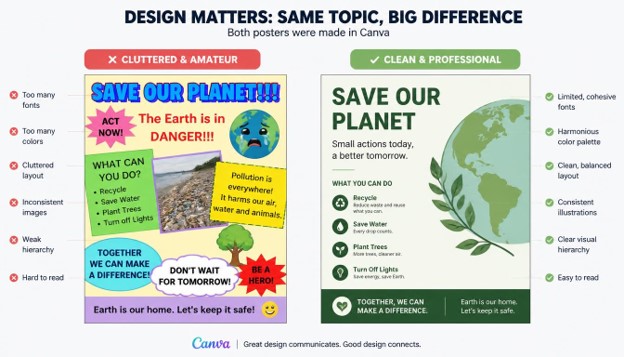
Why Your Canva Posters Look Amateur — 12 Design Mistakes to Fix
Canva has made design accessible to everyone, but accessibility does not always mean professionalism. Thousands of small business owners, students, event planners, and marketers create Canva Posters every single day, yet many of these designs still look homemade, cluttered, or confusing. If you have ever wondered why your Canva Posters do not look as polished as the ones you see from professional designers, you are not alone, and the good news is that the fixes are simpler than you think.
In this guide, we will walk through twelve common mistakes that make Canva Posters look amateur, and we will show you exactly how to fix each one. Whether you are designing a poster for a local event, a product launch, a school project, or a social media campaign, these tips will help your Canva Posters look sharp, credible, and professional. Every section below includes a short explanation, a practical fix, and a suggested visual so you can see the difference between an amateur layout and a polished one.
Let’s dive into the twelve mistakes that are quietly ruining your Canva Posters, and learn how a few small adjustments can completely transform your results.
1. Overcrowding Your Poster With Too Much Text
The single biggest mistake people make with Canva Posters is trying to say everything at once. When a poster is packed with paragraphs, bullet points, and multiple font sizes competing for attention, the viewer’s eye does not know where to look first. This is one of the fastest ways to make Canva Posters feel overwhelming and unprofessional.
A poster is not a brochure. It is meant to be read in three to five seconds from a distance, so every word needs to earn its place. Instead of listing every detail about your event or product, choose one headline, one supporting line, and a clear call to action. If you have more information to share, put it on a website or flyer and use a QR code on the poster instead.
Fix: Cut your text down to the essentials — a strong headline, one supporting sentence, and contact or action details. This single change instantly makes Canva Posters look cleaner and more intentional.
A useful trick is to print a draft and hold it at arm’s length, or view it as a thumbnail on your screen. If you cannot read the headline instantly from that distance, the text is either too small or there is simply too much of it competing for space. Try reading only the largest line of text out loud — if that single line does not communicate the core message on its own, your hierarchy needs work before you add anything else.
It also helps to write your poster copy in a separate document first, edit it down ruthlessly, and only then paste the final short version into your design. Designers call this “writing for the glance,” since posters are rarely read word for word the way an article or email is. Treat every extra sentence as a cost against clarity, not a bonus.

2. Ignoring Visual Hierarchy
Visual hierarchy is the order in which a viewer’s eyes move across your design. Professional Canva Posters guide the eye naturally from the most important element to the least important one, usually starting with a bold headline, moving to an image or graphic, and ending with smaller supporting details.
Amateur designs often give every element the same visual weight, which forces the viewer to work harder to understand the message. If your headline, date, and location all appear in the same font size and color, nothing stands out, and the poster loses its purpose. This lack of hierarchy is one of the most common reasons Canva Posters fail to grab attention in a crowded space like a notice board or social feed.
Fix: Use size, weight, and color to create three clear levels of information — primary (headline), secondary (subheading or image), and tertiary (details like date, time, or website). This structure makes Canva Posters far easier to scan and understand instantly.
One easy way to test hierarchy is to squint at your design or blur it slightly. When you squint, only the largest and boldest shapes should remain visible — that is what your headline should be. If several elements appear equally prominent through the blur, your hierarchy is too flat and needs stronger contrast in size or weight.
Designers often use a simple ratio to build hierarchy quickly: make the headline roughly three times larger than the body text, and the body text slightly larger than any fine print. This rule of thumb removes the guesswork and gives every element a clear, deliberate role in guiding the viewer’s attention from start to finish.

3. Using Too Many Fonts
Canva offers thousands of font options, and that abundance is exactly what gets beginners into trouble. It is tempting to use a decorative script for the headline, a bold sans-serif for the subheading, and a completely different serif for the body text, but mixing too many typefaces makes a design feel chaotic and unpolished. This is a mistake that instantly signals amateur Canva Posters to anyone who sees them.
Professional designers typically stick to two, or at most three, font families per project — one for headlines and one for body text, with a third reserved for small accents if needed. Consistency in typography creates a sense of order and trust, which is exactly what you want your poster to communicate.
Fix: Limit your poster to two complementary fonts. Choose one bold, attention-grabbing font for headlines and one clean, readable font for body text. This simple rule alone can transform how professional your Canva Posters appear.
When choosing a font pairing, look for contrast rather than similarity. A bold display font works well against a simple, neutral sans-serif, because the two typefaces play different roles instead of fighting for the same visual space. Pairing two decorative or two extremely similar fonts often looks messy, since the eye cannot tell whether they are meant to be different or the same.
It also helps to check how your chosen fonts perform at small sizes, since some highly stylized typefaces become unreadable once shrunk down for details like dates or contact information. Reserve decorative fonts for large headline text only, and use a plain, highly legible font for anything smaller than the main heading.

4. Poor Color Combinations
Color is one of the most powerful tools in design, but it is also one of the easiest to get wrong. Many beginners choose colors that clash, that are too similar to blend into each other, or that simply do not match the tone of the event or brand. Bright neon colors on a formal event poster, or low-contrast pastels on a poster meant to grab attention from far away, are common issues that make Canva Posters look unprofessional.
A strong color palette usually includes one dominant color, one or two supporting colors, and a neutral background or accent color like white, black, or gray. Canva’s built-in color palette generator can help you find combinations that work well together, and it is worth spending a few extra minutes here rather than guessing.
Fix: Stick to a maximum of three to four colors, and make sure they align with the mood of your event or brand. Testing your color choices against a color wheel tool will help your Canva Posters feel more cohesive and intentional.
Think about the emotion your event or product needs to convey before picking colors. Warm tones like red, orange, and yellow tend to feel energetic and urgent, which suits sales or festivals, while cooler tones like blue and green feel calm and trustworthy, which suits wellness or corporate events. Matching color psychology to your message adds a layer of professionalism that random color choices simply cannot achieve.
It is also worth testing your palette in grayscale before finalizing it. If the design still reads clearly without color, your contrast and hierarchy are solid, and the color palette is only enhancing an already strong layout rather than compensating for a weak one.

5. Using Low-Resolution or Stretched Images
Nothing screams “amateur” faster than a blurry or pixelated photo on a poster. This usually happens when someone uploads a small image and then stretches it to fill a larger space, or downloads a low-quality image from a search engine instead of using a proper stock photo library. Blurry visuals immediately damage the credibility of Canva Posters, no matter how good the layout or typography is.
Canva has a massive built-in library of high-resolution stock photos and graphics, so there is rarely a need to use a low-quality external image. If you are uploading your own photos, make sure they are high resolution to begin with, and avoid resizing them far beyond their original dimensions.
Fix: Always use high-resolution images, either from Canva’s library or your own camera at full resolution. Before exporting, zoom into your poster at 100 percent to check for blurriness. This one habit alone can save your Canva Posters from looking cheap.
As a general guideline, never stretch an image beyond its original size, since enlarging a photo forces the software to guess at missing pixels, which creates the blurry or blocky look viewers notice immediately. If an image feels too small for the space you need to fill, it is almost always better to choose a different, larger photo than to stretch the one you already have.
It is also worth paying attention to the subject matter of your images, not just their sharpness. A high-resolution photo that is poorly cropped, oddly lit, or unrelated to your message can still weaken a design. Choose visuals that reinforce your headline and support the overall story you are trying to tell.

6. Ignoring White Space
White space, also called negative space, is the empty area around your design elements. Beginners often feel the need to fill every inch of a poster with text, images, or decorative elements, but this instinct actually works against them. Without breathing room, a design feels cramped and difficult to read, and viewers tend to skip over posters that feel too busy. Proper use of white space is one of the clearest signs of professionally designed Canva Posters.
Think of white space as a frame that draws attention to your most important elements. Professional designers intentionally leave margins around the edges and space between text blocks, because this space helps the eye rest and focus on what matters. Removing a few unnecessary graphics or shrinking oversized borders can make a huge difference.
Fix: Add consistent margins around your poster and leave breathing room between text and images. Resist the urge to fill every empty space, since a little emptiness in Canva Posters often makes them look far more premium.
Many luxury and premium brands rely almost entirely on generous white space to communicate sophistication, since a design that does not need to shout for attention feels more confident and established. If your poster is advertising something high-end or professional, consider using even more space than feels comfortable at first — it usually reads as intentional rather than empty.
A simple rule to apply is the “one breath” test: leave enough space around your key elements that your eye can rest for a moment before moving to the next piece of information. If elements feel like they are touching or crowding each other, add margin until each section has its own clearly defined area.

7. Inconsistent Branding
If you are designing a poster for a business, event series, or organization, inconsistency in logos, colors, and fonts across different materials can confuse your audience and weaken brand recognition. Amateur Canva Posters often use a different color scheme or font style than the rest of a brand’s marketing materials, which makes the poster feel disconnected from the business it represents.
Consistency builds trust. When your poster, social media graphics, and website all use the same color palette, logo placement, and typography, your audience recognizes your brand instantly, even at a glance. Canva‘s Brand Kit feature (available on paid plans) allows you to save your brand colors, fonts, and logos so every new design stays consistent automatically.
Fix: Set up a Brand Kit in Canva with your official colors, fonts, and logo files, and apply it to every poster you create. Consistent branding makes Canva Posters look like they came from a professional design team, not a last-minute DIY project.
Beyond colors and fonts, consistency also applies to logo placement, tone of voice, and the overall style of imagery you use, whether that is photography, illustration, or icons. Repeating the same visual patterns across every piece of marketing material, from social posts to printed signage, builds familiarity, and familiarity builds trust over time.
If you work with a small team or multiple people creating designs, sharing a Brand Kit ensures everyone stays aligned without needing to double-check every file manually. This is especially useful for organizations that produce frequent event or promotional materials, since it removes guesswork and keeps every new design on-brand from the very first draft.

8. Misaligned Elements
Alignment might seem like a small detail, but misaligned text, images, and shapes are one of the fastest ways to make a design feel sloppy. When headlines are not centered properly, when text boxes sit slightly off from images, or when margins are uneven on different sides of the poster, the overall design feels unfinished. This is a subtle mistake, but it is one that trained eyes notice immediately in Canva Posters.
Canva actually has built-in alignment guides that appear automatically when you drag elements close to the center or edges of your poster. Using these guides, along with the “Align” tool in the toolbar, ensures that every element lines up precisely with the others.
Fix: Use Canva’s snap-to-grid and alignment tools to make sure every text box, image, and shape lines up cleanly. Select multiple elements and use the “Align center” or “Distribute” options to keep spacing even. This small habit dramatically improves the polish of Canva Posters.
Consistent alignment also applies to the invisible grid your entire layout sits on. Choosing a single axis — either centered or left-aligned — for most of your text and sticking to it throughout the design creates a sense of order that random, mixed alignment cannot achieve. Switching between centered and left-aligned text within the same poster is a subtle but common giveaway of an inexperienced layout.
It helps to zoom in periodically while designing rather than only checking alignment at the very end. Small misalignments are much easier to fix as you go than to hunt down once dozens of elements have already been placed on the canvas.

9. Using Default Templates Without Customization
Canva’s template library is a huge time-saver, but it is also used by millions of other people. If you drop your text into a popular template without changing the fonts, colors, layout, or graphics, there is a good chance your poster will look identical to hundreds of others online. This lack of originality is a quiet but common reason Canva Posters fail to stand out or feel professional.
Templates should be a starting point, not a final product. Swap out the default color palette for your own brand colors, replace stock graphics with images relevant to your event, and adjust the layout slightly to make it your own. Even small changes, like moving an image or changing a font pairing, can make a templated design feel custom-built.
Fix: Never publish a poster straight from a template without customizing at least the colors, fonts, and imagery. A few thoughtful edits can turn a generic template into unique, professional-looking Canva Posters that reflect your own brand identity.
A good starting point is to change the template’s structure slightly, not just its colors. Try swapping the position of the image and text block, adjusting the proportions of each section, or replacing a default shape with a custom graphic that relates to your specific event or product. These structural tweaks go a long way toward making a design feel original.
It also helps to browse a handful of different templates before committing to one, rather than using the very first result that appears. Combining ideas from two or three templates, and then adding your own touches, produces a far more distinctive result than relying on a single template exactly as it was designed.

10. Poor Contrast Between Text and Background
Text that is hard to read because it blends into the background is one of the most functional design failures a poster can have. Light gray text on a white background, yellow text on a light background, or busy photo backgrounds behind small text all make it difficult for viewers to actually read the message. No matter how creative the layout is, if people cannot read the text, the poster has failed at its core job. Poor contrast is a surprisingly common issue in amateur Canva Posters.
A simple contrast checker tool can tell you whether your text and background combination is readable enough, especially for posters that will be viewed from a distance or printed physically. As a general rule, dark text on a light background, or light text on a dark, solid-colored background, tends to be the safest and most readable choice.
Fix: Test your text and background combination for contrast before finalizing your design, and consider adding a subtle overlay behind text placed on busy photos. Strong contrast keeps Canva Posters legible in any lighting or viewing distance.
Contrast issues become even more noticeable outdoors or under bright lighting, where subtle color differences that looked fine on a laptop screen can disappear entirely. If your design will be displayed outside, printed on glossy paper, or viewed under harsh light, err on the side of stronger, higher-contrast combinations rather than subtle ones.
It is also worth checking your design in both light and dark viewing environments, since screens and printed materials render colors differently depending on lighting conditions. A quick test print, or viewing your design on a different device, can reveal contrast problems that are easy to miss while working on a single bright screen.

11. Cluttered Layout With Too Many Design Elements
Icons, shapes, borders, stickers, and decorative graphics can add personality to a poster, but too many of them competing for attention creates visual noise. Beginners often add multiple stickers, several different shapes, and decorative flourishes in an attempt to make a poster look “designed,” when in reality this often has the opposite effect. A cluttered layout is one of the clearest visual signals of amateur Canva Posters.
Professional design tends to follow a “less is more” philosophy. Every graphic element on your poster should serve a purpose, whether that is guiding the eye, reinforcing the theme, or supporting the brand. If an element does not add value, it is usually better to remove it entirely.
Fix: Review your poster and remove any decorative element that does not serve a clear purpose. Aim for one or two supporting graphics rather than five or six. A cleaner layout will instantly make your Canva Posters feel more intentional and professional.
A helpful exercise is to list every element on your poster and ask what job each one is doing. If an icon, border, or sticker cannot answer that question clearly, it is likely just filling space rather than adding value, and removing it will usually strengthen the design rather than weaken it.
Simplicity also makes a design more flexible for reuse. A clean layout with fewer decorative elements is easier to adapt for different sizes, platforms, or future events, while an overly cluttered design often needs to be rebuilt from scratch each time requirements change.

12. Ignoring Print and Display Specifications
A poster that looks perfect on a laptop screen can look completely different once it is printed or displayed at a larger size. Common technical mistakes include designing at the wrong resolution, forgetting to add bleed for printed posters, using RGB colors for a print job that requires CMYK, or not checking the final aspect ratio for the display medium. These technical oversights can quietly undermine even a well-designed poster, and they are often overlooked when creating Canva Posters.
Before exporting, always check what the final poster will be used for. If it is being printed, download it in high resolution (300 DPI) and check whether your printer requires bleed margins. If it will be displayed digitally on social media or a screen, make sure the dimensions match the platform’s recommended size.
Fix: Match your Canva file settings to the final output method — high resolution and CMYK-friendly colors for print, correct aspect ratio for digital display. Getting these technical details right ensures your Canva Posters look as sharp in real life as they do on screen.
If you are unsure about a printer’s exact requirements, it is worth asking directly about bleed size, color profile, and preferred file format before finalizing your design, since these details vary between print shops. Sending a file that does not match specifications can result in unexpected cropping, shifted colors, or delays while the file is corrected and resent.
For digital display, always double-check the exact pixel dimensions required by the platform you are using, whether that is a social media post, a digital signage screen, or a website banner. A design that looks perfect at one size can appear stretched, cropped, or blurry when placed into a differently proportioned frame.

Bonus Tip: Add Short and Concise Paragraphs for Better Readability and UX
If your poster includes any body text beyond the headline, such as event details, a short description, or a call to action, keep every paragraph short and to the point. Long blocks of text are hard to scan, especially on a poster that people view quickly while walking by or scrolling past on a phone. Breaking information into short, digestible chunks improves both readability and overall user experience, and it applies just as much to Canva Posters as it does to websites and blog articles.
Short paragraphs, bullet points, and generous line spacing make information easier to absorb at a glance. Instead of writing a full sentence explaining every detail, break your message into small, scannable pieces: a bold headline, one short line of context, and clear action details like date, time, and location. This approach keeps your Canva Posters easy to read from a distance and friendly to skim for busy viewers.
Fix: Whenever you add body text to a poster, write in short, concise lines rather than long paragraphs. This habit, borrowed from good web design practices, makes your Canva Posters more user-friendly and easier to understand in seconds.

Putting It All Together
Fixing these twelve mistakes will not happen overnight, but even addressing two or three of them on your next project will noticeably improve how professional your poster looks. Start by simplifying your text, choosing a limited color and font palette, and double-checking alignment and contrast before you export. Over time, these small habits become second nature, and your Canva Posters will consistently look polished instead of amateur.
Remember that great design is rarely about adding more — it is almost always about removing what does not serve the message. The best Canva Posters communicate one clear idea quickly, guide the eye naturally, and leave a strong, professional impression. With the fixes outlined in this guide, you now have a practical checklist to review every poster before you hit publish or send it to print.
Whether you are a small business owner, a student, an event organizer, or a hobbyist designer, applying these principles consistently will help your Canva Posters stand out for all the right reasons.
Quick Recap Checklist
Before you export your next design, run through this short checklist to catch the most common issues in one pass. Keep it nearby as a habit, and review it every single time before you hit download or send a file to print.
- Text: Is the headline the only thing you would remember if you glanced away after two seconds?
- Hierarchy: Do your eyes move naturally from headline to image to details, without confusion?
- Fonts: Are you using no more than two typefaces across the entire layout?
- Color: Does your palette stick to three or four colors that match the mood of the event?
- Images: Is every photo sharp, high resolution, and free of stretching or pixelation?
- Space: Is there enough breathing room around your text and graphics, or does it feel cramped?
- Branding: Do your colors, fonts, and logo match your other marketing materials?
- Alignment: Are all elements snapped to a clean, consistent grid?
- Originality: Have you customized the template enough that it no longer looks like a default?
- Contrast: Can you read every line of text instantly, even from a distance?
- Clutter: Does every graphic element serve a clear purpose, or is it just filling space?
- Specifications: Does the file match the correct resolution, color mode, and size for its final use?
Running through this short list takes less than two minutes, but it catches the vast majority of issues before they make it into a finished, published design. Over time, these checks become automatic, and you will start avoiding these mistakes instinctively rather than needing a checklist at all.
Frequently Asked Questions
- Why do my Canva Posters look unprofessional even when I use templates? Using a template without customizing colors, fonts, and images often results in a generic look, since thousands of other people use the same templates. Personalizing at least three elements — color palette, typography, and imagery — helps your Canva Posters feel original rather than copied.
- How many fonts should I use in a poster design? Most designers recommend using no more than two fonts in a single poster: one for headlines and one for body text. Sticking to this rule keeps Canva Posters looking clean, consistent, and easy to read.
- What resolution should I use for printed Canva Posters? For printed materials, export your design at 300 DPI (dots per inch) to avoid blurriness. Digital-only posters can typically use a lower resolution, but 300 DPI is the safest standard for high-quality Canva Posters in print.
- How do I fix low-contrast text on my poster? Choose a text color that stands clearly apart from the background, such as dark text on a light background or light text on a dark background. Adding a subtle color overlay behind text on photo backgrounds also improves readability significantly.
- Is it okay to use Canva’s free stock photos for posters? Yes, Canva’s built-in photo library includes thousands of high-resolution, royalty-free images that are safe to use in most personal and commercial Canva Posters, though it is worth double-checking licensing terms for specific commercial projects.
- How much text should a poster include? A poster should include only the essential information: a headline, one supporting line, and key details like date, time, and location. Keeping paragraphs short and concise improves readability and keeps your Canva Posters focused and effective.
- What is the biggest design mistake beginners make in Canva? Overcrowding the design with too much text, too many fonts, and too many decorative elements is the most common mistake. Simplifying the layout is usually the fastest way to make Canva Posters look more professional.
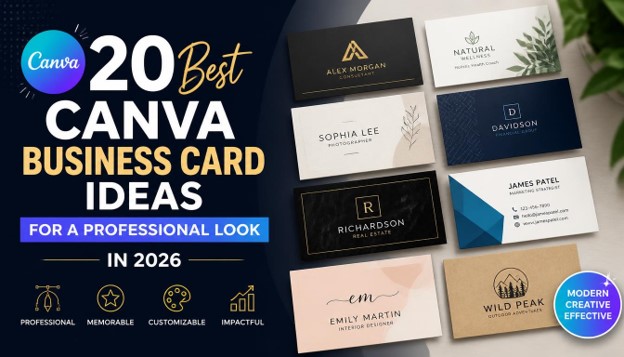
20 Best Canva Business Card Ideas for a Professional Look in 2026
First impressions in business rarely happen over a long meeting or a polished pitch deck anymore — more often than not, they happen in the three seconds it takes someone to glance at a small rectangle of paper you hand them at a conference, a coffee shop, or a networking event. That small rectangle is your business card, and in 2026, more entrepreneurs, freelancers, and corporate professionals are turning to a single design tool to create it: Canva. A well-designed Canva Business Card can say more about your brand than an entire website, because it combines your logo, your color palette, your typography, and your personality into one compact, tangible object that people physically carry away with them. In this guide, we’re going to walk through twenty of the best card ideas you can use right now to build a design that looks professional, feels modern, and actually gets remembered instead of thrown away.
Whether you’re a solo consultant trying to look more established, a real estate agent trying to stand out in a saturated market, or a startup founder who wants a card that reflects a forward-thinking brand, there is a template style on this list built for you. We’ll also cover practical tips on choosing the right paper stock, finishing, and layout, plus answer some of the most common questions people ask about designing this card before sending it off to print.
Why Canva Is the Best Tool for Designing a Business Card in 2026
Before diving into the design ideas themselves, it’s worth understanding why so many professionals default to Canva when they need a new set of cards. Traditional design software like Adobe Illustrator or InDesign requires a steep learning curve, expensive subscriptions, and often a working knowledge of print-ready file formats such as bleed lines and CMYK color profiles. A Canva Business Card, on the other hand, can be built by literally anyone with an internet connection and a few free minutes, because the platform is built around drag-and-drop simplicity rather than professional design jargon.
Canva also maintains a massive, constantly updated library of Canva Business Card templates that are already sized correctly for standard print dimensions, which removes one of the most common mistakes people make when self-designing a card: getting the size or bleed wrong and having text cut off at the printer. Every template in the library has been created by professional designers, meaning even a total design beginner can produce something that looks like it came from an agency. Add in the ability to instantly generate QR codes, drop in stock photography, access thousands of icons, and export print-ready PDF files, and it becomes clear why Canva Business Card has become the default choice for small business owners who need professional results without a professional design budget.
Finally, Canva’s collaboration features mean that if you’re designing on behalf of a team or a client, you can share your project link, gather feedback in real time, and make revisions without ever leaving the browser. This democratization of design is exactly why the ideas below are so achievable — you don’t need any special skill to execute them, just a bit of inspiration and an eye for what fits your brand.
1. Minimalist Canva Business Card
Minimalism has dominated design trends for the better part of a decade, and it remains one of the strongest choices for a Canva Business Card in 2026 because it signals confidence. A minimalist card typically uses a plain white or off-white background, a single accent color, generous white space, and no more than two font families. The idea is to let the negative space do the talking, so your name, title, and contact details breathe instead of competing with busy graphics.

To build this look in Canva, search the template library for “minimalist Canva Business Card,” then strip back any unnecessary icons or shapes the template comes with. Keep your logo small and centered or aligned to one corner, and choose a clean sans-serif font like Montserrat or Poppins for a contemporary feel. A minimalist card built this way works particularly well for consultants, lawyers, architects, and anyone in a field where restraint reads as expertise rather than a lack of creativity.
2. Modern Gradient Canva Business Card
Gradients have made a strong comeback in digital and print design, and a gradient-based design is an easy way to look current without much effort. Instead of a flat single-color background, a gradient card transitions smoothly between two or three complementary colors — think deep purple fading into hot pink, or navy blending into teal. This effect instantly makes a card feel more dynamic and tech-forward.

Canva has a dedicated gradient tool built into its background and shape options, so applying this effect takes only a couple of clicks. Pair a bold gradient background with white or light-colored text for contrast, and keep your layout simple so the gradient itself becomes the visual focal point. This style suits tech startups, digital marketers, app developers, and creative agencies that want their card to feel like a natural extension of their online brand identity.
3. Elegant Black and Gold Canva Business Card
Few color combinations communicate luxury as effectively as black and gold, which is why this remains one of the most requested Canva Business Card styles among professionals in finance, real estate, jewelry, and high-end hospitality. The deep contrast between a matte black background and metallic gold text or accents creates an immediate sense of exclusivity and premium quality.

When designing this card in Canva, use the platform’s gold gradient text effect or a solid gold hex color like #D4AF37 for your name and title, while keeping the supporting contact information in a lighter gray so it doesn’t compete for attention. If your printer offers foil stamping, this design translates beautifully into a physical foil finish, which we’ll cover later in this list. A black and gold card designed this way tends to leave a lasting impression precisely because it feels intentional rather than generic.
4. Creative Photography Canva Business Card
For photographers, videographers, and visual artists, a card built entirely around imagery makes far more sense than one filled with text. A photography-focused design like this uses a striking full-bleed photo — often a sample of your own work — as the entire background, with your name and contact details layered on top in a clean, legible font.

Canva makes this simple through its full-bleed image templates, which allow you to upload your own high-resolution photo and adjust its opacity or add a subtle dark overlay so your text remains readable. Choosing one standout image rather than a busy collage keeps the card looking curated instead of cluttered. This approach turns your business card into a miniature portfolio piece, giving potential clients an instant sense of your visual style before they even visit your website.
5. Bold Typography Canva Business Card
Sometimes the strongest design choice is to let your name or your brand name do all the visual work. A bold typography card design ditches images and icons entirely in favor of oversized, expressive lettering that fills most of the card’s surface. This works especially well for personal brands, copywriters, public speakers, and creative freelancers who want their card to feel unmistakably their own.

In Canva, experiment with condensed, heavyweight fonts like Anton or Bebas Neue for your name, scaled up so it nearly touches the edges of the card, then place your title and contact information in a much smaller font underneath for contrast. The key to making a typography-driven card work is restraint elsewhere — no busy backgrounds, no extra icons, just confident type doing the heavy lifting.
6. Vintage Retro Canva Business Card
Retro-inspired design has found a strong audience among boutique brands, barbershops, coffee roasters, and artisanal businesses that want to communicate craftsmanship and heritage rather than cutting-edge technology. A vintage design like this one typically borrows visual cues from mid-century print design — muted earth tones, serif or script lettering, decorative borders, and textures that mimic aged paper.

Canva’s template search makes it easy to find retro-styled business card layouts, many of which already include ornate borders and vintage color palettes like mustard yellow, burnt orange, and deep forest green. Adding a subtle paper-grain texture overlay, available in Canva’s elements library, enhances the aged feel even further. A well-executed vintage design like this feels warm and personal, making it a great fit for businesses built around tradition and hands-on craft.
7. Eco-Friendly Kraft Paper Canva Business Card
Sustainability has become a genuine selling point for many businesses, and a kraft paper-styled Canva Business Card is a subtle but effective way to communicate environmental consciousness. This design mimics the natural brown tone of recycled kraft paper, often paired with simple black or white text and minimal, earthy line-art illustrations of leaves or plants.

To recreate this in Canva, set your background to a warm tan or brown hex tone, then choose an organic, slightly rough-edged font to reinforce the natural, handmade aesthetic. If you actually print on genuine recycled kraft cardstock, this card design becomes even more authentic, since the digital mockup will match the physical material perfectly. This style suits eco-conscious brands, organic food businesses, wellness coaches, and sustainable fashion labels.
8. QR Code Canva Business Card
A QR code has quietly become one of the most useful additions to a modern business card, bridging the gap between a physical object and your digital presence. A QR code design like this includes a scannable code that instantly links to your website, portfolio, LinkedIn profile, or even a “save contact” vCard file, making it effortless for the recipient to connect with you further.

Canva has a built-in QR code generator accessible directly from the Elements panel, so you can create and place a working code without needing any third-party tool. Position the QR code in a corner where it doesn’t overwhelm the rest of your layout, and consider adding a small line of text like “Scan to connect” so recipients understand what it does. This addition makes your card feel genuinely useful rather than purely decorative.
9. Geometric Pattern Canva Business Card
Geometric design has remained popular because it feels structured, modern, and endlessly customizable. A geometric design like this uses shapes like triangles, hexagons, or overlapping lines to create a distinctive background pattern, often in two or three coordinated colors that reflect your brand palette.
Canva’s shape tools and pre-built geometric templates make this style especially approachable, since you can duplicate and rotate shapes to build a custom pattern in minutes without any advanced design skill. Keep your text on a clean, uncluttered portion of the card — often a solid color block layered over the pattern — so legibility isn’t sacrificed for style. This look is a favorite among architecture firms, design studios, and technology companies that want a card that feels precise and intentional.
10. Watercolor Canva Business Card
For brands in the beauty, wellness, floral, or creative arts space, a soft watercolor aesthetic can convey warmth and artistry far better than sharp geometric lines ever could. A watercolor card design typically features gentle, blended color washes in the background, sometimes combined with hand-painted floral or botanical illustrations.

Canva’s element library includes a wide selection of pre-made watercolor textures and floral graphics that can be layered directly onto a business card template, so you don’t need to paint anything yourself. Pair these soft backgrounds with a graceful script font for your name and a simple sans-serif for your contact details to keep the card from feeling too busy. This approach feels personal and artistic, ideal for makeup artists, florists, therapists, and boutique wellness brands.
11. Corporate Professional Canva Business Card
Not every business needs a flashy, trend-driven design — sometimes the goal is simply to look trustworthy, established, and serious. A corporate Canva Business Card leans into classic design conventions: a white or navy background, a structured grid layout, a conservative serif or clean sans-serif font, and a restrained color palette limited to your brand’s primary olors

In Canva, corporate-style templates are usually organized under categories like “professional” or “business,” and they typically include clearly defined sections for your name, title, company, and contact information, often separated by thin dividing lines. This layout style is ideal for law firms, financial advisors, insurance agents, and corporate executives who want their card to reflect stability and reliability above all else.
12. Real Estate Canva Business Card
Real estate is one of the most competitive industries for personal branding, since agents are essentially selling themselves as much as any property. A real estate-focused card design usually includes a professional headshot, since buyers and sellers want to put a face to the name they’ll be trusting with a major financial decision, along with a clean layout that highlights the agent’s brokerage logo and a tagline.
Canva has an entire category of real estate business card templates that already account for this need, often including subtle house or key iconography alongside space for a photo. When building your own version, choose colors that align with your brokerage’s branding guidelines, and make sure your phone number is the most visually prominent piece of contact information, since most real estate leads still come through a direct phone call rather than email.
13. Photographer Canva Business Card
While we touched on photography-driven visuals earlier, a card specifically designed for professional photographers deserves its own approach, since photographers often want their card to double as a mini portfolio and a reflection of their editing style. A photographer’s card design frequently uses a double-sided layout — a striking image on the front, and clean contact information along with a QR code linking to an online gallery on the back.
Canva allows you to design both sides of a card within the same project file, switching between front and back pages easily. For photographers, choosing a signature color grade or filter consistent with your actual photography work helps the card feel like an authentic extension of your portfolio rather than a generic template with a random stock photo swapped in.
14. Beauty and Salon Canva Business Card
Beauty professionals — from hairstylists to estheticians to nail technicians — benefit from a card design that feels soft, glamorous, and on-trend, since clients are essentially trusting the designer’s taste before they even book an appointment. This style often uses blush pinks, rose gold accents, elegant script fonts, and subtle floral or line-art beauty icons like a pair of scissors or a lipstick tube.
Canva’s beauty and salon business card category includes dozens of templates built specifically around this aesthetic, many of which already incorporate appointment booking details or Instagram handles, since social proof matters enormously in this industry. Adding a small “Book Now” call to action alongside a QR code linking directly to your booking page turns this card into an active marketing tool rather than a passive keepsake.
15. Fashion Designer Canva Business Card
Fashion is an industry where the business card itself needs to demonstrate taste and design sensibility, since it’s often the first tangible product a potential client or buyer will judge you by. A fashion-focused Canva Business Card tends to favor high-contrast black and white palettes, editorial-style typography, and an almost magazine-like layout with generous margins.
Canva’s fashion and lifestyle template category offers several layouts inspired by high-end print editorials, which can be customized with your logo and a signature typeface that matches your brand’s runway or lookbook aesthetic. Because fashion clients often keep cards as physical mementos, investing slightly more in premium cardstock for this particular design tends to pay off in how the brand is remembered.
16. Tech Startup Canva Business Card
Startups need their branding to feel innovative from the very first touchpoint, and a business card is no exception. A tech startup card design usually leans into dark backgrounds, neon or electric accent colors like cyan or violet, and clean geometric or futuristic fonts that echo the visual language of app interfaces and SaaS dashboards.
Canva’s tech and startup template collection often incorporates subtle grid lines, circuit-inspired graphics, or abstract 3D shapes that feel at home in a digital-first brand. Including a QR code that links to your app’s download page or your company’s LinkedIn is a natural fit here, since a tech-savvy audience expects that kind of digital integration.
17. Consultant and Coach Canva Business Card
Consultants, coaches, and speakers sell trust and expertise, which means their business card needs to feel credible without being cold. A consultant-style card design often centers around a confident headshot, a clear one-line value proposition instead of just a job title, and a calm, professional color palette like deep blue, charcoal, or forest green.
Canva’s business and consulting templates frequently include a small tagline field beneath the name, which is worth using deliberately — instead of writing “Business Consultant,” consider something like “Helping Founders Scale Past Six Figures.” This small copywriting choice, combined with a clean layout, makes your Canva Business Card do double duty as a tiny pitch for your services.
18. Restaurant and Cafe Canva Business Card
Food and beverage businesses often use their business cards as a secondary form of marketing, sometimes doubling them as loyalty punch cards or small menus. A restaurant-focused card design tends to use warm, appetizing colors like deep red, mustard, or cream, paired with playful hand-lettered or rustic serif fonts that suggest a welcoming atmosphere.
Canva’s food and restaurant template category includes options that incorporate illustrated coffee cups, cutlery icons, or subtle food photography backgrounds. Adding your operating hours, a QR code linking to your online ordering page, or a small loyalty stamp grid on the back of the card can make this particular card far more functional than a purely decorative one.
19. Double-Sided Canva Business Card
Rather than a specific visual style, this idea is about layout strategy: using both sides of the card to your advantage instead of leaving the back blank. A double-sided design like this might put your logo and name on the front with a clean background, then use the back for a bulleted list of services, a map to your location, a QR code, or even a small testimonial quote.
Canva makes designing both sides simple, since every business card project automatically includes a front and back page you can toggle between in the editor. This approach maximizes the value of a printed card without needing to cram everything onto one crowded surface, and it’s a smart choice for service-based businesses that want their card to communicate more than just contact details.
20. Foil and Metallic Finish Canva Business Card
The final idea on this list isn’t just about the digital design — it’s about how that design translates into a premium physical finish. A foil or metallic Canva Business Card uses Canva’s design tools to plan out where a gold, silver, rose gold, or holographic foil element will sit, which many print partners can then produce as an actual raised, reflective foil stamp on the finished card.
While Canva itself outputs a flat digital file, many print-on-demand services integrated with or compatible with Canva exports allow you to specify foil areas separately during the ordering process. Designing this particular card with a simple, high-contrast logo or initials specifically intended for foil treatment — rather than a busy, multi-colored graphic — will produce the cleanest, most striking result once it comes off the press.
How to Choose the Right Canva Business Card Style for Your Brand
With twenty different directions to choose from, picking the right one comes down to a few practical questions rather than personal taste alone. First, consider your industry norms — a criminal defense attorney and a wedding photographer are both trying to look trustworthy, but “trustworthy” means something completely different in each context, so study what respected competitors in your field are already doing before you commit to a direction for your own design. Second, think about where and how the card will actually be used; a card that will live in someone’s wallet for months needs to remain legible and recognizable even after some wear, while a card handed out at a single trade show can afford to be bolder and more experimental.
Third, always design with your existing brand assets in mind rather than in isolation — your card should feel like a natural extension of your website, social media profiles, and any other printed materials you use, since visual consistency is what actually builds brand recognition over time. Finally, don’t underestimate the value of simply testing a few directions; Canva makes it inexpensive and fast to create two or three variations of your card, print a small batch of each, and see which one actually gets better reactions in real-world networking situations before committing to a large print run.
Understanding Color Psychology Before You Design
Color is doing more persuasive work on a business card than most people realize, since the human brain forms an emotional impression of a color palette before it even processes the text sitting on top of it. Blue tones tend to signal trust, stability, and competence, which is exactly why so many financial services firms, healthcare providers, and corporate consultancies default to navy or royal blue as their primary color. Green, by contrast, is closely associated with growth, health, and sustainability, making it a natural fit for wellness brands, landscaping companies, and eco-conscious startups that want their palette to reinforce their mission without saying a word about it.
Warmer tones carry a different kind of emotional weight. Red creates urgency and energy, which explains why it shows up so often in food and entertainment branding, while orange and yellow tend to feel approachable and optimistic, useful for brands that want to seem friendly rather than intimidating. Black and deep charcoal, on the other hand, are the go-to choices whenever a brand wants to communicate luxury, sophistication, or exclusivity, which is part of why the black and gold combination covered earlier on this list remains such a popular request among premium service providers. When you’re choosing a palette, try to limit yourself to two or three colors total, since a card with too many competing tones can end up looking chaotic rather than intentional, no matter how well each individual color performs on its own.
Common Mistakes to Avoid When Designing Your Card
Even with access to professionally built templates, it’s still surprisingly easy to make a few avoidable mistakes that undercut an otherwise strong design. One of the most frequent errors is cramming too much information onto a single small surface — a name, title, company, phone number, email, website, and three social media handles all competing for space will almost always look cluttered no matter how the layout is arranged, so it’s worth asking whether every single detail truly needs to be there or whether some information is better saved for a follow-up email or a linked landing page. Another common issue is choosing a font that looks stylish on a screen but becomes illegible once printed at actual size, particularly with thin, decorative, or heavily italicized typefaces; always zoom your design to 100 percent and, ideally, print a test copy before finalizing anything.
Low-resolution logos are another frequent culprit behind disappointing final results, since a logo that looks crisp on a website can turn blurry or pixelated once it’s scaled up and printed on physical cardstock, so always use the highest-resolution version of your logo file available. Finally, many people forget to proofread their final card carefully, and a typo in a phone number or a misspelled email address can render an otherwise beautiful design completely useless; ask at least one other person to review the final file before you send it to print, since a fresh set of eyes will often catch small errors that you’ve become blind to after staring at the same design for hours.
Practical Tips Before You Print Your Canva Business Card
Once you’ve settled on a design direction, a handful of technical details can make the difference between a Canva Business Card that looks great on screen and one that disappoints once it’s physically printed. Always design at the standard 3.5 x 2 inch size with Canva’s built-in bleed settings turned on, since this prevents important text or graphics from accidentally being trimmed off during the cutting process. Double-check that your color mode is appropriate for print rather than screen display, because colors that look vibrant on a monitor can sometimes shift slightly when translated to physical ink.
It’s also worth downloading your finished file as a high-resolution PDF print file directly from Canva rather than a standard image format, since this preserves sharper edges on text and fine details in your logo. Before sending your finished card off to a print shop, order a single physical proof if the printer offers one, so you can check the actual paper weight, finish, and color accuracy in person before committing to hundreds of copies. These small steps ensure that the polished design you built in Canva translates just as well into the physical object someone will actually hold in their hand.
Final Thoughts on Designing Your Canva Business Card
A Canva Business Card might be small, but it carries an outsized amount of responsibility for shaping how people perceive your professionalism within just a few seconds of meeting you. The twenty ideas covered in this guide — from minimalist and corporate styles to bold gradients, vintage textures, and industry-specific layouts — all prove that a single design tool like Canva is more than capable of producing a genuinely professional, memorable business card without requiring a background in graphic design or an expensive agency contract.
The real work now is choosing the direction that authentically fits your brand, customizing it with your own colors, fonts, and messaging, and taking the time to get a physical proof before ordering in bulk. Do that, and your finished Canva Business Card will do exactly what a good business card should: make people remember you long after the meeting ends.
Beyond the individual style you choose, it also helps to think about how the card fits into your broader networking habits, since even the most beautifully designed piece of print material only works if it actually reaches the right hands at the right moment. Keep a small stack in your bag, wallet, or car so you’re never caught without one, and consider ordering a modest first batch rather than committing to thousands of copies right away, since your branding, contact details, or even your job title may shift sooner than expected. Treat your first print run as a working draft you can refine once you see how people actually respond to it in real conversations.
Frequently Asked Questions About Canva Business Cards
Is Canva actually good enough to design a professional business card, or should I hire a designer? For the vast majority of small businesses, freelancers, and startups, a Canva Business Card built from one of the platform’s professionally designed templates is more than sufficient to look polished and credible. Canva Business Card templates are created by trained designers and follow proper print standards, so unless you need a highly custom illustration or an extremely unique brand identity, there’s rarely a strong need to pay for a separate designer.
Is Canva free to use for designing a business card, or do I need Canva Pro? Canva’s free plan includes a wide selection of business card templates, fonts, and basic elements, which is enough to design a fully professional business card at no cost. Canva Pro unlocks additional premium templates, more advanced brand kit features, and some exclusive design elements, but it is not a requirement to produce a great-looking card.
What size should I use when designing a Canva Business Card? The standard Canva Business Card size in most countries, including the United States, is 3.5 x 2 inches, and Canva’s default business card templates are already set to this dimension with bleed included. If you’re printing internationally, double-check your local standard size, since some regions like parts of Europe use a slightly different dimension.
Can I add a QR code to my Canva Business Card without using another app? Yes, Canva Business Card has a built-in QR code generator located directly in the Elements panel of the editor, allowing you to create a scannable code linking to a website, social profile, or contact file without leaving the platform. This makes adding a functional digital link to the card extremely straightforward.
How do I make sure my Canva Business Card prints correctly with no cut-off text? Always use a template with Canva’s bleed guides enabled, and keep all important text and logos safely inside the inner margin lines rather than near the very edge of the card. Downloading your finished card as a print-ready PDF, rather than a standard JPEG or PNG, also helps preserve sharp edges and accurate colors once it reaches the printer.
Should I design one side or both sides of my business card in Canva? While a single-sided design is perfectly acceptable and often used for minimalist styles, designing both sides of this card lets you include extra information such as a list of services, a QR code, or a small map without crowding the front layout. Canva automatically provides a front and back page for every Canva Business Card project, so using both sides costs nothing extra in terms of time or design effort.
-

 Graphics Design2 years ago
7.Exploring the Importance of Color Theory Charts
-

 Graphics Design1 year ago
Top 10 Best Graphic Design Tools for Beginners in 2025 (Free & Paid)
-

 Graphics Design2 years ago
10 Stunning Gradient Design Trends You Need to Know in 2024
-

 Graphics Design1 year ago
15 Freelance Graphic Design Tips to Boost Your Career in 2025
-

 Graphics Design2 years ago
29.Retro Design Is Making a Comeback in Modern Spaces
-

 Graphics Design1 year ago
Best Laptops for Graphic Designers – 2025 Buying Guide
-

 Graphics Design2 years ago
2025 Logo Design Trends: What’s In, What’s Out?
-

 Graphics Design2 years ago
15.The Importance of Effective Flyer Design in Marketing
^Inregistrare pe www.binance.com
September 24, 2024 at 10:55 am
Can you be more specific about the content of your article? After reading it, I still have some doubts. Hope you can help me. https://accounts.binance.com/pt-BR/register-person?ref=YY80CKRN
Registrácia
November 30, 2024 at 3:07 pm
Your article helped me a lot, is there any more related content? Thanks!
Εγγραφ στο Binance
December 3, 2024 at 3:45 am
Your article helped me a lot, is there any more related content? Thanks!