
Graphics Design
Using the latest 10 creative logo designs

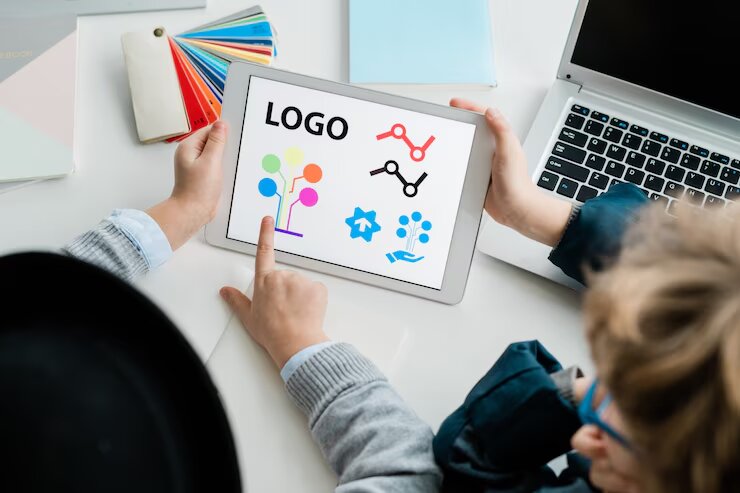
Using the latest 10 creative logo designs.
Here’s an overview:
- 1. Creativity is an integral component of the logo design.
undefined
- 2. The Basic reality why firms need a powerful logo.
• 3. The Top 10 logo design wizards.
• 4. Combining typesetting into the design logo.
• 5: Taking advantage of the negative space to make logos stand out as dominate works.
• 6. Developing the logo which could be applied to both print and digital platforms.
• 7. Color theories as a mean in Logo design.
• 8. Themes and forms of logo design.
1. Creativity is an integral component of the logo design.

Using the latest 10 creative logo designs In my opinion, appropriate design of a company logo helps to recognize company, make it more popular and have a long-lasting impression on those who see it. As far as the using the latest 10 creative logo designs is concerned, getting an idea to is very easy. I believe it is the goal of a designer like me to develop brand identity logos that not only have a visual connection but also tell a story and positively impact the feelings of the audience.
Undefined
- Simplicity: Using the latest 10 creative logo designs Simplicity is what a logo commonly have, hence it is more recognized and applicable in a range of designs.
- Relevance: Using the latest 10 creative logo designs The designing should represent the brand identity, values, and the target audience possessed by the firm.
- Uniqueness: Using the latest 10 creative logo designs Make a logo that is not only like no other logo but one that permits a brand stand apart from the competitors.
- Scalability: A very good logo should be cool in all possible cases like different platforms and reduced sizes.
This way, I will show you multiple interesting, innovative Using the latest 10 creative logo designs concepts, which will help you think outside of the box and make memorable logos for your brand. Posed as one of them the minimalist style and those driven from typography, the other one being the abstract and illustrative ones, the use of varied styles may help you to develop memerizing and innovative logo concepts.
2. The Basic reality why firms need a powerful logo.
The first thing noticeable thing about a company by consumers is the logo. I believe that a logo is the face of a brand. Here are some reasons why having a strong logo is crucial:Here are some reasons why having a strong logo is crucial:
- Brand Recognition: The proper logo design facilitates brand becoming aware to customers. Customers’ successive short-sightedness is a typical trait of all consumers.
- Professionalism: There is no doubt that the logo is the main point of visual identification for a firm and it helps to create a professional look for the business. It sets apart you canvas brand from the competitors’ brands that may not be visually appealing. Hence, the imaged canvas brand will indicate to the customers that you are serious enough about your brand.
- Memorability: A logo that is memorable will certainly mordacious it to people’s minds. This can translate to continued business and also word of mouth drives.
- Establishes Trust: A good diagram comes with the ability to create engagements with your customers. This acts as a sign of a true company existence and carries positive feelings coupled with the brand.
- Differentiation: Uniqueness granted by a logo during the competition of a bunch of samples can help every brand to distinguish. It can be instrumental in establishing what sets the enterprise apart and how customers will be convinced to make purchases rather than go with the competitors.
- Versatility: The correct logo design is suasive, and it can work cross different media and platforms vulee ajilogo hendhihay bou e. Whichever visual representation platform has been adopted whether on a website, a business card or a billboard, the logo should be recognizable and impactful.
The key part of this is comprehending that the logo is the symbol which has the power to make potential customers love and trust your brand more. It means that you should always spend time and pay all the necessary expenses to create a logo that will be attractive to your target audience as well.
3. The Top 10 logo design wizards-Using the latest 10 creative logo designs
Using the latest 10 creative logo designs The making of a distinctive, memorable logo is very important in the business world. undefined
- Minimalistic Design: Sometimes more is also more. A simple and clean logo can make a very strong statement.
- Negative Space Utilization: Using the latest 10 creative logo designs the negative space is a great way to turn the ordinary logo into a clever and aesthetically satisfying one. It adds an element of surprise and creativity due to this.
- Geometric Shapes: Using simple geometric shapes, for instance, circles, squares, or triangles, can lead to a typical and timeless logo design.
- Vintage Style: Evoking an image of a vintage style for the logo will create classic and classy look accompanied with a touch of nostalgia.
- Typography Focus: You can invent unique website logo by playing around with different fonts and typefaces.
- Iconic Symbols: Using brand symbols or icons that are representative of the values of your company will make it easy to remember your logo.
- Color Psychology: Using colors that reflect the overall brand psychology will create certain emotions, feelings and mental associations with it.
- Handmade Design: A hand-drawn or handmade element in your logo can create for you a personalized and genuine design.
- Abstract Concepts: Through the application of non-specific images and graphics you create a spirit of mystery and ambiguity in the logo and people become eager to figure it out.
- Versatile Design: Make sure that your logo looks good in different platforms and size types. A flexible logo remains anonymous irrespective of the place it is displayed.
A Using the latest 10 creative logo designs from such creative logo ideas not only represents a brand but also stays on the audience’s mind for a longer time.
-
Combining typesetting into the design logo.

Using the latest 10 creative logo designs Key to any logo while using typography is its ability to appropriately message and give a brand the right identity by means of a strong visual style. undefined
- Custom Lettering: Using the latest 10 creative logo designs Custom lettering enables me to create an logotype that is completely unique and that works specifically for a brand, expressing its individuality. Through the use of the font, I am able to give the image design of the brand a personality that is unique to them and their purpose.
- Font Pairing: Involving mixed and match different fonts can be a crucial step for me towards the ultimate goal of creating a visually distracting but beautiful logo that balances between sophistication and creativity. A great option for this kind of poster is pairof a bold and catchy font with a delicate and refined one which makes a balanced combination of attractiveness and elegance.
- Negative Space Typography: Drawing attention to negative space within the letters or between the words, I will be able to develop a logo design that meets the mark of being intriguing and memorable. This method not only increases the interest level but also it creates a layer of creativity that makes the pattern captivating for the viewers.
- Hand-Lettered Logos: The hand lettered logos may be the main tool to distinguish the brand from the mass production and add a personal touch to it by showing its authenticity and fine craftsmanship. It might be the hand-lettered logo when it is simple and playful handwritten style or elegant calligraphic design kind of logo, brands can be very unique.
- Hierarchy and Emphasis: Through the application of typography, the designer can create a hierarchy and use the logo to easily point and the viewer underlining the main message. Through a combination of typography methods such as different font sizes or weights, I am able to create an original and striking logo design.
Using the latest 10 creative logo designs Implementing typography morally in the logo design of a brand enables me to invent a visually awe-inspiring and convincing brand identity that touches the heart of the intended audience. Typography can be an instrument of power in a logo design; that is why it can be used to get through the brand’s values, personality, and message.
5: Taking advantage of the negative space to make logos stand out as dominate works.
Negative space as part of a Using the latest 10 creative logo designs is an excellent design tool that can give some visual illusion of depth and creative thinking. In a subliminal technique you are able to intricately combine the surrounding and free spaces of that composition so that you end up with a logo that attracts attention as well as conveying the message in a subtle way. Using the latest 10 creative logo designs Here are some ways to use negative space effectively in logo design Here are some ways to use negative space effectively in logo design:
- Embrace Simplicity: Using the latest 10 creative logo designs negative space means you can create a logo that is simply constructed with the use of the white spaces that have been left behind thus attaining a clean and appealing logo. With the help of elimination from the insignificant aspects, you obtain the core power of your brand or message.
- Create Optical Illusions: A clear way of helping your an innovative and creating an attention-grabbing logo is to use white space as a tool to make your logo interesting by optical illusions. By finding the place for shapes or letters that also hint of something other, the meanings are discovered and the viewers are intrigued.
- Enhance Memorability: Symbols that are crafted with a disregard to places where there should be no color but instead invite viewers to investigate carefully to discover hidden elements make them much more identifiable as viewers spend time to understand them. This may explain the enhanced possibility to create the necessary branding recall and recognition.
- Convey Dual Meanings: Using negative space a Witt can express multiple message or thoughts in single design. In an effortful way to hide your thoughts, you can make some logos that have hidden power or leave feelings that are not simple at first sight.
Using the latest 10 creative logo designs Making use of negative space in your logo can bring excellence not only to your brand identity, but also make your logo recognizable in the marketplace which is overcrowded with logos. However, negative space for those who are used skillfully can have a positive impact on logos, they become visually appealing and leave the audience in an astonishing mood.
6. Developing the logo which could be applied to both print and digital platforms.
To make my Using the latest 10 creative logo designs more adaptable, I always make sure that my logos can be easily changed and adapted for multiple uses. Here are some key points to consider when designing logos for different uses:Here are some key points to consider when designing logos for different uses:
- Scalability: Using the latest 10 creative logo designs The logo should be designed in a way which considers the scalability factor. It should look the same and should not lose quality irrespective of the size it has been designed in. Whether it is for a business card or billboard advertising, readability and clarity of the logo are crucial components that should de be intregrated into the lead design.
- Color Variations: Develop logo’s in diverse color schemes that can be quite viable on different backdrops or printing media. One cannot always use a color version in all cases, because it may never be well perceived in all conditions, that is why a monochrome of a simplified version is helpful.
- Adaptable Layout: Design the logo in a manner that suits these kinds of layouts and orientations as well. A horizontal option might be more useful on the up front of the webpage while a stacked or square option could work perfectly with social networks.
- Consider Different Backgrounds: Make sure that the logo does not lose its visibility over different colorized backgrounds, that’s both light and dark. It can be as simple as exporting the logo and removing all extra and background elements or as complex as adding a border around it to make it stand out.
- Multiple File Formats: Issue the logo file in distinct formats(Adobe illustrator AI, Encapsulated PostScript EPS, PNG, JPEG etc.) to manage multiple usage situation like printing, digital or merchandise.
- Test Across Platforms: Test your logo integrated on different platforms, mediums and devices to be sure your logo conveys in the right way in terms of scale and quality.
Using the latest 10 creative logo designs What you are doing in this case is to develop adaptable logos that can be applied to different things so that the identity of the brand can remain consistent and strong in all the marketing channels.
7. Color theories as a mean in Logo design.
Using the latest 10 creative logo designs Color vector is a vital part of the art of logo making. In case of a logo, I look very carefully on how the emotions and conveyance are communicated by means of different colors. undefined
- Understanding Color Meanings: Colors come with particular feelings and they have meanings attached to them. Another example is that blue can show trust and professionalism and red can stand for passion and energy. This way I will recognize these colors or color symbolism and pick up the colors that express the brand meaning and target audience .
- Creating Contrast: Using the latest 10 creative logo designs Contrast is of great importance since it’s what makes logos aesthetically pleasing and quickly legible. I use contrasting colors for different objects of the logo to catch the eye and make those staple components stand out. This will help to make the design more strong and engaging.
- Maintaining Simplicity: Using the latest 10 creative logo designs Even though multiple colors may push our design, simplicity should not be compromised in logo design. I do not bombard the viewer’s eyes with too many hues that would be distracting. Rather I stick to a simple and concise color palette.
- Considering Cultural Differences: For example, different colors can have their own meanings in different societies. I try to find out cultural connotations of various colors for I could use the colors that are most suitable and in harmony with the target audience.
- Testing for Versatility: Using the latest 10 creative logo designs I then need to test the logo in both color and black and white to make sure it is scalable. A logo should be able to be used in distinct applications, in color or in grayscale without becoming compromised.
Using the latest 10 creative logo designs Applying the mentioned color theory principles in logo design, I’ll be making visually appealing and efficient logos that find resonance with the target audience and successfully portray the brand’s message to them.
8. Themes and forms of logo design.
Indeed, at the point of logo design, the creativity which goes beyond the box is unbelievably powerful and gives rise to thierness iconic and eye-catching creations. To achieve this goal through unique forms and icons may be helpful as they can differentiate your logo from the rest. Here are some ideas to consider:Here are some ideas to consider:
- Geometric Shapes: Using the latest 10 creative logo designs For instance, using such shapes as triangles, hexagons or even more complicated patterns would give your logo a modern and up-to-task look.
- Abstract Forms: Using the latest 10 creative logo designs Able to embrace abstractions compiles the much needed iinnovation, and symbolism into the design that you construct. Abstract shapes are ambiguous and each viewer will have a unique reaction in terms of emotions and understanding.
- Negative Space: Using the latest 10 creative logo designs One of the logo design tips that negative space is adding thoughtfully can create double image, where the area around and between the elements are seen as a secondary image or meaning.
- Cultural Symbols: Using the latest 10 creative logo designs You may even base your symbol on the historical culture to which a brand belongs which will add purpose and power to it. Symbols or type of icons, whether from different cultures can represent or say things about one’s heritage or evoke a specific message.
- Custom Icons: Using the latest 10 creative logo designs Customizable icons that are bshared with the brand alone are an effective way to install a lasting visual representation. They can be quite simple in their conceptual makeup and yet they can give a potent picture of your brand’s values.
- Mascot Logos: Using the latest 10 creative logo designs Incorporating a mascot into a mascotte into your logo can help your brand to appear funny and easy-going by nature. Mascots can be a character who will represent your brand and it will turn out to be a welcome bridge between your brand and the audience.
Through the use of these varied graphical elements, logo design can still go a long way and a logo being used to portray your brand’s personality and values can be taken a notch higher. In a nutshell, play with imagination, put the ring of truth and soul into the whole process.
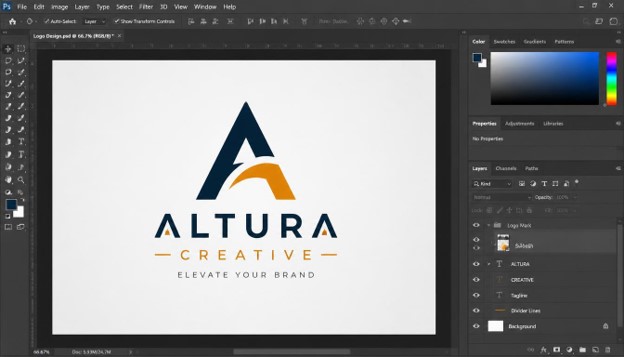
15 Tips Logo Design in Photoshop to Create Better Brand Identities
A logo is the face of a brand. It appears on websites, packaging, social media profiles, invoices, and storefronts, and people form an opinion about a business within seconds of seeing it. A weak logo can make a strong company look unprofessional, while a well-crafted one builds trust before a single word is read.
Many designers and business owners already own Adobe Photoshop, so it is natural to ask whether logo design in Photoshop is a smart choice. The answer is yes, as long as you understand its strengths and limits. Photoshop offers powerful shape tools, a precise Pen tool, flexible typography controls, and a non-destructive workflow that suits modern branding projects.
This guide shares 15 practical tips to help you get better results from logo design in Photoshop. Whether you are a beginner making your first mark or a freelancer refining your process, each tip is explained in short, clear paragraphs so you can apply it right away. By the end, you will know how to plan, build, test, and export a logo that supports a strong brand identity.
Why Logo Design in Photoshop Still Works
Photoshop is best known for photo editing, but it has grown into a capable design tool. Logo design in Photoshop gives you shape layers, vector paths, smart objects, layer styles, and advanced color management in one place. That means you can move from concept to mockup without switching software.
Another advantage is familiarity. Millions of creators already know the Photoshop interface, so the learning curve for logo design in Photoshop is gentler than starting from scratch in a new program. You can build on skills you already have.
It is worth being honest about one limit. Photoshop is primarily a raster program, which means pixel-based files can lose sharpness when scaled up. However, if you use shape layers, paths, and smart objects correctly, logo design in Photoshop can still produce clean, scalable results. The tips below show you how.
Tip 1: Start With Research and a Clear Brand Brief

Great logos begin long before you open Photoshop. Start by learning about the business: its mission, audience, values, and competitors. Ask what feeling the brand should create, whether that is trust, energy, luxury, or friendliness.
Write a short brand brief that answers these questions in plain language. Include the company name, tagline, target customers, and the words the brand wants to be associated with. This document becomes your compass throughout the project.
Next, study competitors. Note which colors, shapes, and styles dominate the industry, then decide how your design can stand apart. A logo that looks like everyone else’s will never be memorable.
Finally, gather a mood board with color samples, typography examples, and visual references. Doing this groundwork saves hours later, because your logo design in Photoshop will have a clear direction instead of random experimentation. Research turns creative guessing into confident decision making.
Tip 2: Sketch Ideas on Paper Before Opening Photoshop

It is tempting to jump straight into the software, but paper is faster for generating ideas. A pencil lets you explore ten concepts in the time it takes to build one digital layout. Sketching also frees you from technical distractions.
Draw small thumbnails, dozens of them if possible. Try wordmarks, symbols, monograms, and combinations. Do not judge them yet; the goal is quantity first, quality second.
After a round of sketching, circle the three strongest ideas. Look for concepts that are simple, distinctive, and connected to the brand brief. Weak ideas usually reveal themselves quickly when you view them side by side.
When you finally begin logo design in Photoshop, you can scan or photograph your best sketch and place it on a layer as a reference. Lower its opacity and trace over it using shape tools or the Pen tool. This hybrid method keeps the human touch of hand drawing while delivering the precision of digital work.
Tip 3: Set Up the Right Document From the Start

Your document settings shape everything that follows. For logo design in Photoshop, create a large canvas, such as 3000 by 3000 pixels, at 300 pixels per inch. A big canvas gives you room to zoom in on fine details and export high-resolution versions later.
Choose RGB color mode for logos that will mainly appear on screens, such as websites and social media. If the logo will be printed, you may need a CMYK version too, but it is usually best to design in RGB first and convert carefully at the end.
Set the background to transparent. A transparent canvas ensures your logo can be placed over any color or photo without an ugly white box around it.
Turn on rulers and guides right away. They help you keep elements aligned and centered as you work. Taking two minutes to prepare the document properly will prevent frustrating problems, especially when logo design in Photoshop becomes complex with many layers.
Tip 4: Use Shape Tools for Clean, Vector-Based Elements

Shape layers are the foundation of scalable logo design in Photoshop. Unlike painted or brushed pixels, shapes are vector-based, which means their edges stay crisp at any size. Always choose the Shape option rather than Pixels when using the Rectangle, Ellipse, Polygon, or Custom Shape tools.
Many famous logos are built from basic geometry. Circles, squares, and triangles combine into surprisingly sophisticated marks. Try overlapping shapes and using the path operations, such as Combine, Subtract, Intersect, and Exclude, to carve out new forms.
The Properties panel lets you adjust corner radius, stroke, and fill numerically. This precision matters because logos rely on consistent proportions. A corner radius that is off by a few pixels can make a design feel sloppy.
Practicing with shapes is one of the fastest ways to improve your logo design in Photoshop. Start with simple combinations, then gradually build more complex icons as your confidence grows.
Tip 5: Master the Pen Tool for Custom Shapes

When basic shapes are not enough, the Pen tool gives you complete control. It creates paths made of anchor points and curve handles, allowing you to draw any custom outline. For serious logo design in Photoshop, this tool is essential.
The secret to smooth curves is using as few anchor points as possible. Too many points create lumpy, uneven edges. Place points at the extremes of a curve, then pull the handles to shape the line.
Use the Direct Selection tool to refine your work. You can move individual points, adjust handles, and fix small errors without redrawing everything. Zooming in to 200 or 300 percent helps you spot flaws that would be invisible at normal size.
The Pen tool takes practice, so be patient. Trace over simple objects, letters, and your own sketches until the process feels natural. Once you are comfortable, your logo design in Photoshop will feel more like drawing and less like fighting the software.
Tip 6: Use Smart Objects for Non-Destructive Editing

Clients love revisions, so your workflow should make changes easy. Smart Objects protect your original artwork while letting you scale, rotate, and transform it repeatedly without losing quality. Converting logo elements into Smart Objects is one of the smartest habits in logo design in Photoshop.
Right-click a layer and choose Convert to Smart Object. You can then resize it up and down as many times as needed with no degradation. You can also double-click it to edit the contents in a separate window.
Smart Objects are especially useful for mockups. You can place your finished logo inside a Smart Object, then reuse it across business cards, signage, and packaging templates. Update it once and every mockup refreshes automatically.
Pair Smart Objects with adjustment layers and smart filters for a fully non-destructive workflow. When feedback arrives, you can change a color or effect in seconds instead of starting over. This flexibility makes logo design in Photoshop far more efficient.
Tip 7: Choose Typography That Matches the Brand Personality

Typography carries as much personality as any symbol. A bold sans-serif feels modern and confident, while a delicate serif suggests elegance and tradition. Script fonts can feel personal, but they risk poor readability at small sizes.
When working on logo design in Photoshop, limit yourself to one or two typefaces. Too many fonts create visual noise and weaken the brand. A common approach is to pair a distinctive display font for the name with a simple, readable font for the tagline.
Pay close attention to kerning, which is the space between individual letters. Default spacing is rarely perfect, especially in a wordmark. Adjust it manually so the gaps look even, and check pairs like “AV” or “TY” that often need tightening.
Also confirm the font license. Many free fonts are not cleared for commercial use, and using them in a logo can cause legal trouble later. Finally, consider converting text to shapes so the logo looks the same everywhere. Careful type choices elevate any logo design in Photoshop.
Tip 8: Build a Purposeful Color Palette

Color triggers emotion faster than shape or text. Blue often signals trust and stability, red suggests energy and urgency, green connects to nature and growth, and yellow feels optimistic. Choose colors that reflect the brand’s personality and appeal to its audience.
Keep the palette small. Most effective logos use one to three colors. This restraint makes the design easier to reproduce and easier to remember.
Use the Color Picker and Swatches panel to save your exact values. Record the hex codes, RGB numbers, and, if needed, CMYK equivalents so the brand can stay consistent across every platform. Consistency is a big part of professional logo design in Photoshop.
Do not forget accessibility. Check that your colors have enough contrast against both light and dark backgrounds. A beautiful palette that cannot be read is a failed palette. Testing color combinations early will save you from redesigning later in your logo design in Photoshop project.
Tip 9: Use Grids, Guides, and Alignment for Balance

Professional logos feel balanced because their proportions are deliberate. Grids and guides help you achieve that. In logo design in Photoshop, you can enable the grid from the View menu and drag guides from the rulers.
Use circles and squares as construction aids. Many iconic marks are built on geometric grids, where every curve and angle relates to another. Even a simple set of guides can make your design look more harmonious.
The Align and Distribute options in the toolbar are powerful allies. Select multiple layers and align their centers or edges with a single click. Manual dragging, by contrast, often leaves tiny gaps that look careless once zoomed in.
Optical balance matters too. Sometimes mathematically centered elements look off, and a small nudge fixes it. Trust your eyes as well as your tools. Combining grids with intuition gives your logo design in Photoshop a polished, deliberate look.
Tip 10: Keep the Design Simple and Memorable

Simplicity is the golden rule of branding. The most recognizable logos in the world use very few elements, and you can sketch them from memory. Complexity makes a logo harder to recognize, print, and scale.
During logo design in Photoshop, ask yourself whether every element earns its place. If removing a detail does not hurt the message, remove it. Gradients, textures, and tiny decorative lines often add clutter rather than value.
A useful test is the squint test. Step back or squint at your logo. If the basic shape and idea are still clear, the design is strong. If it turns into a blur, it is too complicated.
Memorability also comes from a unique twist, such as a clever negative space or a hidden shape. Aim for one clear idea rather than many competing ones. Simple, focused logo design in Photoshop produces marks that people remember and recognize instantly.
Tip 11: Organize and Name Your Layers

A messy layers panel slows you down. Layers named “Shape 47 copy 3” become impossible to manage when a client asks for a change. Good organization is a hallmark of professional logo design in Photoshop.
Give every layer a clear, descriptive name, such as “Icon Circle,” “Wordmark,” or “Tagline.” Group related layers into folders, and use color labels to separate sections of the design. This structure makes revisions quick and painless.
Save multiple versions of your file as the project evolves. Names like “logo-v1,” “logo-v2,” and “logo-final” protect you if you need to return to an earlier idea. Also consider keeping alternate layouts, such as horizontal and stacked versions, in separate groups.
If you collaborate with another designer or hand files to a client, organized layers show respect for their time. Clean files are easier to understand, edit, and reuse. Strong organization supports every stage of logo design in Photoshop.
Tip 12: Use Layer Styles and Effects Sparingly

Photoshop offers drop shadows, bevels, glows, and gradient overlays, and it is easy to overuse them. Heavy effects can date a logo quickly and cause problems when printing or embroidering. A strong logo should work in flat color first.
When you do use layer styles in logo design in Photoshop, keep them subtle. A gentle gradient or soft shadow can add depth for digital use, but the core design must stand on its own without them.
Consider creating two versions: a flat primary logo and an enhanced version for special uses like web banners or app icons. The flat version becomes your dependable workhorse for signage, stamps, and merchandise.
Remember that effects can hide weaknesses in the underlying design. If the logo only looks good with a glow or bevel, the concept probably needs improvement. Restraint keeps logo design in Photoshop timeless and versatile.
Tip 13: Test Your Logo in Black and White and at Small Sizes

A logo must work everywhere, not just on a large monitor. Before finalizing your logo design in Photoshop, test the design in pure black, pure white, and grayscale. If it loses its impact without color, the structure needs work.
Shrink the logo to favicon size, around 32 by 32 pixels, and to the size of a social media profile picture. Fine lines and small text often disappear at these sizes. If details vanish, simplify them or create a compact version of the logo.
Test on different backgrounds too. Place your logo on white, black, and busy photographic backgrounds to see how it behaves. You may need a reversed version for dark surfaces.
Many brands maintain a logo family: a full version, a stacked version, an icon-only mark, and a monochrome version. Planning this system during logo design in Photoshop makes the brand flexible across websites, packaging, and print.
Tip 14: Present Your Logo in Realistic Mockups

Clients find it easier to approve a logo when they can see it in real life. Mockups place your design on business cards, storefronts, shirts, mugs, and websites, showing how the identity will actually look. This is a major strength of Photoshop.
Use mockup templates with Smart Objects. Double-click the Smart Object layer, paste your logo, save, and the mockup updates instantly. It takes only a few minutes to produce a professional-looking presentation.
Show a variety of applications, but do not overwhelm the client. Three to five well-chosen mockups are usually enough. Include both light and dark contexts so they understand how the logo adapts.
Good presentation also builds your credibility as a designer. Explaining the reasoning behind your choices, tied back to the brand brief, turns opinions into informed decisions. Mockups are the final step that makes logo design in Photoshop feel real and convincing.
Tip 15: Export Your Logo in the Right Formats

Delivering the right files is just as important as designing the logo. Export a transparent PNG for web and digital use, a JPG for situations that need a solid background, and a PDF for print. Use File, Export, Export As to control size and format.
Photoshop can also export shape layers as SVG, which is useful for websites. Keep in mind that complex effects, pixel layers, and some text settings may not carry over perfectly, so always check the exported file in a browser.
For professional printing, large signage, or vehicle wraps, many designers rebuild or refine the final master in a dedicated vector program such as Adobe Illustrator. Being upfront about this with clients is a sign of professionalism, not weakness.
Finally, package everything neatly: the layered PSD, exported files in several sizes, color codes, font names, and a short usage guide. A complete delivery gives the client confidence and ensures your logo design in Photoshop project ends on a strong note.
Common Mistakes to Avoid in Logo Design in Photoshop
Even experienced designers fall into a few traps. The most frequent mistake is using raster brushes or low-resolution images, which leads to blurry edges. Always build with shapes and paths whenever possible.
Another error is copying trends without thinking. Popular styles fade quickly, and a logo tied to a fad may look outdated in two years. Focus on timeless principles instead of temporary fashion.
Some designers also skip the testing phase. A logo that has never been viewed small, in black and white, or on different backgrounds can fail in real use. Careful testing is a required step in logo design in Photoshop, not an optional one.
Finally, never use stock icons, clip art, or unlicensed fonts as the core of a logo. Originality and legal safety are essential. Avoiding these mistakes will make your logo design in Photoshop work stronger and more professional.
Frequently Asked Questions (FAQs)
- Is Photoshop good for logo design?
Yes, Photoshop can be very effective when used correctly. Its shape layers, Pen tool, and Smart Objects make logo design in Photoshop practical for many projects. For very large print applications, some designers finalize the file in a vector program.
- What canvas size should I use for logo design in Photoshop?
A canvas of 3000 by 3000 pixels at 300 PPI is a solid starting point. It provides enough resolution for high-quality exports while keeping the file manageable. Always use a transparent background.
- Can I create a vector logo in Photoshop?
You can create vector shapes and paths using the Shape and Pen tools, and you can export SVG files. However, Photoshop is mainly pixel-based, so complex projects may benefit from Illustrator. Using shape layers keeps logo design in Photoshop as scalable as possible.
- Which tools are most important for logo design in Photoshop?
The Shape tools, Pen tool, Type tool, and Smart Objects are the most important. Guides, grids, and the Align options also help you achieve precision. Mastering these tools improves the quality of your logo design in Photoshop quickly.
- What file formats should I deliver to a client?
Deliver a layered PSD, transparent PNGs, a JPG, and a PDF at minimum. Add an SVG when suitable for web use. Providing multiple versions makes your logo design in Photoshop project complete and useful.
- How many colors should a logo have?
Most strong logos use one to three colors. Fewer colors make the design easier to reproduce and more memorable. Always test a single-color version as part of your logo design in Photoshop process.
- How long does it take to design a logo in Photoshop?
A simple logo may take a few hours, while a full brand identity with research, concepts, and revisions can take days or weeks. Planning and sketching reduce the time spent in the software. Efficient logo design in Photoshop depends on preparation.
- Can beginners learn logo design in Photoshop?
Absolutely. Start with shape tools, simple typography, and basic color theory. With regular practice and the tips in this guide, beginners can produce professional-looking work through logo design in Photoshop.
Conclusion
A great brand identity begins with a thoughtful logo, and the tips above show that logo design in Photoshop is more capable than many people assume. By researching the brand, sketching first, setting up your document correctly, using shapes and paths, and staying non-destructive with Smart Objects, you build a strong foundation.
Typography, color, grids, and simplicity then shape the personality of the mark. Organized layers, restrained effects, thorough testing, convincing mockups, and proper exports make sure the logo works in the real world.
Practice these 15 tips consistently, and your logo design in Photoshop skills will grow with every project. Start with one small idea today, apply what you have learned, and watch your brand identities become clearer, stronger, and more memorable.
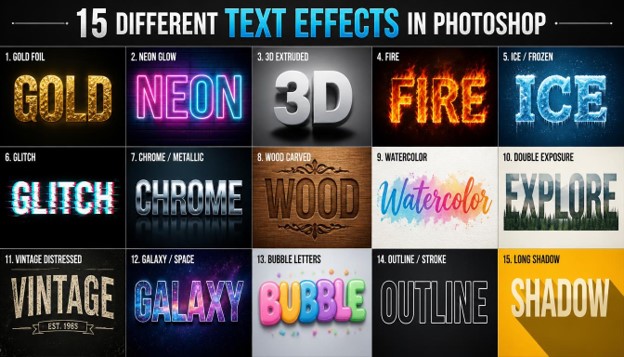
15 Best Text Effects in Photoshop: Easy Tutorials for Beginners (2026)
Typography can make or break a design. Whether you’re building a poster, a YouTube thumbnail, a social media banner, or a logo, the right lettering style pulls the eye in and sets the mood before anyone reads a single word. That’s exactly why so many designers search for Text Effects in Photoshop — they’re one of the fastest ways to turn plain type into something people stop scrolling for.
If you’re new to Photoshop, the idea of layer styles, blending modes, and smart objects can feel intimidating. The good news is that most professional-looking Text Effects in Photoshop only take a handful of steps once you know the right settings. In this guide, we’ll walk through 15 beginner-friendly tutorials, each broken into short, easy steps so you can follow along even if you’ve never opened Photoshop before.
By the end of this article, you’ll have a personal toolkit of Text Effects in Photoshop you can reuse on any project — from gold foil lettering to glitch text, neon signs, and 3D typography.
Why Learn Text Effects in Photoshop?
Before jumping into the tutorials, it helps to understand why designers rely so heavily on these techniques.
Good typography sells an idea in under two seconds. A movie poster, a game logo, or a product label often communicates its entire mood through lettering alone.
Learning Text Effects in Photoshop gives you a shortcut to that kind of visual impact without needing to draw anything from scratch. Every technique below uses layer styles, blend modes, and simple filters — no advanced illustration skills required.
Each section is short on purpose. Add short and concise paragraphs for better readability and UX, so you can skim, find the effect you want, and jump straight to it.
1. Gold Foil Text Effect

Gold foil lettering is one of the most requested Text Effects in Photoshop for wedding invitations, luxury branding, and greeting cards.
Steps:
- Type your text in a bold, thick font like Montserrat Black or Poppins Bold.
- Apply a Gradient Overlay using warm gold tones (from dark amber to bright yellow).
- Add a Bevel and Emboss layer style with a low depth and smooth technique.
- Add a subtle Drop Shadow to lift the letters off the background.
- Finish with a Pattern Overlay set to “foil texture” at low opacity for realism.
This is one of the simplest Text Effects in Photoshop because it only relies on the Layer Style panel — no external brushes needed.
Where to use it: Gold foil lettering works best on wedding invitations, luxury product packaging, and any design with a dark or cream-colored background that lets the warm tones stand out.
Common mistake to avoid: Beginners often make the gradient too flat. Add at least four color stops — dark brown, amber, bright gold, and a pale highlight — so the light appears to hit the letters unevenly, just like real foil.
2. Neon Glow Text Effect

Neon text is a favorite among beginners because it looks advanced but takes only minutes to create.
Steps:
- Choose a rounded, script-like font to mimic real neon tubing.
- Set the fill color to a bright pink, blue, or green.
- Add an Outer Glow layer style using the same color as the text.
- Duplicate the glow with a second, softer Outer Glow at a larger size.
- Place your text on a dark background so the glow pops.
This effect is beginner-friendly because Photoshop’s built-in glow settings do most of the heavy lifting.
Where to use it: Neon text suits nightlife event posters, gaming channel branding, and bar or restaurant signage graphics.
Common mistake to avoid: Skipping the second, larger glow layer is the biggest mistake beginners make. A single glow looks flat, while two stacked glows at different sizes create the soft light bloom that sells the neon illusion.
3. 3D Extruded Text Effect

3D lettering adds depth and works great for headlines, YouTube thumbnails, and game titles.
Steps:
- Type your text and convert it to a Smart Object.
- Go to the 3D menu and choose “New 3D Extrusion from Selected Layer.”
- Adjust the extrusion depth in the Properties panel.
- Rotate the object slightly for a dynamic angle.
- Add lighting from the 3D panel to create realistic shading.
This is one of the more advanced Text Effects in Photoshop, but Photoshop’s 3D tools make it approachable for beginners.
Where to use it: 3D extruded lettering is a strong choice for movie title cards, YouTube thumbnails, and app splash screens where you want the headline to feel physical and dimensional.
Common mistake to avoid: Rendering at low quality settings makes edges look jagged. Always switch the render mode to “Ray Traced Final” before exporting so the shading and reflections look smooth.
4. Fire Text Effect

Fire text is dramatic and works well for movie posters, gaming logos, and event banners.
Steps:
- Type your text in a bold font and duplicate the layer.
- Apply the Wind filter (Filter > Stylize > Wind) rotated vertically.
- Use Liquify to push the top edges upward like flames.
- Add a Gradient Map with red, orange, and yellow tones.
- Set the blend mode to Screen and layer in a fire texture overlay.
Fire is one of the more detailed Text Effects in Photoshop, but following the steps in order keeps it manageable.
Where to use it: Fire text fits horror and action movie posters, gym or fitness branding, and gaming thumbnails that need a high-energy, dramatic feel.
Common mistake to avoid: Applying the Wind filter only once often looks weak. Run it two or three times, alternating direction slightly, so the flame edges look layered instead of flat and uniform.
5. Ice / Frozen Text Effect

The frozen look pairs perfectly with winter campaigns and fantasy-style designs.
Steps:
- Type your text in a strong, geometric font.
- Apply a blue-to-white Gradient Overlay.
- Add Bevel and Emboss with a “Chisel Hard” technique for a crystalline look.
- Overlay an ice texture image and set the blend mode to Screen.
- Add small white specks using the Spatter filter to mimic frost.
Of all the Text Effects in Photoshop on this list, this one relies most on a good texture image, so choose a high-resolution ice or frost photo.
Where to use it: The frozen look works well for winter sale banners, fantasy game logos, and holiday greeting cards with a cool color palette.
Common mistake to avoid: Using a warm-toned frost texture breaks the illusion. Stick to blue-white or gray-blue textures so the temperature of the image matches the temperature of the gradient.
6. Glitch Text Effect

Glitch text is popular in gaming, tech, and streaming graphics.
Steps:
- Type your text and duplicate the layer twice.
- Change one duplicate’s channel to red-only and offset it slightly left.
- Change the second duplicate to cyan-only and offset it slightly right.
- Add random rectangular selections and shift them horizontally for a “torn” look.
- Finish with a light Noise filter for texture.
This is a fast, fun entry into Text Effects in Photoshop because there’s no painting or texture work involved — just layer offsets.
Where to use it: Glitch text is a natural fit for gaming channel intros, tech product launches, and cyberpunk-style album covers.
Common mistake to avoid: Offsetting the channels too far apart makes the text unreadable. Keep the shift between three and eight pixels so the glitch reads as intentional rather than broken.
7. Chrome / Metallic Text Effect

Chrome text works well for retro branding, car logos, and 90s-inspired designs.
Steps:
- Type your text in a rounded, bold font.
- Apply a Gradient Overlay with alternating light gray, white, and dark gray stripes.
- Add Bevel and Emboss with high depth for a reflective edge.
- Add an Inner Shadow for extra dimension.
- Finish with a subtle Drop Shadow underneath.
Metallic styles are consistently among the most searched Text Effects in Photoshop, largely because they look complex but are built entirely from gradients.
Where to use it: Chrome lettering suits automotive branding, retro band merchandise, and any design channeling a 1990s or early-2000s aesthetic.
Common mistake to avoid: Using only two gradient shades looks flat instead of reflective. Add at least five alternating light and dark stops to mimic the way real chrome bounces light unevenly.
8. Wood Carved Text Effect

This rustic style suits cafe menus, farmhouse branding, and handcrafted product labels.
Steps:
- Place a wood texture image as your background.
- Type your text and set the fill to 0% opacity.
- Add Bevel and Emboss with the “Chisel Hard” technique.
- Add an Inner Shadow to simulate a carved groove.
- Add a Pattern Overlay using the wood texture so the letters blend into the surface.
This is a great effect for practicing how layer styles interact with textures rather than flat colors.
Where to use it: Wood carved text is ideal for cafe menus, farmhouse or rustic branding, and handmade product labels where a natural, handcrafted feel matters.
Common mistake to avoid: Forgetting the Inner Shadow step leaves the text looking like a sticker instead of a carving. That shadow is what creates the illusion of a groove cut into the surface.
9. Watercolor Text Effect

Soft, painterly lettering is ideal for wedding stationery, greeting cards, and lifestyle brands.
Steps:
- Type your text in a clean, readable font.
- Place a watercolor texture image above the text layer.
- Right-click the texture and choose “Create Clipping Mask.”
- Adjust the texture’s Hue/Saturation to match your brand colors.
- Add a soft Drop Shadow for gentle depth.
This is one of the easiest Text Effects in Photoshop for beginners since it only requires a clipping mask and one texture image.
Where to use it: Watercolor lettering fits wedding stationery, floral branding, and lifestyle blog headers where a soft, handmade feel is the goal.
Common mistake to avoid: Using a watercolor texture that’s too uniform makes the effect look like a plain color fill. Choose a texture with visible brush strokes and uneven edges for a more authentic painted look.
10. Double Exposure Text Effect

Double exposure text blends a photo directly into the lettering for a cinematic look.
Steps:
- Type your text in a bold, thick font.
- Place a photo (like a landscape or portrait) above the text layer.
- Create a Clipping Mask so the photo only shows inside the letters.
- Adjust the photo’s contrast and add a black-and-white adjustment layer.
- Add a soft Gaussian Blur at the edges for a dreamy transition.
Among all Text Effects in Photoshop, this one is especially popular on Instagram and Pinterest because of its artistic, editorial feel.
Where to use it: Double exposure text works well for travel brand headers, music album art, and editorial magazine covers that want a cinematic, story-driven tone.
Common mistake to avoid: Choosing a photo with too much detail can make the letters unreadable. Pick images with clear silhouettes, like a single mountain or a tree line, so the letterforms stay legible.
11. Vintage Distressed Text Effect

Distressed lettering fits band merch, retro posters, and denim or leather branding.
Steps:
- Type your text in a serif or slab-serif font.
- Place a grunge or paper texture above the text and Clipping Mask it.
- Lower the layer’s opacity so worn spots show through the letters.
- Add a Color Overlay in a faded sepia or cream tone.
- Add slight rotation and a paper background for an aged feel.
This effect proves that Text Effects in Photoshop don’t have to look shiny or futuristic — plenty of trending styles lean vintage instead.
Where to use it: Distressed lettering suits band merchandise, denim or leather product tags, and retro travel posters with a worn, well-loved feel.
Common mistake to avoid: Over-distressing the text can make it unreadable at a glance. Keep the core letterforms mostly intact and concentrate the wear and texture around the edges instead.
12. Galaxy / Space Text Effect

Space-themed text works well for gaming channels, sci-fi posters, and music covers.
Steps:
- Type your text in a bold, wide font.
- Place a galaxy or nebula photo above the text and Clipping Mask it.
- Boost saturation and contrast on the galaxy layer.
- Add small white dots using a soft round brush for extra stars.
- Add an Outer Glow in purple or blue for a cosmic edge.
This is a favorite among the Text Effects in Photoshop community because the results look far more advanced than the actual steps required.
Where to use it: Galaxy text is a strong pick for sci-fi movie posters, astronomy content, and music covers with a dreamy, otherworldly mood.
Common mistake to avoid: Skipping the saturation boost leaves the galaxy texture looking dull inside the letters. Push the vibrance up noticeably so the nebula colors read clearly at a small size.
13. Bubble Letters Text Effect

Playful, rounded bubble text is great for kids’ brands, party invites, and casual social posts.
Steps:
- Type your text in a thick, rounded font (or use a bubble-letter font).
- Add Bevel and Emboss with a smooth, high-gloss technique.
- Add a Gradient Overlay in bright, candy-like colors.
- Add a small white highlight shape on each letter for a glossy shine.
- Finish with a soft Drop Shadow underneath.
This is one of the most beginner-friendly Text Effects in Photoshop, since the whole look comes from just two layer styles.
Where to use it: Bubble letters are perfect for children’s brands, birthday party invitations, and playful social media posts aimed at a younger audience.
Common mistake to avoid: Forgetting the small highlight shape on each letter is the most common miss. That tiny white shine is what sells the glossy, balloon-like finish.
14. Outline / Stroke Text Effect

Outlined text is minimal, modern, and extremely versatile for logos and posters.
Steps:
- Type your text and set the fill opacity to 0%.
- Add a Stroke layer style, choosing a color and width that fits your design.
- Set the stroke position to “Outside” for a cleaner edge.
- Optionally add a second, thinner inner stroke in a contrasting color.
- Place the text over a bold background image or solid color.
This is the simplest entry on the list and a great starting point if you’re brand new to Text Effects in Photoshop.
Where to use it: Outlined text works well for minimalist logos, streetwear branding, and any design that needs to sit cleanly over a busy photo background.
Common mistake to avoid: Setting the stroke width too thin at large sizes makes it disappear when scaled down. Preview the design at its smallest intended size before finalizing the stroke weight.
15. Long Shadow Text Effect

Long shadow text is a flat-design classic, popular in app icons and minimalist posters.
Steps:
- Type your text in a bold, geometric sans-serif font.
- Duplicate the text layer and fill the duplicate with a darker shade.
- Use Free Transform to stretch the duplicate diagonally behind the original.
- Lower the shadow layer’s opacity slightly for a soft flat effect.
- Keep the background simple so the shadow reads clearly.
This wraps up our list of the best Text Effects in Photoshop for beginners — from realistic textures to flat, modern design styles.
Where to use it: Long shadow text suits app icons, flat-design posters, and minimalist portfolio headers where a clean, modern aesthetic matters most.
Common mistake to avoid: Stretching the shadow at an inconsistent angle across multiple letters breaks the flat-design illusion. Use Free Transform once on the whole text layer, not letter by letter, to keep the angle uniform.
Why These Text Effects in Photoshop Work So Well Together
Looking at all fifteen techniques side by side, a pattern emerges. Every single one of these Text Effects in Photoshop relies on the same small toolkit: layer styles, clipping masks, gradients, and a handful of filters. Once you’re comfortable with those four building blocks, you can mix and match them to invent entirely new looks.
For example, combining the gold foil gradient technique with the outline effect’s stroke settings can produce a completely new “gold outline” style. Or you could take the neon glow’s Outer Glow setting and apply it to the galaxy text for a glowing cosmic effect. This is really the biggest lesson beginners take away from practicing Text Effects in Photoshop: the tools are reusable, even if the final results look completely different.
Another reason these techniques work so well is that Photoshop keeps every layer style live and editable. Unlike effects baked directly into pixels, you can revisit a Bevel and Emboss setting weeks later and tweak the depth, angle, or color without redoing the whole effect from scratch. That non-destructive workflow is part of what makes practicing Text Effects in Photoshop so much less stressful for beginners than people expect.
How to Choose the Right Text Effect in Photoshop for Your Project
With fifteen options to pick from, choosing the right Text Effects in Photoshop for a specific project can feel overwhelming at first. A simple way to narrow it down is to think about mood, audience, and background before you even open Photoshop.
Start with mood. Every effect on this list carries an emotional tone. Fire and glitch text feel aggressive and high-energy, which suits gaming or action content. Watercolor and gold foil feel soft and elegant, which suits weddings or lifestyle brands. Matching the mood of your Text Effects in Photoshop choice to the mood of your project is the single biggest factor in whether a design feels “right.”
Think about your audience next. A children’s brand will almost always benefit more from bubble letters or bright neon than from a distressed vintage look. A luxury skincare brand, on the other hand, will lean toward gold foil, chrome, or a subtle outline effect. Ask who’s going to see the final design before deciding which Text Effects in Photoshop technique to apply.
Finally, consider the background. Some effects, like neon glow and fire, need a dark background to read properly. Others, like outline and long shadow, work best on a light or photo-based background. Testing your chosen Text Effects in Photoshop style against the actual background you plan to use will save you from having to redo the effect later.
A quick decision checklist:
- Formal or luxury project → Gold Foil, Chrome, or Outline
- Playful or casual project → Bubble Letters, Neon Glow, or Long Shadow
- Nature or handmade brand → Watercolor, Wood Carved, or Vintage Distressed
- Tech, gaming, or sci-fi project → Glitch, Galaxy, or 3D Extruded
- Bold, high-impact headline → Fire, Ice, or 3D Extruded
Once you’ve narrowed your options down using this checklist, go back to the matching tutorial above and follow the steps in order. Because every technique in this guide uses short, numbered steps, you shouldn’t need more than 10–15 minutes per effect once you’re comfortable with the Layers panel.
Tools and Shortcuts That Speed Up Every Text Effect
A few Photoshop tools show up again and again across these Text Effects in Photoshop tutorials. Getting comfortable with them will make every future project faster.
The Layer Style panel (double-click any layer) is where Bevel and Emboss, Gradient Overlay, Outer Glow, Stroke, and Drop Shadow all live. Almost every effect in this guide touches this panel at least once.
Clipping Masks (Alt/Option-click between two layers) let you contain a texture or photo inside your text shape, which is the backbone of the watercolor, double exposure, galaxy, and wood carved effects.
Smart Objects (right-click a layer > Convert to Smart Object) protect your text from becoming permanently pixelated when you apply filters like Liquify, Wind, or 3D extrusion. Always convert to a Smart Object before running a filter on text.
The Gradient Tool and Gradient Editor are used in more of these Text Effects in Photoshop tutorials than any other tool, from gold foil to chrome to ice. Spend ten minutes getting familiar with adding and adjusting color stops, and every future tutorial will move faster.
Learning these four tools well is really the fastest path to mastering Text Effects in Photoshop as a whole, since nearly every advanced technique is just a creative combination of the same basic building blocks.
Before You Start: A Simple Photoshop Setup Checklist
A little preparation before opening any tutorial saves a lot of frustration later. Here’s a short checklist worth running through first.
Check your canvas size. Start with a document at least 1920 by 1080 pixels for web graphics, or larger if you’re designing for print. Working too small makes fine details like bevels and glows look chunky when you scale up later.
Set your color mode. Use RGB for anything going online, and CMYK only if the final file is headed to a printer. Switching modes after finishing a design can shift your colors unexpectedly, so it’s best to decide upfront.
Organize your layers early. Name each layer as you create it — “Text,” “Texture,” “Glow,” and so on — rather than leaving everything as “Layer 1,” “Layer 2.” This becomes especially helpful once you start combining multiple effects on one project.
Keep a folder of textures and gradients. Several tutorials in this guide call for outside images, like wood grain, grunge paper, or galaxy photos. Building a small personal library of high-resolution textures means you’ll never be stuck mid-tutorial searching for the right file.
Save incrementally. Use File > Save As with a version number (v1, v2, v3) every time you try a new variation. This makes it painless to go back a step if an effect doesn’t turn out the way you expected.
None of these steps take more than a minute or two, but together they make every tutorial in this guide noticeably smoother to follow.
Common Beginner Mistakes to Avoid
A few mistakes show up again and again when beginners are just getting started, regardless of which effect they’re trying. Watching out for these will save you time across every project.
Flattening the file too early. It’s tempting to merge all your layers once a design looks finished, but this makes it impossible to go back and adjust a color or shadow later. Keep your layers separate and only flatten a copy when you’re ready to export.
Ignoring the font choice. The steps matter, but the font you start with matters just as much. A thin, delicate font will never look convincing with a heavy 3D extrusion, and a chunky display font will look clumsy with a delicate watercolor treatment. Match the font weight to the effect before you begin.
Skipping the preview at export size. A design can look stunning zoomed in at 100%, then fall apart once shrunk down to a thumbnail or business card size. Always zoom out and check your work at the actual size it will be viewed.
Overusing filters. More isn’t always better. Stacking five different filters on one text layer often muddies the result instead of improving it. Most of the effects in this guide use two or three filters at most — resist the urge to add extra “just in case.”
Keeping these simple habits in mind will make every future design project, not just these fifteen tutorials, turn out cleaner and more professional.
Quick Tips for Better Results
- Always work on a duplicate layer so your original text stays editable.
- Convert text to a Smart Object before applying filters like Liquify or Wind.
- Use high-resolution textures (2000px or larger) so your Text Effects in Photoshop stay sharp when exported.
- Save your finished layer styles as presets so you can reuse them instantly on future projects.
- Export a PNG with a transparent background if you plan to reuse the text elsewhere.
Frequently Asked Questions
- What are Text Effects in Photoshop? Text Effects in Photoshop are styles and techniques — like glow, 3D, gold foil, or fire — applied to type using layer styles, filters, and blending modes to make lettering more visually striking.
- Are Text Effects in Photoshop hard to learn for beginners? No. Most of the effects in this guide use Photoshop’s built-in Layer Style panel, which means no drawing skills or plugins are required. A few, like fire or galaxy text, take slightly more steps but are still beginner-friendly.
- Which Photoshop version do I need for these tutorials? Any recent version of Photoshop (CC 2020 or newer) supports every technique in this article, including the 3D extrusion tools and Liquify filter.
- Can I apply these Text Effects in Photoshop to a logo? Yes, but for logos it’s best to keep the design simple and scalable. Outline, gold foil, and bevel-based effects tend to work best for branding since they stay legible at small sizes.
- Do I need special fonts for these effects? Not necessarily. Bold, thick fonts like Montserrat, Poppins, or Bebas Neue work well for most effects. Script fonts suit the neon effect, while serif fonts fit the vintage and wood-carved looks best.
- How do I save a text effect so I can reuse it later? Right-click the text layer in the Layers panel and choose “Copy Layer Style.” You can then paste it onto any new text layer, or save it as a style preset from the Styles panel.
- Why does my text effect look pixelated when exported? This usually happens when the canvas resolution is too low or a texture image was stretched beyond its original size. Always start with a canvas of at least 1920px wide and use high-resolution textures.
- What’s the easiest effect to start with? The Outline/Stroke effect and the Bubble Letters effect are the two easiest Text Effects in Photoshop for absolute beginners, since both rely on just one or two layer style settings.
- Can I combine multiple Text Effects in Photoshop on the same text layer? Yes. Layer styles stack, so you can combine a Gradient Overlay from the gold foil effect with a Stroke from the outline effect on the same layer to create a custom hybrid look.
- How long does it take to learn all 15 Text Effects in Photoshop? Most beginners can comfortably work through all 15 tutorials in this guide over a single weekend, spending roughly 15–20 minutes per effect including experimentation.
Final Thoughts
Mastering Text Effects in Photoshop doesn’t require years of design experience — it just requires following the right steps in the right order. Start with the simpler techniques like the outline or bubble letter effect, then work your way up to more advanced looks like fire, galaxy, or 3D extrusion.
With these 15 tutorials in your toolkit, you now have a full library of Text Effects in Photoshop to pull from for any project, whether it’s a poster, a thumbnail, a logo, or a social media post. Practice each one a few times, save your favorite layer styles as presets, and you’ll be creating scroll-stopping typography in no time.
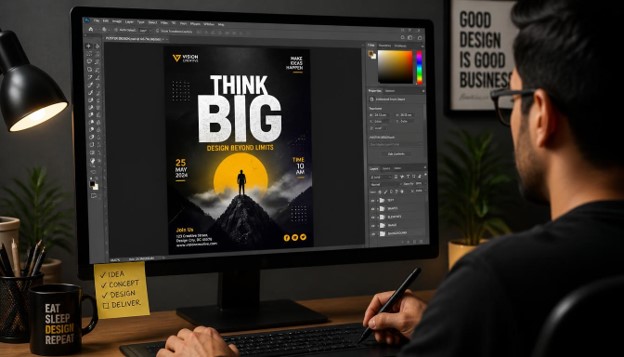
Photoshop Poster Design: 15 Techniques to Create Eye-Catching Posters
Posters remain one of the most powerful tools in visual marketing, and mastering Photoshop Poster Design is the fastest way to turn a blank canvas into a scroll-stopping visual. Whether you are promoting a concert, launching a product, or building a personal portfolio, the right approach to Photoshop Poster Design can be the difference between a poster that gets ignored and one that gets shared.
In this guide, we will walk through 15 practical, tested techniques that professional designers use every day. Each section focuses on a specific part of the workflow, so you can apply these ideas immediately, whether you are a complete beginner or someone looking to sharpen existing skills. By the end of this article, you will have a complete roadmap for creating posters that stand out in a crowded feed or a busy street corner.
Short and focused paragraphs are used throughout this article so that the information is easy to scan, easy to digest, and easy to put into action right away.
What Is Photoshop Poster Design?
Photoshop Poster Design refers to the process of using Adobe Photoshop to plan, build, and finalize promotional or artistic posters. It combines typography, color theory, image editing, and composition into a single flat design that communicates a message quickly.
Unlike a website or an app interface, a poster has only a few seconds to capture attention. This makes Photoshop Poster Design a discipline that rewards clarity, bold choices, and strong visual hierarchy over subtlety.
Understanding this foundation is essential before diving into the specific techniques below, because every technique in Photoshop Poster Design exists to serve one goal: getting the viewer’s attention and holding it long enough to deliver the message.
1. Start With a Clear Concept Before Opening Photoshop

Every strong piece of Photoshop Poster Design begins away from the software itself. Before you touch a single tool, define the purpose of the poster. Is it selling a product, announcing an event, or expressing a mood?
Sketch rough thumbnails on paper or in a notes app. This step feels slow, but it saves hours later because you will not be redesigning the layout halfway through your Photoshop Poster Design session.
Collect reference images and build a simple mood board. Reference material keeps your Photoshop Poster Design grounded in a consistent visual direction instead of drifting from idea to idea.
Once the concept is locked, write down three words that describe the feeling you want the poster to communicate — bold, playful, elegant, urgent, and so on. These words will guide every decision you make in your Photoshop Poster Design process, from color to font choice.
2. Choose the Correct Canvas Size and Resolution

One of the most overlooked steps in Photoshop Poster Design is setting up the canvas correctly from the start. A poster meant for print needs a much higher resolution than one meant only for social media.
For print work, set your resolution to at least 300 pixels per inch (PPI) and use the CMYK color mode. For digital-only Photoshop Poster Design projects, 72 PPI in RGB mode is generally sufficient and keeps file sizes manageable.
Always add bleed if the poster will be professionally printed. A standard bleed of 0.125 inches on each side prevents white edges from appearing after trimming.
Getting this step right early in your Photoshop Poster Design workflow avoids the frustrating experience of discovering blurry or pixelated output after hours of work.
3. Build a Strong Color Palette

Color is one of the fastest ways to communicate mood in Photoshop Poster Design. A poster with a chaotic, unplanned color scheme feels unfinished, while one built on a deliberate palette feels professional immediately.
Limit yourself to two or three primary colors plus a neutral for text and background support. This restraint is a hallmark of experienced Photoshop Poster Design work and keeps the composition from feeling cluttered.
Use Photoshop’s color picker alongside external tools like Adobe Color to generate complementary or analogous palettes. Save these swatches so they stay consistent throughout your entire Photoshop Poster Design file.
Consider the psychology of color as well. Warm tones like red and orange tend to feel urgent and energetic, which works well for event posters, while cool tones like blue and green feel calm and trustworthy, better suited for wellness or corporate themes.
4. Choose Typography That Matches the Message

Typography carries as much weight as imagery in Photoshop Poster Design. The font you choose sets an immediate tone before a single word is even read.
Pair no more than two typefaces: one bold display font for the headline and one simpler font for supporting text. This pairing strategy is a core principle of effective Photoshop Poster Design and prevents visual noise.
Adjust tracking and leading manually rather than relying on default settings. Tight tracking on a large headline often looks more intentional and confident in Photoshop Poster Design compositions.
Avoid overused system fonts when possible. A distinctive typeface instantly elevates the perceived quality of any Photoshop Poster Design project, even when the rest of the layout is simple.
5. Establish a Clear Visual Hierarchy

Visual hierarchy guides the viewer’s eye in the correct order: headline first, supporting details second, fine print last. This is one of the most important structural techniques in Photoshop Poster Design.
Use size, weight, and contrast to separate these three levels. A common mistake in Photoshop Poster Design is making too many elements the same size, which forces the eye to work harder than necessary.
Try squinting at your canvas or reducing the zoom level. If the headline is not the first thing you notice, your hierarchy needs adjustment before moving forward in the Photoshop Poster Design process.
Whitespace also plays a role here. Giving elements room to breathe is often more effective in Photoshop Poster Design than adding more graphics to fill empty space.
6. Organize Your Work With Layers and Groups

As a poster grows in complexity, an unorganized layers panel becomes a serious obstacle. Professional Photoshop Poster Design work always relies on clean, labeled layer groups.
Group layers by section: background, imagery, typography, and effects. This structure makes it far easier to make quick edits later in your Photoshop Poster Design file without hunting through dozens of unnamed layers.
Use color-coded labels for layers that need special attention, such as elements still awaiting client approval. This small habit saves significant time in any Photoshop Poster Design project with multiple revisions.
Lock background layers once they are finalized. This prevents accidental changes while you continue refining the rest of the Photoshop Poster Design composition.
7. Experiment With Blending Modes

Blending modes allow layers to interact with each other in creative, often unexpected ways. They are one of the most underused tools in beginner Photoshop Poster Design work.
Modes like Multiply, Screen, and Overlay can merge textures with color layers to create atmosphere without extra manual painting. This technique adds depth to Photoshop Poster Design projects quickly.
Try applying a texture layer set to Overlay at reduced opacity over a flat color background. This single trick can transform a plain Photoshop Poster Design layout into something that feels tactile and rich.
Do not be afraid to cycle through every blending mode on a layer to see what happens. Some of the best discoveries in Photoshop Poster Design happen through experimentation rather than planning.
8. Use High-Quality Images and Textures

Low-resolution or poorly lit images will undermine even the best layout. Sourcing high-quality visuals is non-negotiable in professional Photoshop Poster Design.
Use reputable stock photo sites or your own photography whenever possible. Stretching a small image to fit a large canvas is a common mistake that instantly signals amateur Photoshop Poster Design work.
Textures such as grain, paper, or fabric can add realism and warmth. Layering a subtle grain texture over a digital illustration is a popular trick in modern Photoshop Poster Design trends.
Always check licensing terms before using any image commercially. This protects your project and your client from legal issues tied to unauthorized use in Photoshop Poster Design work.
9. Apply the Rule of Thirds and Grid Systems

Composition theory did not disappear with the move to digital tools. The rule of thirds remains one of the most reliable techniques in Photoshop Poster Design for balanced, natural-feeling layouts.
Turn on Photoshop’s built-in grid or guides (View > Guides) and divide your canvas into thirds both horizontally and vertically. Placing key elements along these lines creates instinctively pleasing compositions in Photoshop Poster Design.
Grid systems also help align multiple text blocks and images consistently. A poster built on a hidden grid feels more polished, even if the viewer never consciously notices the structure behind the Photoshop Poster Design.
Break the grid occasionally for emphasis. A single element that intentionally ignores the rule of thirds can draw extra attention, a technique advanced Photoshop Poster Design artists use sparingly and deliberately.
10. Color Grade With Adjustment Layers

Adjustment layers let you fine-tune the overall mood of a poster without permanently altering the original pixels. This non-destructive approach is central to efficient Photoshop Poster Design.
Curves and Color Balance are two of the most versatile adjustment layers. A gentle S-curve can add contrast and punch to any Photoshop Poster Design composition in seconds.
Use a Gradient Map on a low opacity Overlay blend to unify colors across the whole poster. This is a fast way to make a Photoshop Poster Design piece feel cohesive, even when it combines several different image sources.
Clip adjustment layers to specific groups when you only want the effect applied to one section. This level of control is what separates amateur output from refined Photoshop Poster Design results.
11. Add Depth With Shadows and Lighting

Flat elements can make a poster feel lifeless. Adding directional shadows and light sources brings a sense of three-dimensional depth to Photoshop Poster Design layouts.
Use the Drop Shadow layer style with a low opacity and a soft edge for a natural look. Harsh, high-opacity shadows are a common beginner mistake in Photoshop Poster Design work.
Painting soft light with a low-opacity white brush on a new layer set to Soft Light can simulate glow around a focal point. This technique instantly draws the eye in Photoshop Poster Design compositions.
Keep a single consistent light direction throughout the poster. Mismatched shadows are one of the quickest ways to break the illusion of depth in any Photoshop Poster Design piece.
12. Create Custom Shapes and Vector Elements
Custom shapes give a poster a distinctive identity that stock elements cannot match. The Pen Tool remains one of the most valuable skills for advanced Photoshop Poster Design.
Practice drawing simple geometric shapes before attempting complex illustrations. Confidence with vector paths opens up far more creative options in Photoshop Poster Design work.
Combine shapes using the Path Operations menu (Union, Subtract, Intersect) to build unique icons or decorative elements. These custom touches make a Photoshop Poster Design piece feel original rather than templated.
Keep shape layers editable as vectors for as long as possible. This flexibility allows quick resizing without quality loss later in the Photoshop Poster Design process.
13. Use Smart Objects for Non-Destructive Editing

Smart Objects preserve the original quality of an image or layer even after resizing or applying filters. This is one of the most important habits to build in Photoshop Poster Design.
Convert any imported image to a Smart Object immediately (right-click > Convert to Smart Object). This single step prevents quality loss throughout the rest of your Photoshop Poster Design session.
Smart Filters applied to Smart Objects remain fully editable. This means you can adjust a Gaussian Blur or Sharpen filter at any point without redoing the effect from scratch in your Photoshop Poster Design file.
Linked Smart Objects are especially useful when the same logo or graphic appears across multiple poster variations. Updating one file updates every linked instance across your Photoshop Poster Design series.
14. Add Text Effects and Filters Thoughtfully
Text effects can add excitement to a headline, but overusing them is a common trap in Photoshop Poster Design. Restraint usually produces a more professional result than piling on every available filter.
Layer styles like Gradient Overlay, Stroke, and Bevel & Emboss can be combined subtly to give text texture and dimension. A well-executed effect enhances a Photoshop Poster Design headline without overwhelming it.
Warp Text and Puppet Warp allow headlines to follow curves or dynamic shapes, useful for event posters that need extra energy. Used sparingly, this technique adds personality to Photoshop Poster Design work.
Always test text effects at both full size and thumbnail size. An effect that looks great zoomed in can disappear entirely when the Photoshop Poster Design is viewed small on a phone screen.
15. Export and Optimize for Print and Web
The final step of any Photoshop Poster Design project is exporting correctly for its intended use. A beautifully designed poster is only useful if it displays or prints properly.
For print, export as a high-resolution PDF or TIFF in CMYK, keeping the 300 PPI resolution intact. Skipping this step can ruin months of Photoshop Poster Design work at the printing stage.
For web and social media, use “Export As” to create optimized JPG or PNG files in RGB at 72 PPI. Compressing file size without sacrificing visible quality keeps your Photoshop Poster Design assets loading quickly online.
Save a master PSD file with all layers intact before flattening anything. This backup ensures you can revisit and edit the Photoshop Poster Design project months or years later without starting over.
Bringing It All Together
Mastering Poster Design is less about memorizing shortcuts and more about combining fundamentals: strong concept, disciplined color and type choices, careful composition, and a non-destructive workflow. Each of the 15 techniques above builds on the others, and together they form a repeatable process you can apply to any project.
Start small. Pick two or three techniques from this list and apply them to your next Photoshop Poster Design project before trying to use all fifteen at once. Skills like layer organization and Smart Objects will quickly become second nature, freeing up mental space to focus on the creative side of Poster Design.
With consistent practice, what once felt like a complicated, multi-step process will become an intuitive part of your creative workflow, and your posters will start to reflect the professional polish that strong Poster Design is known for.
Frequently Asked Questions About Photoshop Poster Design
- Is Photoshop good for poster design? Yes. Photoshop remains one of the most flexible tools available for poster design because it combines photo editing, typography, and vector-style shape tools in one workspace, making it ideal for both print and digital output.
- What size should I use for a poster in Photoshop? Standard print poster sizes include 18×24 inches and 24×36 inches at 300 PPI in CMYK. For digital posters meant for social media, common sizes are 1080×1350 pixels at 72 PPI in RGB.
- Do I need Illustrator as well as Photoshop for poster design? Not necessarily. Photoshop’s Pen Tool and shape layers cover most vector needs for a typical poster project. Illustrator becomes more useful for complex logos or illustrations that require extensive vector editing.
- How can I make my poster look more professional in Photoshop? Focus on strong visual hierarchy, a limited color palette, thoughtful typography pairing, and non-destructive editing with Smart Objects and adjustment layers. These fundamentals matter more than any single filter or effect.
- What resolution is best for printing a poster from Photoshop? 300 PPI is the industry standard for high-quality print output. Anything lower can result in a blurry or pixelated final product once printed at full size.
- How long does it take to design a poster in Photoshop? This varies widely based on complexity, but a simple poster can take one to three hours, while a highly detailed composite design with custom illustrations may take several days from concept to final export.
- Can beginners learn poster design in Photoshop quickly? Yes. The core techniques covered in this guide — layout, color, typography, and layers — can be learned within a few weeks of regular practice, even though full mastery takes longer.
-

 Graphics Design3 years ago
7.Exploring the Importance of Color Theory Charts
-

 Graphics Design1 year ago
Top 10 Best Graphic Design Tools for Beginners in 2025 (Free & Paid)
-

 Graphics Design2 years ago
10 Stunning Gradient Design Trends You Need to Know in 2024
-

 Graphics Design1 year ago
15 Freelance Graphic Design Tips to Boost Your Career in 2025
-

 Graphics Design2 years ago
29.Retro Design Is Making a Comeback in Modern Spaces
-

 Graphics Design1 year ago
Best Laptops for Graphic Designers – 2025 Buying Guide
-

 Graphics Design2 years ago
2025 Logo Design Trends: What’s In, What’s Out?
-

 Graphics Design2 years ago
15.The Importance of Effective Flyer Design in Marketing