
Graphics Design
Free Online Tools for Graphic Design Projects


Free Online Tools for Graphic Design Projects
In this modern world where all things are considered to be digitally faster, graphic design projects have become a significant aspect in almost all fields such as marketing, education, advertising, product development, and social media branding. Whether it is a basic image editing or an advanced branding image, people and companies always require quality outputs and at the same time do not want to spend too much. It is at this point that free online tools come in-between innovation and cost effectiveness.
A time could not be more appropriate than to get into the graphic design projects. There are so many varieties of free platforms that have powerful functionalities previously owned by paid software. The tools allow one to develop something visually appealing when it comes to any design need. Being a novice or an eager designer in search of easy prototyping tools, this guide will take you through the finest collection of available free online tools exclusively tailored at boosting your graphic design projects.
This paper is not a mere list, it will compare, and contrast, in categories, the most trusted free tools according to the type of use. We include graphic design projects making, picture touching up, interface/user experience design, font searching, and mockup creation. You will also get real-life uses, contrast between tools, tricks of the professionals, and responses to frequently asked questions tailored to enable you make right decisions.
1. Projects of Graphic Design Introduction
Graphic design projects are constructed assignments that are directed at visual content used in a form of communication, narration, branding, or amusement. These can be design of logos, on website, brochures, adverts, packaging and even online interactive experience. The major elements include visual hierarchy, composition, layout, typography, and use of colours.
As digital platforms are becoming smarter and easier to use, free online tools are levelling up a new world of possibilities to creative minds. The tools have been developed to be so potent that they are used in some manner by even the professionals in major companies who want to accelerate production or experimented on new designs. Graphic design projects these tools are able to cover a broad part of the required graphic design projects not just about the cosmetic options of little UI but going to the dependable all-in-one design suits.
2. Advantages of Availing Free Online Tools

There are numerous advantages in using free tools in the graphic design projects work on your various projects:
- Cost Efficiency: They do not require subscriptions and licenses which are quite costly hence everyone can design.
- Cloud-Based Access: Majority of them can be directly accessed via the browser and do not need any installation. They can be used in different devices.
- Friendliness: The simplicity of use allows the drag and drop functionalities and user-friendly interfaces.
- Flexibility: It allows generation of content using templates or scratch according to your graphic design projects requirements.
- Collaboration: Programs such as Figma and Canva allow working on a project in real-time and across multiple users, which is necessary when completing a project in a team.
- Continuous Improvements: Several of the tools keep getting regular updates containing new functionalities and are therefore relevant and efficient.
- Templates and Assets: Free templates, icons, and stock pictures can be selected and are often available at no cost. Most platforms have thousands of resources.
3. Graphic and Illustration Creation Tools

Canva
Canva remains the leading brand in the area of entry-level tools as far as graphic design projects are concerned. Canva allows you to make the marketing material, social media publications, presentations, among other heroes, using thousands of customizable assets and can make it in different dimensions.
Key FeaturesMade-in templates, brand kit organization, sharing teams, and resizing of designs.
- Applications: Instagram stories, YouTube thumbnails, email body.
- Advantages: It is ideal when starting out or when marketing.
- Watermark on certain premium material (cons).
Vectr
Vectr lightweight yet powerful graphic design projects editor that is suitable when designing graphics in the web. It can be used to share and collaborate without any problems and it is particularly beneficial to remote teams.
- Main Features: The cross-platform, the ability to edit the vector paths, sharing with the URL.
- Use Cases: The design of the logo, iconography, wireframes.
- Pros: Can be performed free and is painless.
- Cons: Lack completeness of practices that paid ones can offer.
Gravit Designer
Gravit Designer falls between simple and advance design programs. It is spectacular to draw pictures and more sophisticated work concerning the designs.
- Noteworthy Functionality The precision tools are more advanced, SVG export is available, CMYK is compatible.
- Use Cases: Brochure design, UI elements, artistic illustrations.
- Advantages: Cross-platform and cloud-based.
- Cons: The Pro subscription is needed to get advanced features.
4. Photo Editing Tools
Pixlr X
Pixlr X is a kind of browser-based photo editing tool that functions well in graphic design projects works based on images. It gives instant solutions and beautifications at the smallest cost.
- Main Characters: filters, layers, single wash.
- Use Cases: Photographing of events, banners graphic design projects.
- Advantages: Ultra quick interface.
- Cons: Ad heavy unless one is subscribed.
Fotor
Fotor has made photo editing an extremely friendly prospect. It is not as powerful as other programs, but the fact it has automated effects means it is ideal when rapid content is to be created.
Key Features: HDR, collage templates, AI effects.
- Use Cases: Editing product listing, editing profile photos.
- Advantages: Stuttering and straight to the point.
- Cons: This may have no control over precision edits.
Photopea
Photopea is the direct alternative to Photoshop, compatible with PSD, AI and Sketch files.
- Core features: Layer masks, vector shape, advanced editing functions.
- Print-ready flyers, complex retouching..
- Pros: Browser-based complete-feature editor.
- Debs: Not as smooth of an interface.
5. UI UX and Web Design Tools

Figma
Figma is adopted among professional UI/UX designers and developers. It has real-time collaboration, and thus, it is among the most suitable applications to use on team-based graphic design work.
- Main Strengths: Interprototyping, version history, design systems.
- Use Cases: Prototypes of mobile application and websites wireframes.
- Positives: Great team work.
- Disadvantages: Big learning curve.
Lunacy
Lunacy is a powerful offline design software with support to Sketch files.
- Main Features: Applied artificial intelligence, offline editing.
- Use Cases: Libraries of icons, dark/light user interfaces.
- Pros: Wonderful when used by the Windows users.
- Cons: Does not contain all collaboration features.
MockFlow
MockFlow is a tool meant to conduct wireless and UI preparation. It is quick, easy and most ideal at initial phases of web-based graphic design projects.
Key Features: Component libraries, mapping of page flow.
- Use cases: wireframe UX, idea mapping.
- Advantages: Fast prototyping.
- Cons: Low final designs aesthetics.
6. Font and Text Type Tools

Google Fonts
The on-demand font library with free fonts for both print and digital graphic design projects.
Use Cases, Blogs, business cards, responsive designs.
FontPair
Assists in pairing Google Fonts pairs which go well together. It proves to be particularly handy when it comes to the projects of brand guidelines in the sphere of graphic design projects.
DaFont
Superb in allowing a search of decorative or themed fonts when an informal project requires graphic design projects.
7. Color Palette Works
Coolors
Perform auto-generated trendy color schemes and export to graphic design projects.
Adobe Color
Test palettes in different visual patterns, and derive color out of pictures.
Paletton
Concentrates on the theory of color, which it is quite clever to take when the designers desire balanced palettes.
8. Icons and Vectors Tools
Flaticon
Comprehensive icon groups, having various styles (flat, outline and 3D) which will be applicable to almost all graphic designing needs.
Iconscout
Free, premium, and interactive components of web UI kits are offered.
Freepik
Includes editable drawings, which are fantastic in case of an infographic and promotion images.
9. Mockups and Prototypes Tools

Smartmockups
Converts simple designs into real life images such as T-shirts, phone, and packaging.
MockupEditor
Edit the list of mockups on environment basis through a simple drag and drop.
Mediamodifier
Perfect in publishing and eCommerce-centered art design work that require fast graphics.
10. Participation and Feedback Tools
Miro
An interactive whiteboard deployed by teams to think, share and discuss graphic design projects.
InVision
Export the design files, distribute to the stakeholders and receive feedback in real time.
MarkUp.io
Add and control markups to your graphic slabs. Ideal in working remotely.
11. Other Tools and Resources to Special Design Tasks
- bg: blur the background of images by a one-click.
- Unsplash: Royalty-Free photographic material which can be used to enhance your graphic work.
- Giphy: Find GIFs and animation.
- Crello: Canva alternative with plentiful animations.
- Blush: Make use of hand-drawn illustrations of style elements that can be customized.
12. How to get best use of Free Graphic Designs Tools
- Combine several tools working together and exploit their strengths.
- Save or store projects in a cloud.
- Become a member of such forums and communities as r/design on Reddit.
- Sign up with tool blogs to check out new features.
- Browse YouTube tutorials and educational centers.
- Save time by reusing templates on same graphic designs.
13. The Frequently Asked Questions About Free Internet Graphic Design Tools.
Q1: Can free tools be sufficient in use in professional graphic design projects?
Yes. Even when a budget is tight many professional-level activities in graphic design are performed by free tools.
Q2: Is it possible to work with these tools on mobile?
Indeed, the majority of the tools would provide you with apps or a mobile-friendly interface.
Q3: Am I going to bump into copyright when utilizing free resources?
Review the license conditions, and particularly the commercial use ones. Royalty free resources are provided in most the tools.
Q4: What tool would be most appropriate to a novice in the graphic design projects?
Canva is the easiest to use as it has an easy interface and offers a lot of templates.
Q5: Is there any restriction to free tools?
Right, there are tools, which are limited in their features or export capabilities, or show ads. Nevertheless, numerous ones are proven enough to produce quality work.
14. Conclusion
This has enabled artists and designers to develop fantastic graphic design projects without forking out a lot of money as free online tools have enabled both artists and the professionals to create some phenomenal works. Everything you need, whether it is editing an image, prototyping, or illustration of vectors, and gathering knowledge to feedback collection, has a trustful tool. The fact is that the democratic access to design resources implies that the only constraint is your creativity.
Whether it is personal branding, product roll-out, or freelancing, knowing how to master these tools can make you stand out. Find them, experiment with their abilities and mix and match to make your graphic design project progress easier.
Adobe Illustrator Tutorial for Beginners: 25 Powerful Skills to Master in 2026
If you have been searching for an Adobe Illustrator tutorial that explains everything in plain language, this guide is built for you.
Adobe Illustrator is the industry-standard vector graphics software. Designers use it for logos, icons, illustrations, typography, packaging, and social media graphics. Marketers, students, and small business owners use it every day too.
This Adobe Illustrator tutorial covers 25 practical skills in a logical order. Each skill builds on the one before it, so you can follow along step by step and see real progress.
By the end of this Adobe Illustrator tutorial, you will understand the interface, draw with precision, work with color and type, and export professional files. Let’s get started.
Why Learn Illustrator in 2026?

Design demand keeps growing, and vector skills are among the most valuable you can have. Vector graphics scale to any size without losing sharpness, which is why they are the standard for logos and branding.
Any quality Adobe Illustrator tutorial will tell you that the fundamentals matter more than flashy effects. In 2026, Illustrator also includes AI-powered features that speed up repetitive work. Learning the basics first makes those tools far more useful.
Following a structured Adobe Illustrator tutorial saves you weeks of trial and error. Instead of guessing, you learn the right workflow from day one.
What You Need Before You Start
You need a computer that can run Adobe Creative Cloud and an Illustrator subscription or free trial. A mouse works perfectly well. A drawing tablet is optional.
Every skill in this Adobe Illustrator tutorial works on both Windows and Mac. Keyboard shortcuts are the only difference: use Ctrl on Windows and Cmd on Mac.
Keep Illustrator updated, because menus can shift slightly between versions. Everything in this Adobe Illustrator tutorial applies to recent releases.
How to Use This Guide
Work through the skills in order. Open Illustrator, follow each step, and practice on a real file.
Do not rush. Spend 15 to 20 minutes on each skill, and save your practice files so you can see how far you have come.
25 Powerful Skills to Master
Skill 1: Understand the Workspace and Interface

Every Adobe Illustrator tutorial starts with the workspace, and for good reason. Knowing where things live saves hours later.
The toolbar sits on the left, the Properties panel on the right, and the artboard in the center. The Essentials workspace is the best choice for beginners.
Spend ten minutes clicking through the panels. If you get lost, go to Window > Workspace > Reset Essentials.
Skill 2: Create and Set Up Artboards

Artboards are the canvases you design on. This Adobe Illustrator tutorial recommends setting the size, units, and color mode before you draw anything.
Press Ctrl/Cmd + N to create a new document. Choose a preset such as Web, Print, or Mobile, or enter a custom size.
You can add multiple artboards to a single file. This is perfect for logo variations, social media sets, or multi-page layouts.
Skill 3: Use the Selection and Direct Selection Tools

Selecting objects correctly is the foundation of everything else. In this Adobe Illustrator tutorial, you will use two tools constantly.
The Selection Tool (V) moves and resizes whole objects. The Direct Selection Tool (A) edits individual anchor points and path segments.
Hold Shift to select several objects at once. Press Ctrl/Cmd + Shift + A to deselect everything.
Skill 4: Draw Basic Shapes

Shapes are the building blocks of vector art. Many professional logos start as simple circles, squares, and triangles.
Use the Rectangle, Ellipse, Polygon, and Star tools to create shapes. Hold Shift to keep proportions equal, and click on the artboard to enter exact dimensions. This Adobe Illustrator tutorial encourages you to build a small icon from shapes alone.
Live corners let you round edges by dragging the small circle widgets on a shape.
Skill 5: Master the Pen Tool

The Pen Tool (P) is the most powerful tool in Illustrator, and the one beginners fear most. Any serious Adobe Illustrator tutorial must cover it.
Click to create straight segments. Click and drag to create smooth curves with handles.
Practice by tracing a simple shape or a printed image. Place as few anchor points as possible, because fewer points create smoother curves.
Skill 6: Use the Pencil and Curvature Tools

If the Pen Tool feels hard, the Curvature Tool (Shift + `) is a friendly alternative. Click to place points and Illustrator creates smooth curves automatically.
The Pencil Tool (N) lets you draw freehand lines. It works especially well with a tablet.
Many designers mix all three tools. This Adobe Illustrator tutorial suggests you try each one and keep the one that feels natural.
Skill 7: Work with Layers

Layers keep your artwork organized. Without them, complex files quickly become messy.
Open the Layers panel from Window > Layers. Create separate layers for background, shapes, text, and details, and name each one clearly.
Lock layers you are not editing. A well-organized file is one habit every Adobe Illustrator tutorial should teach early.
Skill 8: Apply Fill and Stroke

Fill is the color inside a shape, and stroke is the outline. Together they define how every object looks.
Use the Properties panel or the toolbar to change each one. Press Shift + X to swap fill and stroke quickly.
In the Stroke panel, adjust weight, caps, corners, and dashed lines. This part of the Adobe Illustrator tutorial is simple, but you will use it in every project.
Skill 9: Use Color Swatches and Color Modes

Color choices make or break a design. Illustrator offers two main modes: RGB for screens and CMYK for print.
Create swatches for your brand colors so you can reuse them consistently. Drag colors into the Swatches panel to save them.
The Adobe Illustrator tutorial rule here is simple: choose the color mode first, because converting later can shift your colors.
Skill 10: Create Gradients

Gradients add depth and modern style. Select an object, open the Gradient panel, and click the gradient preview.
Add color stops by clicking beneath the slider. Drag stops to change how colors blend, and switch between linear, radial, and freeform types.
Use gradients with care. This Adobe Illustrator tutorial recommends two or three harmonious colors for a polished look.
Skill 11: Work with Typography

Text is a core part of most designs. Select the Type Tool (T), click the artboard, and start typing.
Use the Character panel to adjust font, size, tracking, and leading. Choose fonts that match the mood of your project, and limit yourself to two typefaces.
Good typography is a skill worth practicing daily. Every strong Adobe Illustrator tutorial emphasizes readability first.
Skill 12: Type on a Path and Outline Text

The Type on a Path Tool lets text follow a curve or shape. It is great for badges, seals, and circular logos.
Draw a path, then click it with the Type on a Path Tool and type your text. Drag the bracket handles to slide the text along the line.
When your design is final, use Type > Create Outlines to convert text into shapes. This Adobe Illustrator tutorial advises doing it on a copy so your original stays editable.
Skill 13: Align and Distribute Objects
Precise alignment separates amateur work from professional work. The Align panel does the hard work for you.
Select several objects and click align left, center, right, top, or bottom. Use distribute options to space them evenly.
You can also align to the artboard. This Adobe Illustrator tutorial calls the Align panel one of the most underrated time-savers.
Skill 14: Use the Shape Builder Tool

The Shape Builder Tool (Shift + M) combines and cuts overlapping shapes in a natural, visual way.
Select overlapping shapes, choose the tool, and drag across the sections you want to merge. Hold Alt/Option and click to delete a section.
With this one tool you can create complex logos from simple circles and squares. It is a favorite of many logo designers.
Skill 15: Use the Pathfinder Panel

The Pathfinder panel offers precise ways to combine shapes: Unite, Minus Front, Intersect, and Exclude.
Unite merges shapes into one. Minus Front cuts the top shape out of the bottom one, which is perfect for creating holes and cutouts.
Experiment with each option on simple shapes. This Adobe Illustrator tutorial recommends learning Pathfinder alongside the Shape Builder Tool.
Skill 16: Master Transform Tools

Transform tools let you rotate (R), scale (S), reflect (O), and shear objects. They are essential for symmetrical designs.
Double-click a tool to enter exact values. Use Alt/Option while transforming to create a copy instead of moving the original.
Press Ctrl/Cmd + D to repeat the last transformation. This trick creates radial patterns in seconds.
Skill 17: Use Clipping Masks
Clipping masks hide parts of artwork outside a chosen shape. They are perfect for placing images or patterns inside shapes.
Place the shape on top of your artwork, select both, and press Ctrl/Cmd + 7. The artwork now appears only inside the shape.
You can release the mask anytime. Every complete Adobe Illustrator tutorial includes this non-destructive technique.
Skill 18: Use the Appearance Panel and Effects
The Appearance panel shows every fill, stroke, and effect applied to an object. You can stack several fills and strokes on one shape.
Go to Effect to add drop shadows, blurs, glows, and more. Because effects are live, you can change or remove them anytime.
Keep effects subtle. This Adobe Illustrator tutorial prefers clean design over heavy decoration.
Skill 19: Create and Use Brushes

Brushes add hand-drawn character to vector artwork. Illustrator includes calligraphic, art, scatter, bristle, and pattern brushes.
Open the Brushes panel, pick a style, and draw with the Paintbrush Tool (B). You can also create custom brushes from your own shapes.
Try the Blob Brush Tool for painting filled shapes. It is a fun way to bring illustration into your Adobe Illustrator tutorial practice.
Skill 20: Convert Images with Image Trace

Image Trace turns raster images, like photos or sketches, into editable vector art.
Place an image, select it, and click Image Trace in the Properties panel. Choose a preset such as Black and White Logo or 6 Colors, then click Expand to edit the paths.
Clean source images give the best results. This Adobe Illustrator tutorial recommends high-contrast sketches for beginners.
Skill 21: Create Symbols and Patterns

Symbols let you reuse an object many times and update all copies at once. They are great for icons and repeated elements.
Patterns fill shapes with repeating designs. Select your artwork and choose Object > Pattern > Make to open the pattern editor.
Adjust tile type and spacing until the repeat looks seamless. This Adobe Illustrator tutorial skill is useful for textiles, wallpapers, and packaging.
Skill 22: Use Guides, Grids, and Smart Guides
Guides help you place elements precisely. Drag from the rulers (Ctrl/Cmd + R) to create them.
Turn on Smart Guides with Ctrl/Cmd + U. They show alignment hints, distances, and anchor points as you move objects.
Enable the pixel grid for web graphics so edges stay crisp. Precision is a recurring theme in this Adobe Illustrator tutorial.
Skill 23: Use the Blend Tool and Gradient Mesh
The Blend Tool (W) creates smooth transitions between two objects, in shape and color. It works well for flowing lines and 3D-looking effects.
Choose Object > Blend > Make, then adjust the steps in Blend Options. The Gradient Mesh Tool adds realistic color shifts across an object.
These tools are more advanced. Come back to them after you finish the first 20 skills in this Adobe Illustrator tutorial.
Skill 24: Save Time with Libraries, Actions, and Shortcuts
Speed comes from smart habits. Creative Cloud Libraries store colors, logos, and graphics that sync across your devices and Adobe apps.
Actions record repeated steps so you can play them back with one click. Learning a handful of keyboard shortcuts also makes you much faster.
Start with V, A, P, T, and M. Add a new shortcut each week, and your workflow will quickly improve.
Skill 25: Save, Export, and Share Your Work
Your design is only useful if you can share it correctly. Save a working copy as .AI to keep layers and editability.
Use File > Export > Export As for PNG, JPG, or SVG, and Save as PDF for print. Export for Screens lets you create multiple sizes at once.
Always keep the original .AI file. Finishing with clean exports completes your Adobe Illustrator tutorial journey.
Common Mistakes Beginners Make
Many beginners add too many anchor points, ignore layers, or mix color modes. These small errors cause big problems later.
Another common mistake is skipping practice. Watching an Adobe Illustrator tutorial is helpful, but real skill comes from making your own projects.
Finally, do not copy fonts and colors randomly. Follow a simple system so your designs stay consistent, just as this Adobe Illustrator tutorial recommends.
A Simple 30-Day Practice Plan
Week one: focus on skills 1 to 6. Create a simple icon set using shapes and the Pen Tool. Following this Adobe Illustrator tutorial daily will build confidence.
Week two: practice skills 7 to 13. Design a business card with color, type, and alignment.
Week three: tackle skills 14 to 20. Build a logo with the Shape Builder Tool, then trace a sketch with Image Trace. Use your Adobe Illustrator tutorial notes to stay on track.
Week four: complete skills 21 to 25. Make a pattern, a small poster, and export everything properly.
Final Thoughts on Your Adobe Illustrator Tutorial Journey
You now have a roadmap of 25 powerful skills. This Adobe Illustrator tutorial gave you the foundation to create logos, icons, and illustrations with confidence.
Remember that mastery is built through consistent practice. Revisit this Adobe Illustrator tutorial whenever you need a refresher on a tool.
Open Illustrator today and start with Skill 1. Bookmark this page so you can return to it often.
Keep creating, stay curious, and enjoy the process. Your next great design is only a few clicks away.
Frequently Asked Questions (FAQs)
How long does an Adobe Illustrator tutorial take to complete?
Most beginners finish the basics in two to four weeks with 30 to 60 minutes of daily practice. Reaching an advanced level takes several months.
Is Adobe Illustrator hard for beginners?
It can feel overwhelming at first because of the many tools. With a clear Adobe Illustrator tutorial like this one, you learn one skill at a time and progress quickly.
Can I learn Adobe Illustrator for free?
Yes. Adobe offers a free trial, and there are many free resources online. Following this Adobe Illustrator tutorial during your trial period is a great way to start.
What is the best Adobe Illustrator tutorial for beginners?
The best Adobe Illustrator tutorial is one that is structured, practical, and updated. Look for guides that teach core tools first and include hands-on exercises, just like this Adobe Illustrator tutorial does.
Which tool should I learn first?
Start with the Selection Tool and basic shapes, then move to the Pen Tool. Mastering the Pen Tool opens the door to almost every other technique. For a more guided Adobe Illustrator tutorial path, follow the skills in order.
Do I need a drawing tablet?
No. You can complete every step in this Adobe Illustrator tutorial with a mouse. A tablet helps with freehand drawing but is not required.
What is the difference between Illustrator and Photoshop?
Illustrator creates vector graphics that scale infinitely. Photoshop edits pixel-based images such as photos.
How often should I practice?
Practice a little every day. Short, consistent sessions beat occasional long ones, so follow an Adobe Illustrator tutorial step by step and build a small project each week.
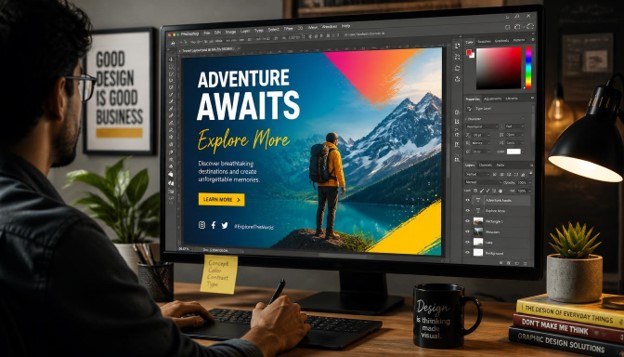
25 Amazing Photoshop Tips to Improve Your Designs and Fix Common Problems
Every designer hits the same walls in Adobe Photoshop. Edges look jagged, colors feel flat, files grow huge, and simple edits take far too long. The good news is that most of these problems have quick fixes.
This guide shares 25 practical Photoshop tips that help you work faster, design cleaner, and rescue projects that seem broken. Whether you are a beginner or a working professional, these Photoshop tips fit almost any workflow.
Each tip is short, actionable, and easy to test. You can read the article from top to bottom or jump straight to the problem you need to solve today.
Bookmark this page, because the best Photoshop tips are the ones you return to again and again.
Why Photoshop Tips Matter for Every Designer
Photoshop is deep. Even after years of use, most designers touch only a small part of what it can do.
Learning the right Photoshop tips saves hours every week. It also raises the quality of your work, because you spend less time fighting the software and more time making creative decisions.
Good habits like organizing layers, working non-destructively, and using shortcuts compound over time. Small Photoshop tips often create the biggest gains.
Below, the tips are grouped into five sections: workspace and workflow, selections and masks, retouching and color, design and typography, and export and automation.
Workspace and Workflow
1. Customize Your Workspace and Save It

A cluttered workspace slows you down. Go to Window > Workspace and choose a preset that matches your task, such as Photography, Graphics and Web, or Motion.
Then drag panels where you want them and save the layout with Window > Workspace > New Workspace. You can now reset it any time with a single click.
Many designers overlook this among Photoshop tips, yet it removes friction from every project. A tidy workspace also reduces eye strain during long sessions.
Keep only the panels you use daily, such as Layers, Properties, and Adjustments. Everything else can stay hidden until you need it. Building a workspace around your habits is one of the easiest Photoshop tips to apply today.
2. Learn Essential Keyboard Shortcuts

Shortcuts are the fastest way to speed up your work. Instead of hunting through menus, you trigger tools and commands in a fraction of a second.
Start with the basics. Ctrl/Cmd + J duplicates a layer, Ctrl/Cmd + T opens Free Transform, and Ctrl/Cmd + Z undoes your last step. Add Ctrl/Cmd + Alt/Option + Shift + E to stamp all visible layers into a new one.
Ask any veteran and they will name shortcuts as the most valuable of all Photoshop tips.
Learn five new shortcuts each week and practice them until they feel natural. You can also build custom keys under Edit > Keyboard Shortcuts. Over a month, these tiny Photoshop tips will noticeably shorten your editing time.
3. Use Smart Objects for Non-Destructive Editing

Resizing a normal layer again and again slowly destroys its quality. Each scale-down throws away pixels that you cannot get back.
Right-click a layer and choose Convert to Smart Object. Photoshop now stores the original data, so you can scale, rotate, and warp freely without losing sharpness.
Smart Objects also keep filters editable. Apply Gaussian Blur or Sharpen, and you can adjust or hide the filter later.
Among all Photoshop tips for quality control, this one prevents the most regret. Use it for logos, photos, and mockups.
If you place images with File > Place Embedded, they become Smart Objects automatically. That single habit is one of the smartest Photoshop tips for keeping projects flexible.
4. Use Adjustment Layers Instead of Direct Edits

Applying Brightness or Hue changes directly to pixels is permanent. Adjustment layers give you the same result with full control.
Click the half-black circle icon at the bottom of the Layers panel and choose an adjustment such as Curves, Levels, or Vibrance. Each one comes with its own mask, so you can paint the effect exactly where you want it.
You can lower the opacity, change the blend mode, or delete the layer whenever you like. Nothing in your original image is harmed.
Of all Photoshop tips for color work, this is the one professionals rely on daily. Repeat it on every project and your edits become far easier to revise.
Stacking several subtle adjustments usually looks better than one strong edit. These Photoshop tips reward patience.
5. Organize Layers With Names, Colors, and Groups

A file with 150 layers named “Layer 47” is a nightmare. Good organization saves you and your clients time.
Double-click a layer name to rename it. Press Ctrl/Cmd + G to group selected layers, and right-click to assign a color label such as red for text and blue for backgrounds.
Use groups for sections like Header, Content, and Footer. Collapse them when you are not working on them so the panel stays readable.
It may not sound exciting, but organization is one of the most underrated Photoshop tips. Handing off a clean PSD makes you look professional.
Search layers by name using the filter bar at the top of the Layers panel. Combined with naming, these Photoshop tips let you find any element in seconds.
Selections and Masks
6. Master Select Subject and the Object Selection Tool
Cutting out objects used to take forever. Today Photoshop can detect your subject with one click.
Choose Select > Subject and Photoshop uses AI to outline the main object. For more control, use the Object Selection Tool, draw a rough box around what you want, and let it snap to the edges.
Hold Shift to add to a selection and Alt/Option to subtract from it. Then refine with the Quick Selection Tool.
Selections are the foundation of compositing, and these Photoshop tips make them painless. Practice on photos with clear contrast first.
Once you feel confident, try complex images with hair or fur. Combining several Photoshop tips, such as Select Subject followed by Select and Mask, gives excellent results.
7. Refine Edges With Select and Mask

Rough cutouts are the biggest giveaway of a poor edit. Select and Mask helps you fix halos, jagged edges, and messy hair.
With a selection active, click Select and Mask in the top options bar. Use the Refine Edge Brush on hair and fuzzy edges, and adjust Smooth, Feather, and Shift Edge for a natural blend.
Turn on Decontaminate Colors to remove the colored fringe left from the old background. Output to a new layer with a layer mask for the safest workflow.
This is one of those Photoshop tips that turns an amateur cutout into a professional one. Take a minute to view your result on different backgrounds, both light and dark.
Using such Photoshop tips consistently will make your composites believable.
8. Use Layer Masks Instead of the Eraser
The Eraser tool deletes pixels forever. A layer mask hides them instead, and you can bring them back at any time.
Select a layer and click the Add Layer Mask button. Paint with black to hide areas, paint with white to reveal them, and use soft gray for partial transparency.
Press X to swap between black and white while painting. Use a soft brush for gentle transitions and a hard brush for crisp edges.
Non-destructive editing is a recurring theme among Photoshop tips, and masks are its best example. Every professional retoucher relies on them.
Try gradients on masks to blend two photos smoothly. These practical Photoshop tips instantly improve composites, shadows, and fades.
9. Use Clipping Masks for Clean Design Effects

A clipping mask makes one layer appear only inside the shape of the layer below it. It is perfect for placing photos inside text or shapes.
Place an image above a text or shape layer, then right-click it and choose Create Clipping Mask, or press Ctrl/Cmd + Alt/Option + G. The image now fills only the shape.
You can move the image around to choose the best crop, and the shape stays perfectly sharp. Add adjustment layers above and clip them too, so they affect only that one layer.
Designers love this trick for posters, thumbnails, and social graphics. It ranks high among Photoshop tips for creative layouts.
Try it with textures on lettering. Small Photoshop tips like this add polish with almost no effort.
10. Remove Distractions With Content-Aware Fill

Stray wires, people, or trash can ruin a great photo. Content-Aware Fill removes them and rebuilds the background automatically.
Draw a selection around the object with the Lasso Tool, expand it by a few pixels, then go to Edit > Content-Aware Fill. Check the green sampling area in the preview and adjust it if needed.
Output to a new layer so the edit stays reversible. For tiny blemishes, the Remove Tool or Spot Healing Brush is faster.
Removing distractions is among the most requested Photoshop tips from beginners. Results improve when your selection has a bit of breathing room around the object.
If the first attempt looks repetitive, try again with a different sampling area. Practicing these Photoshop tips builds confidence quickly.
Retouching and Color
11. Heal Blemishes With the Healing Brush and Clone Stamp
Skin blemishes, dust spots, and small flaws are easy to fix if you use the right tool for each job.
Use the Spot Healing Brush for small isolated marks. For larger areas or textured surfaces, use the Healing Brush, hold Alt/Option, and sample a clean area nearby.
The Clone Stamp is better when you need an exact copy of pixels. Always retouch on a separate empty layer and set the tool to Sample: Current & Below.
These are classic Photoshop tips for portrait work, and they keep skin looking natural instead of plastic. Keep brush hardness low and zoom in to about 100 percent.
Subtle edits beat heavy ones. Following these Photoshop tips prevents the over-smoothed look that clients dislike.
12. Fix Dull Colors With Curves

Flat, low-contrast images are one of the most common problems in digital photos and designs. Curves is the most powerful fix.
Add a Curves adjustment layer and pull the line into a gentle S-shape. Lift the highlights slightly and lower the shadows to add contrast without clipping detail.
You can also edit the Red, Green, and Blue channels separately to correct color or create a mood. Click the small hand icon to adjust tones directly on the image.
Learning Curves is one of the best Photoshop tips for anyone serious about color. It takes practice, but it rewards you with total control.
Keep adjustments small at first. Regular use of these Photoshop tips will train your eye to see tonal balance.
13. Use the Camera Raw Filter for Quick Enhancements
Even if your image is a JPEG or a flattened design, you can use the Camera Raw Filter. It gives you Lightroom-style sliders inside Photoshop.
Convert your layer to a Smart Object, then choose Filter > Camera Raw Filter. Adjust Exposure, Highlights, Shadows, Texture, and Clarity in one panel.
The masking tools inside Camera Raw let you brighten only the sky or the subject. Because you used a Smart Object, you can reopen the filter whenever you want.
This is one of the most efficient Photoshop tips for a quick, polished finish. It combines many separate edits into one place.
Add a subtle vignette or a bit of grain to finish. These beginner-friendly Photoshop tips can transform an average photo in minutes.
14. Correct Color Casts With the Gray Eyedropper
Indoor lighting often gives photos an unwanted yellow, green, or blue tint. Fixing it takes about ten seconds.
Add a Curves or Levels adjustment layer and pick the middle eyedropper, the gray point. Click on something in the image that should be neutral gray or white, and the tint disappears.
If the result is too cold or too warm, use Photo Filter or Color Balance to fine-tune it. Compare with the original by toggling the layer’s visibility.
Accurate color builds trust, especially in product photos. These Photoshop tips are essential for e-commerce and portrait work.
Try a few different sample points until it looks right. Practicing such Photoshop tips will make your images look consistent across a whole set.
15. Add Depth With Dodge and Burn

Dodging brightens and burning darkens. Together they shape light, add dimension, and make subjects stand out.
Create a new layer, fill it with 50 percent gray, and set the blend mode to Soft Light. Paint with a soft white brush at low opacity to lighten, and black to darken.
Use a flow of 5 to 10 percent and build the effect slowly. This method is fully reversible because the effect lives on its own layer.
Retouchers consider this one of the most artistic Photoshop tips in the entire program. It can sculpt faces, products, and landscapes.
Zoom out often to check the overall balance. When you master these Photoshop tips, your images will feel more three-dimensional.
16. Sharpen Smartly With the High Pass Filter
Standard sharpening filters can create ugly halos. High Pass sharpening keeps edges crisp and natural.
Duplicate your layer and convert it to a Smart Object. Go to Filter > Other > High Pass and set the radius between 1 and 3 pixels. Then change the blend mode to Overlay or Soft Light.
You can lower the opacity or add a mask to sharpen only the important areas, such as the eyes or product details.
This is a favorite among photographers and one of the most reliable Photoshop tips for final touches. Always sharpen at the end, after resizing.
If the image starts to look crunchy, reduce the radius. Repeating these Photoshop tips on every export improves clarity across your portfolio.
17. Reduce Noise in Low-Light Photos

Grainy photos are a common problem when shooting in low light. Photoshop offers a strong built-in fix.
Convert the layer to a Smart Object, then choose Filter > Noise > Reduce Noise. Increase Strength and Reduce Color Noise until the grain fades, then bring back detail with the Preserve Details slider.
For RAW-quality results, try Camera Raw’s Denoise feature in recent versions. It uses machine learning to clean noise while keeping textures.
Fixing grain quickly is among the most helpful Photoshop tips for event and night photography. Do not push the sliders too far or the image will look waxy.
Apply noise reduction before sharpening. Following these Photoshop tips in the right order gives the cleanest finish.
18. Use Generative Fill to Extend or Change Images
Generative Fill uses AI to add, remove, or replace content based on a text prompt. It is available in recent versions of Photoshop.
Make a selection with the Lasso or Marquee Tool, click Generative Fill in the contextual bar, and type what you want, such as “clear blue sky.” You can also leave the prompt empty to remove an object.
It is also great for extending a canvas. Use the Crop Tool to drag the edges outward, then click Generate to fill the new space.
Every generation creates a separate layer, so you can compare variations. Many creators now count this among the most exciting Photoshop tips.
Always review results at full size for odd details. Used carefully, these modern Photoshop tips can save hours of manual work.
Design and Typography
19. Use Character and Paragraph Styles for Consistent Text

Consistent text makes a design look professional. Styles let you apply the same formatting to many text layers at once.
Open Window > Character Styles and Paragraph Styles. Format a text layer the way you like, then click the plus icon to save it as a style. Apply it to other text layers with one click.
If you later edit the style, every layer using it updates automatically. That is a big time saver on brochures, menus, and web layouts.
Careful typography is one of the quiet Photoshop tips that separates polished layouts from rushed ones. Limit yourself to two or three fonts.
Adjust tracking and leading for readability. These simple Photoshop tips help your text look clean and intentional.
20. Align Perfectly With Guides, Smart Guides, and Grids

Misaligned elements are an instant sign of amateur work. Photoshop has several tools to keep everything neat.
Turn on View > Show > Smart Guides to see pink lines when objects align or share equal spacing. Drag guides from the rulers, or use View > New Guide Layout to create columns and margins.
Use the Align options in the top bar to line up selected layers, and Distribute to space them evenly. Turn on Snap so objects lock to guides.
Layout precision is one of the most practical Photoshop tips for web and print design. It creates balance and a clear visual hierarchy.
Leave generous white space between sections. These layout Photoshop tips make your designs easier to read and more attractive.
21. Create Depth With Layer Styles and Blend Modes

Layer Styles add shadows, strokes, glows, and gradients without permanent changes. Double-click a layer to open the Layer Style dialog.
Use Drop Shadow with low opacity and a large blur for a soft, realistic shadow. Add a subtle Gradient Overlay to give flat shapes some dimension.
Blend modes change how layers interact. Multiply darkens, Screen lightens, Overlay adds contrast, and Color applies hue. Cycle through them with Shift + plus or minus to see the effect live.
These are creative Photoshop tips for text effects, buttons, and lighting. Avoid overdoing them, since heavy effects can look dated.
Copy a style to other layers by right-clicking and choosing Copy Layer Style. Mastering these Photoshop tips will give your designs a modern, professional finish.
22. Design Logos and Icons With Vector Shapes

Pixels blur when scaled up, but vector shapes stay sharp at any size. That makes them ideal for logos, icons, and buttons.
Use the Rectangle, Ellipse, and Custom Shape tools with the mode set to Shape. Combine shapes with Path Operations, such as Unite, Subtract, and Intersect, to build unique forms.
Use the Pen Tool for custom curves. Keep paths simple, with as few anchor points as possible.
Working with vectors is one of the smartest Photoshop tips for anyone creating brand assets. You can also paste shapes from Illustrator as Smart Objects.
Export final logos as SVG or PNG for different uses. Applying these Photoshop tips keeps your branding crisp on screens and in print.
23. Save Time With Swatches and Creative Cloud Libraries

Using the same brand colors and assets across projects is easy with libraries. They keep everything in one shared place.
Open Window > Libraries and create a new library. Drag colors, character styles, logos, and graphics into it. They sync across Photoshop, Illustrator, and other Adobe apps.
You can also share a library with teammates so everyone uses the same approved assets. Save frequently used colors in the Swatches panel and organize them into groups.
Consistency builds brand recognition, which makes this one of the most business-friendly Photoshop tips. It also removes guesswork when picking hex codes.
Name your library items clearly. Small organizational Photoshop tips like these save minutes on every single project.
Export and Automation
24. Export Sharp Images With the Right Settings

Blurry exports and huge files frustrate clients. The right settings solve both problems.
Use File > Export > Export As for web images. Choose JPG for photos, PNG for graphics with transparency, and WebP for smaller files. Keep quality between 70 and 85 percent for a good balance.
Check your document size before exporting. For web, 72 PPI is enough, while print usually needs 300 PPI. Convert to sRGB so colors appear correctly in browsers.
Getting exports right is among the essential Photoshop tips for anyone who publishes online. Faster pages also help your website rank better.
Always zoom to 100 percent to check quality. Following these practical Photoshop tips prevents last-minute surprises.
25. Automate Repetitive Work With Actions and Batch

If you repeat the same steps on many images, let Photoshop do the work. Actions record your steps and replay them with one click.
Open Window > Actions, click New Action, and perform your edits while recording. Stop recording, then run the action on other files. To process a whole folder, use File > Automate > Batch.
Try actions for resizing, watermarking, sharpening, or applying a signature color grade. You can also use Image Processor to convert many files to JPG.
Automation is one of the most powerful Photoshop tips for busy professionals. It turns an hour of clicking into a few seconds.
Test your action on a single image first. These time-saving Photoshop tips are perfect for bloggers, photographers, and agencies.
Common Photoshop Problems and Quick Fixes
Even with great habits, problems pop up. Here are the most common ones and the fast solutions.
- Photoshop is running slowly: Increase the RAM allocation in Preferences > Performance, clear the cache, and merge or rasterize unused layers.
- Jagged edges on selections: Use Select and Mask, and add a small feather of 0.5 to 1 pixel.
- Blurry text or images: Check your document resolution and avoid scaling raster layers. Use Smart Objects.
- Colors look different after export: Convert to sRGB and check that your monitor is calibrated.
- File is too large: Delete hidden layers, flatten a duplicate copy, and save a compressed version for sharing.
Knowing a few troubleshooting Photoshop tips prevents panic when deadlines are close. Most issues come from settings, not from your skills.
Save a checklist of these fixes near your desk. Experienced designers use such Photoshop tips as a quick reference during busy projects.
Final Thoughts on Photoshop Tips
You now have 25 useful ways to work faster, edit smarter, and solve everyday design problems. You do not need to learn everything at once.
Pick three Photoshop tips from this list and use them on your next project. Once they feel natural, add three more.
Consistent practice is what turns these Photoshop tips into real skill. Over time, your designs will look cleaner, your files will stay organized, and your edits will take less time.
Remember that Photoshop rewards curiosity. Experiment, break things, and use the Undo command freely.
Keep this guide handy and share it with fellow designers. The more you apply these Photoshop tips, the more confident and creative you will become.
Frequently Asked Questions (FAQs)
What are the best Photoshop tips for beginners?
Start with layers, layer masks, and adjustment layers. Learn a handful of keyboard shortcuts, and use Smart Objects so your edits stay reversible. These basics support almost everything else you will do in the program.
How can I make Photoshop run faster?
Close unused documents, allocate more RAM in Preferences, and clear your cache regularly. Keep layer counts under control by merging or grouping layers. Using Smart Objects wisely and saving to a fast drive also helps.
What is the difference between a layer mask and the Eraser tool?
The Eraser permanently deletes pixels, while a layer mask only hides them. With a mask, you can paint white to bring the content back. That is why professionals prefer masks for nearly all edits.
How do I fix blurry images in Photoshop?
Use Filter > Sharpen > Smart Sharpen or the High Pass method for mild blur. Make sure you are not enlarging a small image too far. Sharpening cannot fully restore detail that was never captured, so start with the best source file available.
Are these Photoshop tips useful for professional designers too?
Yes. Many of these Photoshop tips, such as non-destructive editing, styles, and automation, are used daily by professionals. Even experts benefit from revisiting the fundamentals to work faster and stay consistent.
Which file format should I use to export from Photoshop?
Use JPG for photographs, PNG when you need transparency, and WebP for smaller web images. Choose PDF or TIFF for print. Always save a layered PSD copy so you can make changes later.
Graphics Design
Photoshop Brushes: 25 Powerful Brushes Every Designer Should Know to Avoid Common Mistakes (2026)
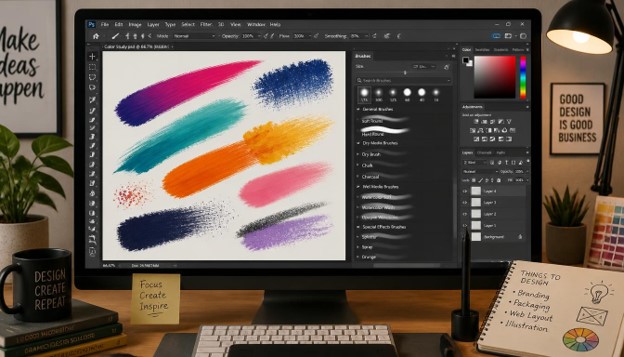
Photoshop Brushes: 25 Powerful Brushes Every Designer Should Know to Avoid Common Mistakes (2026)
If you have ever opened the Brush panel and felt overwhelmed by the sheer number of options, you are not alone. Photoshop Brushes are one of the most powerful tools inside Photoshop, yet most designers only ever use a tiny fraction of what these tools can actually do. The result is flat artwork, muddy textures, and hours wasted trying to fix mistakes that better brush choices could have avoided in the first place.
In this guide, we are going to walk through 25 of the most useful Photoshop Brushes that every designer, illustrator, and photo editor should have in their toolkit. Along the way, we will point out the common mistakes people make with Photoshop Brushes and show you how to avoid them. Whether you are retouching photos, designing concept art, building textures, or creating social media graphics, this list of Photoshop Brushes will give you a solid foundation to work from in 2026 and beyond.
Each brush type below comes with a short explanation of what it does, when to use it, and a quick tip to help you get better results. We have kept the paragraphs short and easy to scan, so you can quickly find the Photoshop Brushes that fit your current project without reading through walls of text.
What Are Photoshop Brushes and Why Do They Matter?
Photoshop Brushes are customizable tools that let you paint, draw, texture, and blend directly on your canvas. Unlike a plain round brush, a well-made brush can simulate watercolor, charcoal, fur, smoke, or even fabric stitching in a single stroke.
The difference between amateur-looking artwork and professional design often comes down to brush choice. A designer who understands Photoshop Brushes can add realism, depth, and mood to an image in seconds. Someone who ignores brush settings ends up with flat, lifeless results no matter how much time they spend.
Add short and concise paragraphs for better readability and UX. This is exactly why we have broken this article into small, scannable sections. Long blocks of text are hard to read on a screen, and readers scanning for Photoshop Brushes tips usually want quick, actionable answers rather than dense paragraphs.
Photoshop Brushes are not just for illustrators. Photographers use them for dodging and burning, retouchers use them for skin smoothing, and web designers use them to build textured backgrounds. Once you understand how brushes work, you will find new uses for them in almost every project.
Common Mistakes Designers Make With Photoshop Brushes
Before we get into the list, let’s talk about the mistakes that hold most people back when using Photoshop Brushes.
Mistake 1: Using default settings only. Many designers never touch the Brush Settings panel. They pick a brush, click it on the canvas, and move on. This ignores opacity jitter, scattering, and texture options that make Photoshop Brushes look natural instead of robotic.
Mistake 2: Ignoring pressure sensitivity. If you use a drawing tablet, failing to enable pen pressure for size and opacity is one of the biggest reasons strokes look stiff and uneven.
Mistake 3: Overusing hard round brushes. Hard edges work for some tasks, but relying on them for everything makes artwork feel flat. Mixing in textured Photoshop Brushes adds much-needed variation.
Mistake 4: Not organizing brush libraries. As you download more Photoshop Brushes, your panel can get cluttered fast. Without folders and clear naming, you waste time hunting for the right brush mid-project.
Mistake 5: Skipping brush resolution checks. Some brushes look great at low zoom but pixelate badly when scaled up for print. Always check a brush’s native resolution before committing to a large canvas.
Mistake 6: Forgetting to save custom presets. If you spend time tweaking a brush to get the perfect scatter and texture, save it as a preset. Otherwise, you will have to redo that work every single time.
Keep these mistakes in mind as you go through the list below. Each brush category comes with tips to help you sidestep these exact problems.
25 Powerful Photoshop Brushes Every Designer Should Know

1. Sketchy Pencil Brush
This is one of the most versatile Photoshop Brushes for concept artists and illustrators. It mimics the texture of graphite on paper, complete with slight grain and pressure-sensitive line weight.
Use it for quick thumbnails, rough layouts, or adding a hand-drawn feel to digital work. Pair it with a textured paper layer for an even more authentic look. Many designers keep this among their most-used brush types simply because it’s fast to sketch with and easy to erase cleanly during the planning stage of a project.

2. Watercolor Splash Brush
Watercolor brushes are among the most popular Photoshop Brushes because they add organic, unpredictable texture that is nearly impossible to fake with solid fills.
They work best when you lower the opacity and layer multiple strokes on top of each other. This builds up realistic pigment pooling, just like real watercolor paint. For book covers, invitations, and greeting cards, this style of brush has become a go-to choice because it instantly softens an otherwise digital-looking design.
3. Chalk Texture Brush
Chalk brushes give you a soft, slightly rough edge that’s perfect for vintage posters, hand-lettering, and rustic branding projects.
This brush type is great for adding texture to typography without needing a separate texture layer.
4. Charcoal Brush
Charcoal brushes produce heavy, expressive strokes with natural smudging. Among Photoshop Brushes, this one is a favorite for dramatic portrait sketches and moody concept art.
Combine it with the Smudge tool for even more realistic blending between light and shadow areas. Portrait artists often reach for this brush before switching to cleaner tools for final detailing, since the loose charcoal texture is ideal for blocking in values quickly.
5. Ink Splatter Brush
Ink splatter brushes add chaotic, organic energy to a design. They’re commonly used in grunge posters, band merchandise, and editorial illustration.
Because splatter patterns repeat if used carelessly, rotate and scale the brush between strokes to keep the pattern looking random and natural.

6. Smoke Brush
Smoke brushes are essential for anyone doing atmospheric compositing work, from movie posters to album covers. Good smoke brushes among Photoshop Brushes include soft edges and varied density.
Layer several smoke strokes at different opacities and blend modes like Screen or Lighten for the most convincing results. This makes smoke one of the more technically demanding brush types to master, but also one of the most rewarding once you get the layering right.
7. Cloud Brush
Cloud brushes save enormous time when building skies for matte paintings or landscape composites. Rather than painting every wisp by hand, a good cloud brush gives you a realistic base to build on.
Always match the light direction of your cloud brush strokes to the rest of your scene, or the composite will look off.
8. Grass and Foliage Brush
Foliage brushes let you quickly populate a landscape with grass, leaves, and shrubs. These are some of the most time-saving Photoshop Brushes for environment artists and photo editors.
Vary the size and rotation of each stroke to avoid an obvious repeating pattern. Landscape and environment artists rank foliage among the most time-saving brushes in their entire library, since manually painting individual leaves would take hours.
9. Hair Brush
Hair brushes are indispensable for portrait retouching and character illustration. They allow you to add fine, wispy strands that would take forever to paint manually with a standard round tip.
Set the brush to follow pen tilt and rotation if your tablet supports it, so each strand flows naturally with your hand movement.
10. Fur Brush
Similar to hair brushes, fur brushes simulate the texture of animal coats. These are popular Photoshop Brushes among character designers and creature artists.
Layer light and dark fur strokes to build volume, then finish with a few stray hairs along the silhouette edge for realism.

11. Splatter Paint Brush
Paint splatter brushes add bold, energetic marks that work well in sports branding, streetwear design, and music promotion graphics.
Because these brushes can look repetitive, always mix in at least two or three different splatter variations in a single design.
12. Grunge Texture Brush
Grunge brushes simulate scratches, dirt, and worn surfaces. They’re one of the most requested categories of Photoshop Brushes because they instantly age a design and add character.
Apply grunge texture on a separate layer set to Multiply so it interacts naturally with the colors beneath it. Streetwear and music merchandise designers lean on this texture constantly, since a worn, distressed look has stayed popular across multiple design trends over the years.
13. Light Leak and Lens Flare Brush
These brushes simulate the warm, hazy light leaks seen in analog photography. They’re a fast way to give digital photos a nostalgic, cinematic look.
Keep opacity low and place light leaks near a light source in the image so the effect looks believable rather than pasted on.
14. Snow and Rain Brush
Weather brushes let you add falling snow or rain streaks without manually painting thousands of individual particles. These practical Photoshop Brushes are widely used in seasonal marketing graphics.
Vary the brush size slightly between layers to create a sense of depth, with larger flakes or drops appearing closer to the viewer.
15. Fire and Flame Brush
Fire brushes are tricky to get right, but a well-made one saves huge amounts of time compared to painting flames by hand.
Use warm color layers underneath with a Screen blend mode, and always add a subtle glow layer behind the flame shapes for realism. Movie poster artists and album cover designers often build fire effects from several overlapping stroke variations rather than a single pass, since real flames rarely hold one consistent shape for long.

16. Dust and Particle Brush
Dust brushes add tiny floating specks that catch the light, which is a small detail that makes a huge difference in atmospheric compositions.
Scatter these particles more densely near light sources and sparsely elsewhere to mimic how dust behaves in real environments. A subtle motion blur applied to a duplicate particle layer can also help sell the illusion of depth, since faraway specks appear softer than ones close to the camera.
17. Concept Art Rock Brush
Rock and stone texture brushes are a staple for environment concept artists. They let you rough in cliffsides, boulders, and terrain quickly during the early stages of a piece.
Rotate and flip the brush frequently so repeated rock shapes don’t create an obviously tiled look across your terrain. These texture sets pair particularly well with a grungy overlay, which helps break up any remaining repetition and adds extra grit to cliff faces and canyon walls.
18. Cross-Hatching Brush
Cross-hatching brushes replicate the fine, overlapping line technique used in traditional pen-and-ink illustration. They’re excellent for comic book shading and editorial illustration styles.
Adjust line spacing and angle in the Brush Settings panel to control how dark or light the shaded area appears. Comic artists and editorial illustrators often keep several angle variations of this brush saved, treating it as one of the core Photoshop Brushes in their shading workflow.
19. Halftone Brush
Halftone brushes create the dotted pattern associated with vintage comics and screen printing. This style remains popular in modern streetwear and poster design.
Keep dot size consistent across a single design element, but vary spacing to create gradients of light and shadow. This effect works especially well on apparel graphics and gig posters, where a retro print aesthetic is often the whole point of the design.
20. Stitch and Fabric Brush
Stitch brushes simulate sewing lines and fabric textures, which is useful for mockups, patches, and apparel design projects.
Combine a stitch brush with a subtle drop shadow to make the thread appear slightly raised off the fabric surface. This small touch of dimension is often what separates a convincing apparel mockup from one that reads as obviously flat and digital.
21. Calligraphy Brush
Calligraphy brushes bring elegant, variable-width strokes to hand-lettering projects. These are some of the most refined Photoshop Brushes available, closely mimicking real brush pens and nibs.
Practice consistent pressure control, since uneven pressure is the most common reason digital calligraphy looks shaky compared to real ink work. Slowing down your stroke speed also helps, since rushing tends to produce thin, inconsistent lines that break the illusion of a real brush pen.

22. Abstract Geometric Brush
Geometric pattern brushes let you stamp shapes like triangles, hexagons, or dot grids quickly across a canvas. They’re useful for modern branding and background design.
Set these brushes to scatter along the path so the pattern feels dynamic rather than mechanically repeated. Try combining two contrasting shapes, like circles and triangles, on separate layers to build a more layered, modern pattern instead of relying on a single repeated motif.
23. Wood Texture Brush
Wood grain brushes add convincing texture to furniture mockups, rustic branding, and packaging design. They save the trouble of photographing or sourcing separate wood texture images.
Rotate the grain direction to follow the form of the object you’re texturing for a believable result. Adding a soft highlight layer along raised edges will also help sell the illusion of a real, physical wood surface rather than a flat digital pattern.
24. Skin Retouching Brush
Soft, low-opacity retouching brushes are essential in portrait photography workflows. They allow subtle smoothing without erasing natural skin texture entirely.
Always work on a duplicate layer with reduced opacity so retouching stays soft and doesn’t create an artificial, plastic look. Zoom out periodically while retouching, since smoothing that looks fine up close can appear excessive once you view the full image at normal size.
25. Starburst and Sparkle Brush
Sparkle brushes add small highlights and glints of light, commonly used in beauty, jewelry, and fashion photography retouching.
Use them sparingly. A handful of well-placed sparkles looks intentional, while too many scattered across an image looks cluttered. Placing sparkles along the edges of jewelry, glassware, or wet surfaces tends to look far more natural than scattering them randomly across the entire frame.

How to Choose the Right Photoshop Brushes for Your Project
With thousands of options available online, picking the right Photoshop Brushes can feel overwhelming. The key is to think about the outcome you want before you start browsing brush packs.
If you’re working on a photo-realistic composite, look for Photoshop Brushes with natural texture variation, like the smoke, cloud, or dust brushes covered earlier. These add believable atmosphere without requiring you to hand-paint every detail.
If your project leans toward branding or typography, calligraphy, grunge, and geometric brushes tend to be more useful. These Photoshop Brushes give you clean, controllable strokes that still carry personality and texture.
For illustrators working in concept art or character design, prioritize brushes with strong edge control, like the sketchy pencil, charcoal, and cross-hatching sets. These Photoshop Brushes give you the flexibility to move between loose sketching and detailed rendering in the same file.
It also helps to think about file size and performance. Extremely high-resolution Photoshop Brushes can slow down your canvas, especially when you’re stacking dozens of strokes on a single layer. If you notice lag, try flattening completed sections before continuing.
Finally, consider your own workflow speed. Some designers prefer a smaller set of versatile Photoshop Brushes they know inside and out, while others like having a huge library to pull from for every possible scenario. Neither approach is wrong, but knowing your own habits will help you build a collection that actually gets used instead of sitting untouched in a folder.
Photoshop Brushes for Different Design Niches
Different fields of design tend to gravitate toward different categories of Photoshop Brushes. Here’s a quick breakdown of what works best where.
Photography and retouching. Photographers rely heavily on soft, low-opacity Photoshop Brushes for dodging, burning, and skin smoothing. Sparkle and light leak brushes are also popular for adding a finished, editorial look to portrait work.
Illustration and concept art. Illustrators reach for sketchy pencil, charcoal, and cross-hatching brushes during the early stages of a piece, then switch to smoke, cloud, and foliage brushes when building out environments and atmosphere.
Branding and marketing. Marketing designers often use grunge, splatter, and calligraphy Photoshop Brushes to give otherwise clean, corporate layouts a more human, handcrafted feel. This is especially common in streetwear, food and beverage, and lifestyle branding.
Game and environment art. Concept artists building game worlds depend on rock, foliage, and fur brushes to quickly rough in terrain, vegetation, and creature designs before moving into detailed rendering.
Social media and content creation. Content creators frequently use snow, rain, and sparkle Photoshop Brushes to add seasonal or festive touches to thumbnails, banners, and promotional graphics without needing to source separate stock overlays.
No matter which niche you work in, the underlying principle stays the same: understanding how Photoshop Brushes behave under different settings will always produce better results than clicking a random brush and hoping for the best.
How to Install and Organize Photoshop Brushes
Once you’ve collected a solid set of Photoshop Brushes, installation is simple. Open the Brush Settings panel, click the menu icon, and choose Import Brushes. Select the .abr file you downloaded, and the new brushes will appear in your panel.
Organization matters more than most people realize. Create folders by category, such as Texture, Nature, Lettering, and Retouching. This makes it much faster to find the right brush when you’re in the middle of a project instead of scrolling through hundreds of thumbnails.
It’s also worth deleting brushes you never use. A cluttered brush panel filled with Photoshop Brushes you downloaded once and forgot about only slows you down.
Consider setting up a naming convention as well. Prefixing files with a category, like “TEX_grunge01” or “NAT_foliage03,” makes searching the panel far faster than scrolling through generic default names. If you work across multiple projects or clients, you might even keep separate brush libraries saved as individual .abr files, so you can load only the set relevant to the job at hand instead of cluttering your main panel with everything at once.
Backing up your brush library is another step people tend to skip until it’s too late. Store your .abr files in a cloud folder or external drive, especially if you’ve spent hours fine-tuning custom presets. Losing a carefully built collection to a computer crash or failed update is a frustrating, avoidable setback.
Photoshop Brush Shortcuts and Workflow Tips
Speed matters when you’re deep into a project, and a few keyboard shortcuts can save you significant time when switching between brush tools.
Pressing the bracket keys, [ and ], quickly decreases or increases brush size without needing to open any panel. Adding Shift to either bracket adjusts hardness instead, which is useful when moving between soft blending strokes and crisp detail work.
The number keys control opacity in ten percent increments, so tapping 5 instantly sets opacity to fifty percent. This is much faster than dragging a slider, especially when you’re building up layered textures like smoke or watercolor effects.
Holding Alt while clicking with a brush tool active temporarily switches to the Eyedropper, letting you sample a color from your canvas without switching tools manually. This is especially handy when working with skin tones during retouching or blending multiple texture layers together.
If you frequently reuse a specific combination of size, opacity, scatter, and texture settings, save it as a Tool Preset. This locks in your configuration so you can jump straight back into a familiar workflow instead of rebuilding settings from scratch every session.
Finally, get comfortable with the Brush Settings panel’s preview window at the bottom. It shows you exactly how your current settings will behave before you commit a single stroke to the canvas, which can save a lot of trial and error, especially with more complex texture-based tools.
Building these habits into your daily workflow pays off over time. What feels slow and deliberate at first becomes second nature after a few weeks of consistent practice, and you’ll find yourself reaching for the right tool almost automatically.
Tips for Getting the Most Out of Your Photoshop Brushes
Short paragraphs make this section easy to scan, so here are quick, practical tips you can apply right away:
- Always test a new brush on a blank layer before committing it to your main artwork.
- Adjust opacity jitter and size jitter in Brush Settings to avoid repetitive-looking strokes.
- Use a graphics tablet with pressure sensitivity whenever possible, since mouse-drawn strokes rarely look as natural.
- Save your favorite brush combinations as tool presets so you don’t have to reconfigure settings every session.
- Group similar Photoshop Brushes into folders so your panel stays organized as your collection grows.
- Check brush resolution before scaling artwork up for print to avoid pixelation.
- Rotate, flip, and resize texture brushes between strokes to prevent an obvious repeating pattern.
Following these habits will help you avoid the most common mistakes designers make and get consistently better results from any set of Photoshop Brushes you use.
It’s also worth revisiting your brush settings periodically. As you grow more comfortable, you’ll likely find new combinations of scatter, texture, and dual-brush settings that give your Photoshop Brushes an even more personalized feel. Many professional designers spend as much time refining brush behavior as they do actually painting, because a well-tuned brush can cut editing time dramatically.
Don’t be afraid to combine multiple Photoshop Brushes within the same piece of artwork. A landscape composite, for example, might use cloud brushes for the sky, foliage brushes for the ground, and dust particle brushes for atmosphere, all layered together with different blend modes. Mixing brush types is often what separates a flat digital painting from one that feels layered and dimensional.
Brush Presets vs. Custom Textures: Which Should You Use?
A common question designers run into is whether to rely on premade brush packs or build custom textures from scratch. Both approaches have a place, and understanding the trade-offs will help you decide which fits a given project.
Premade brush packs are fast. You can download a set, import it, and start painting within minutes. This is ideal for tight deadlines or exploratory work, where you need believable texture without spending hours crafting it yourself. High-quality packs from experienced artists also tend to include thoughtful scatter and jitter settings already dialed in, which saves you the trial and error of building those settings from zero.
Custom textures, on the other hand, give you full creative control. If you’re working on a signature style or branding for a client, a set of hand-built brushes can produce a look that no one else has access to. This matters most in competitive fields like editorial illustration or packaging design, where standing out visually is part of the job.
A practical middle ground many professionals land on is starting with premade brush sets and modifying them. Import a texture pack, then tweak the shape dynamics, scatter, and color dynamics settings until the strokes feel like your own. This gives you the speed of a ready-made resource with a layer of personalization that keeps your work from looking identical to everyone else using the same download.
If you do decide to build your own texture from scratch, start simple. Photograph or scan a real-world surface, like crumpled paper, tree bark, or fabric, then clean it up in Photoshop and define it as a brush preset. Natural, photographed textures often look more convincing than purely digital ones because they carry authentic imperfections that are hard to replicate by hand.
Whichever route you choose, keep testing on real projects. A texture that looks great in an isolated preview swatch doesn’t always behave the same way once it’s layered into a full composition with other elements, lighting, and color grading applied.
Final Thoughts
Photoshop Brushes are one of the most underrated tools in a designer’s kit. The difference between a flat, uninspired design and a polished, professional one often comes down to which brushes you reach for and how well you understand their settings.
The 25 brushes covered in this guide represent a well-rounded toolkit that covers illustration, photo retouching, texture work, and typography. Start by downloading a few categories that match your current projects, experiment with the settings, and build your own personal library of go-to Photoshop Brushes over time.
Avoiding the common mistakes we outlined, like relying only on default settings or skipping resolution checks, will save you time and frustration. With the right set of Photoshop Brushes and a bit of practice, you’ll notice a real difference in the depth and realism of your work.
Design trends shift constantly, but the underlying value of understanding your tools never really goes out of style. Software updates may add new panels, new AI-assisted features, and new shortcuts over the years, yet the fundamentals covered in this guide, choosing the right texture, adjusting settings thoughtfully, and organizing your library, will remain useful no matter how the interface changes around them.
If you’re just getting started, don’t feel pressured to master all 25 categories at once. Pick two or three that align with your current projects, spend a week or two really learning their settings, and expand from there. Skills built slowly and deliberately tend to stick far better than trying to absorb everything in a single afternoon.
Bookmark this guide and come back to it whenever you’re starting a new type of project. Having a quick reference for which brush category fits which situation can shave real time off your workflow, letting you spend less time hunting through menus and more time actually creating.
Frequently Asked Questions About Photoshop Brushes
- Where can I download free Photoshop Brushes? Many design communities and marketplaces offer free brush packs, including sites dedicated to digital art resources. Always check the license before using downloaded Photoshop Brushes in commercial projects.
- Are Photoshop Brushes compatible across different Photoshop versions? Most .abr brush files work across recent Photoshop versions, though very old brush sets may need reformatting. It’s a good idea to test new Photoshop Brushes after any major software update.
- Can I create my own custom Photoshop Brushes? Yes. You can turn any image or texture into a brush using the Edit menu’s “Define Brush Preset” option. This is a great way to build unique Photoshop Brushes tailored to your personal style.
- Why do my Photoshop Brushes look pixelated when I zoom in? This usually happens when a brush’s native resolution is lower than your canvas size. Always check the pixel dimensions of a brush before using it on a large or print-ready file.
- How many Photoshop Brushes should I actually keep in my library? There’s no fixed number, but quality matters more than quantity. A focused library of 50 to 100 well-organized Photoshop Brushes is usually more useful than thousands of unsorted, rarely-used ones.
- Do Photoshop Brushes work with a mouse, or do I need a tablet? Photoshop Brushes work with a mouse, but a pressure-sensitive tablet gives far more natural results, especially for texture and lettering brushes that rely on varying stroke width.
- What’s the biggest mistake beginners make with Photoshop Brushes? The most common mistake is never opening the Brush Settings panel. Default settings rarely produce the best results, and small adjustments to scatter, jitter, and texture can dramatically improve how natural your strokes look.
- Can Photoshop Brushes slow down my computer? Very large or high-resolution Photoshop Brushes can affect performance, especially on older machines. If you notice lag while painting, try flattening layers periodically or lowering the brush’s spacing setting to reduce processing load.
- Are paid Photoshop Brushes worth buying over free ones? Paid brush packs are often more polished and better organized, but plenty of free Photoshop Brushes are just as capable for everyday design work. It usually comes down to whether you need a specific, highly refined effect or a general-purpose set.
-

 Graphics Design3 years ago
7.Exploring the Importance of Color Theory Charts
-

 Graphics Design1 year ago
Top 10 Best Graphic Design Tools for Beginners in 2025 (Free & Paid)
-

 Graphics Design2 years ago
10 Stunning Gradient Design Trends You Need to Know in 2024
-

 Graphics Design1 year ago
15 Freelance Graphic Design Tips to Boost Your Career in 2025
-

 Graphics Design2 years ago
29.Retro Design Is Making a Comeback in Modern Spaces
-

 Graphics Design1 year ago
Best Laptops for Graphic Designers – 2025 Buying Guide
-

 Graphics Design2 years ago
2025 Logo Design Trends: What’s In, What’s Out?
-

 Graphics Design2 years ago
15.The Importance of Effective Flyer Design in Marketing
jalalive 2
June 26, 2025 at 3:54 am
This gave me a whole new perspective on something I thought I already understood. Great explanation and flow!
situs bodong
June 26, 2025 at 5:58 pm
I truly appreciate your technique of writing a blog. I added it to my bookmark site list and will
spotbet
June 27, 2025 at 5:29 am
This is exactly the kind of content I’ve been searching for.
jalalive 2
June 28, 2025 at 6:24 am
This post cleared up so many questions for me.
jala live gratis
June 28, 2025 at 6:53 am
This gave me a whole new perspective on something I thought I already understood. Great explanation and flow!
jalalive 22
June 28, 2025 at 7:21 am
You write with so much clarity and confidence. Impressive!
jalalive 2
June 28, 2025 at 7:50 am
This was really well done. I can tell a lot of thought went into making it clear and user-friendly. Keep up the good work!
jala live
June 28, 2025 at 8:18 am
I wasn’t sure what to expect at first, but this turned out to be surprisingly useful. Thanks for taking the time to put this together.
jala live
June 28, 2025 at 8:43 am
I enjoyed your perspective on this topic. Looking forward to more content.
jalalive 2
June 28, 2025 at 9:10 am
I wasn’t expecting to learn so much from this post!
jala live gratis
June 28, 2025 at 9:37 am
Your passion for the topic really shines through.
jalalive 2
June 28, 2025 at 10:04 am
What I really liked is how easy this was to follow. Even for someone who’s not super tech-savvy, it made perfect sense.
omega89
June 28, 2025 at 10:19 am
For the reason that the admin of this site is working, no uncertainty very quickly it will be renowned, due to its quality contents.
jala live gratis
June 28, 2025 at 10:31 am
You’re doing a fantastic job with this blog.
jala live
June 28, 2025 at 10:59 am
I never thought about it that way before. Great insight!
jalalive world cup
June 28, 2025 at 11:27 am
This content is gold. Thank you so much!
jalalive world cup
June 28, 2025 at 11:56 am
I love how practical and realistic your tips are.
jalalive 22
June 28, 2025 at 12:21 pm
Very useful tips! I’m excited to implement them soon.
buaya77
June 30, 2025 at 9:52 am
I do not even understand how I ended up here, but I assumed this publish used to be great