
Graphics Design
Breaking Down the 7 Key Steps of the Graphic Design Process

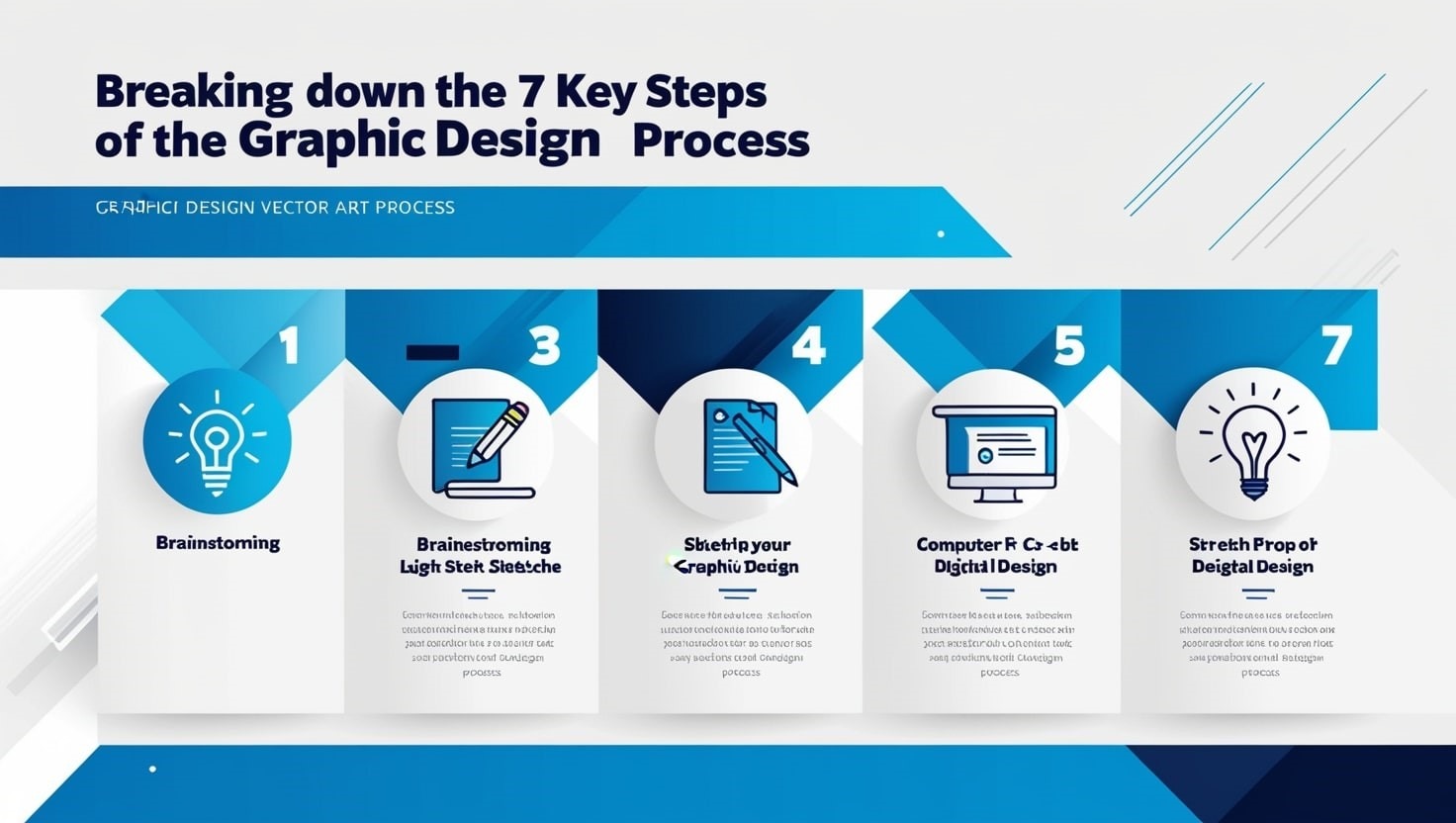
Breaking Down the 7 Key Steps of the Graphic Design Process
Graphic design process is a lot more than just having eye pleasing visuals. It is a rigmarole on creativity, the formulation of plans and then solving the procedural problems in order to achieve an effective visual communication tool. Both your logo design, website design or your marketing campaign strategies will follow some graphic design steps for proper and appealing outcome. In this post, we shall take our time to explain to you seven critical stages in the graphic design process that any professional graphic designer goes through to come up with a quality design.
Outline of the Article
- Introduction
- Step 1: Defining the Project Brief
Understanding Client’s Needs
Key Components of a Design Brief
- Step 2: Research and Discovery
Market Research
Competitor Analysis
Audience Understanding
- Step 3: Brainstorming and Concept Development
Idea Generation
Sketching Initial Concepts
5.Step 4: Creating a Rough Draft
Wireframes and Layouts
Drafting with Software
- Step 5: Design Development and Refinement
Fine-tuning the Design
Getting Feedback
- Step 6: Client Review and Feedback
Presenting Designs to Clients
Managing Feedback and Revisions
- Step 7: Final Delivery and Launch
Preparing the Final Files
Launching the Design into the Market
- The Importance of Flexibility in the Design Process
- Common Pitfalls in the Graphic Design Process
- How to Communicate Effectively with Your Client
- Why Iteration is Key in Graphic Design
- Conclusion
Introduction
Graphic design process basically is the ability to portray information with the help of graphics where elements have to be combined in the right manner. But of course, if you’ve ever drawn something from scratch, you will understand that it’s not as simple as it looks. Designing a professional graphic design is not a mere act of opening design software and start working on creating a masterpiece. The author presents procedures that guarantee each design achieves its goal and makes an impact to the target group. Here are the seven steps to the process of designing for graphics to provide an understanding of the necessary action that go into transforming these ideas into actuality.
Step 1: Defining the Project Brief

The initial task when it comes to graphic design process is essentially to set out the goals of the project, in what can be referred to as the project brief. This step may be often strategic for the entire project, and therefore, should be done to perfection for the best results.
Understanding Client’s Needs
Graphic design process anything, before speaking of colors, or fonts, or layout, the designer must first know what both the client and the product wants. This entails collection of information concerning the project’s objectives, target users, intended goals and expected achievements. In most cases the clients may not even be clearly aware of what they need until there is someone to ask them the right questions.
Key Components of a Design Brief
A good design brief should include the following:A good design brief should include the following:
Project scope: Now the question is what exactly has to be designed?
Objectives: What is the purpose of design overall?
Target audience: For whom is the design?
Budget and timeline: Is there anything that would limit me in some ways?
Step 2: Research and Discovery:

From the above brief, you add onto it and that takes you to the **research and discovery** section. It assists designers as they get to discover more about the context of the project, the scope of the industry, and the intended receivers.
Market Research
In this manner, how and what you want your new sofa, bed, wardrobe or breakfast nook to look like can be well informed by how they are made and the current trends in design today. This can be especially useful to discover what is effective from the perspective of visual presentation and what is not.
Competitor Analysis
It is necessary to observe what others are doing in the research of competitors is part of the research. It assists in knowing areas in the market that remain uncovered or areas that the client can set himself apart viscerally.
Audience Understanding
Graphic design process can always serve different purposes and touching on the need to understand your audience is very important when designing. Are you creating for the young adults? Professionals? Families? Being aware of who is going to view the design radically alters the kind of design that one is going to create.
Step 3: Ideas Generation and Conceptualization

Having your research in front of you, it is high time to begin **idea generation or concept formulation**. This is where creativity comes into the picture.
Idea Generation
Begin with the generation of ideas in which you can write down all the possibilities of ideas at first glance absurd. But how many items are, thus, placed on sale initially still matters more than the quality of the items offered. This means that the more you have available concepts and ideas the more likely you are to realize a particular concept that is good.
Sketching Initial Concepts
After you have a list of a few ideas, begin creating somewhat more crude concepts. These can be as simple as a few hasty sketches with pencil as well as even fundamental digital work sketches. The aim is to see how your ideas will look like when implemented or can be implemented in real life.
Step 4: Creating a Rough Draft
Following brainstorming you proceed to the next step or this process which is the **rough draft**. Ideas that you have at first are here starting to become more concrete.
Wireframes and Layouts
Specifically, in the case of more complex design solutions, such as website or application design, the wireframes are the perfect tools for the preliminary analysis of the structure and placement of the elements without getting lost in the nuances, such as color and typography. Specifically, for simple regions such as logos, a conceptual sketch can be less descriptive than rough form findings.
Drafting with Software
When you are satisfied with the sketches and wireframes, you can proceed to the graphical representation of your plans on graphic software such as Illustrator, Photoshop or Figma among others. This is where your ‘works in progress’ turn more into refined pieces of writing.
Step 5: Design Development and Refinement
The next step is polishing and building on the draft that is just created in order to have a final result. This step revolves around refining your concepts or ideas which you have come up with initially.
Fine-tuning the Design
This is where you come up with details. While resizing some letters and changing the color or the position on the page, the ultimate idea as for every kind of design is really simple and that is to make it as visually appealing as possible.
Getting Feedback
Here it is important to receive the approval of the client or other designers if any were involved in the project. Evaluating someone else’s work is always different from evaluating your own work and this might mean that a fresh set of eyes will detect problems that you might have overlooked during the drafting process.
Step 6: Client Review and Feedback

After you have fine tuned the design you then proceed to the **clients review**. As you noticed it is very important to present your design in a manner that interferes with constructive criticism.
Presenting Designs to Clients
When presenting designs, it is important that the steps followed in producing the designs are explained to the clients. Give reasons for the specific decisions made during the design process and how the decisions provided meets the objectives from the brief.
Managing Feedback and Revisions
This is true because clients will always make some requests or change which is perfectly acceptable. The most important principle is to be ready to receive criticism and use it for enhancement of the design. The only caution with this is to remember to always fulfill the client’s directives as well as incorporating your judgment.
Step 7: Final Delivery and Launch
After some modifications you are now set for **final delivery **and **launch**.
Preparing the Final Files
After the client has agreed on the design, finalize the files in each of the suitable formats. This could be as simple as exporting logos in different formats (PNG, JPG, SVG etc. ) or making sure that web design is set for development.
Bringing the Design in to the Market
Graphic design process last one of them is to make sure that the design is correctly implemented across all the organization’s units and processes. In print designs it may require the interaction with a printer while in digital designs it may involve engaging with developers in order to confirm that all functions correctly.
Flexibility as an Aspect in Design Process
Graphic design process above sequences depict that no design process is ever 100 percent linear. It is useful here, to use the step-wise approach flexibly, especially as more information is collected in the process or feedback is received from clients. I think that flexibility should be the keynote to supply idea, in order to design effectively.
Getting to the Identity – Common Pitfalls in the Graphic Design Process
Despite the use of the systematic approach it is possible to stumble upon some common mistakes. These are for instance failing to conduct research, inadequate communication with the client or inadequate time spend for revisions. Mentioned above are some of the challenges that you can learn and avoid them.
Effective Communication Strategies with Your Client

This implies that the process of communication is a critical element in the whole graphic design process. It is also important to involve the client at each step of the process especially when submitting working papers or seeking his or her input. That is why communication, or lack thereof, can be such a huge timesaver or time waster at the same time.
Why it iteration is good in Graphic design
Graphic design process **reiterative** in the most basic and profound senses of that term. It is for this reason that most times a design will have some form of imperfection on its first implementation. Rereading and editing your work will make you discover some ways that you could improve the work that you could not discover when creating the work.
Conclusion
Graphic design process can be defined as a complex procedure of creating more than just visual appearance of an object that is still rather a systematic sequence of actions that demand not only imagination but also critical thinking and efficient collaboration. Every stage of the process starting from the definition of the brief and ending in the delivery contributes a lot to the success of the given project. Adhering to these seven steps of the process means that you will create and deliver better and more effective designs that will suit the needs of your client as well as your own requirements.
FAQs
- Which stage of the Graphic design process seems to be the most vital to a graphic designer?
The most critical of them all is the identification of the project brief since it will act as a guide to the rest of the project.
- It also made me wonder how long does a typical graphic design project take?
That, of course, depends on the specifics of the issue but generally the design of one or another project takes several days to several weeks for a standard design project.
- Is it possible for a design brief to shift during the course of the process?
Of course, it can be done, if the brief is mutable when new information becomes available and is processed.
where the situation is significantly different, these changes should be very well communicated.
- That is a question that will be answered as we go through the article, which outlines the most often used tools employed by the graphic designers.
That includes Adobe Creative Suite of products including Illustrator, Photoshop and InDesign, Figma, Sketch among others. These tools assist the designers to realise their creativity in the best manner possible.
Graphics Design
Modern Logo Design in Illustrator: Build a Clean and Memorable Brand Identity (2026)
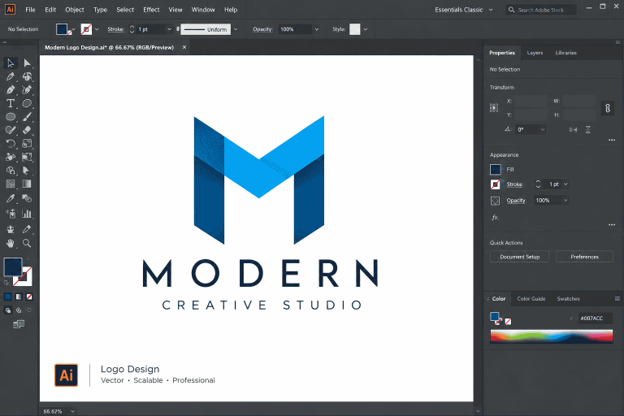
Modern Logo Design in Illustrator: Build a Clean and Memorable Brand Identity (2026)
Every strong brand starts with a simple mark that people recognize in a second. In 2026, Logo Design in Illustrator is still the most trusted way to create that mark. Adobe Illustrator gives you sharp vector shapes, precise typography and flexible color control in one workspace.
This guide walks you through logo design in Illustrator from the first idea to the final export. You will learn the tools, the workflow and the design rules that professionals use every day. Every section is short and practical, so you can follow along and apply each step right away.
Whether you are a beginner or a freelancer who wants a cleaner process, this tutorial will help you build a logo that looks professional and stays memorable. Let’s get started.
Why Illustrator Is the Industry Standard for Logo Design

Illustrator is built on vector graphics. A vector is a shape defined by math, not by pixels, so it stays sharp at any size. That is exactly what a brand needs. This is the first reason logo design in Illustrator remains popular with agencies and freelancers.
A logo might appear on a tiny app icon in the morning and on a giant billboard by night. With Logo Design in Illustrator, the same file works for both. You never lose quality when you scale up or down.
Illustrator also gives you tight control over anchor points, curves and alignment. You can fix a single curve without redrawing the whole mark. Smooth edits like this make logo design in Illustrator faster and more flexible. This precision is hard to match in raster tools.
Another big advantage is compatibility. Printers, web developers, packaging suppliers and sign makers all accept vector files. When you deliver an Illustrator file, nobody has to ask for a better version.
Finally, Illustrator connects with the rest of the Adobe ecosystem. You can move artwork into Photoshop, InDesign, After Effects or Adobe Express in a few clicks. That makes logo design in Illustrator a smart choice for designers who build full brand systems, not just one-off marks.
If you are choosing a main tool for brand work, Illustrator is the safest long-term investment. Clients expect it, and the skills you learn will stay useful for years.
Logo Design Trends to Know in 2026

Trends should guide your thinking, not control it. Still, understanding what is current helps you build a logo that feels fresh and relevant. Treat these trends as a toolbox for logo design in Illustrator, not a rulebook.
Minimalism with personality. Clean shapes and generous white space remain popular. The best minimal logos still carry one clever detail, such as a hidden shape or a unique cut.
Flexible and adaptive marks. Brands now live on phones, wearables, social avatars and screens of every size. Designers build logos that simplify automatically for small spaces.
Bold, friendly typography. Rounded sans-serif and custom lettering help brands feel approachable. Many wordmarks use slightly adjusted letter shapes to feel unique.
Geometric construction. Circles, grids and consistent angles create balance. This style is perfect for logo design in Illustrator because Illustrator makes geometry easy.
Gradients used with restraint. Soft gradients are back, but smart designers always prepare a flat version too. A logo must work in one color before it earns a gradient.
Motion-ready design. More logos are designed with animation in mind. Separate shapes and clean layers make it easier to animate later.
Notice the pattern: simple, flexible and thoughtful. Even as styles change, those three qualities keep a logo useful. They are the foundation of every successful logo design in Illustrator project in 2026.
Research and Brand Strategy Before You Open Illustrator

Great Logo Design in Illustrator starts before the first shape. A logo without strategy is just decoration. Take time to understand the brand first. Research makes logo design in Illustrator more purposeful and easier to defend.
Start with a short client questionnaire. Ask what the business does, who it serves and what makes it different. Ask which three words describe the brand personality.
Next, study the audience. A children’s education brand needs a different feel than a law firm. Age, culture and buying habits all influence shape, color and tone.
Then review competitors. Collect ten logos in the same industry and look for patterns. If every competitor uses blue and a globe, you have a chance to stand apart.
Write a one-page creative brief that includes:
- The brand name and tagline
- Target audience
- Brand personality keywords
- Preferred and restricted colors
- Where the logo will appear most often
This brief becomes your reference during the project. When a client asks for changes later, you can point back to the goals you agreed on.
Good strategy saves hours of revisions. It also keeps logo design in Illustrator focused on business goals. It also helps you explain your design choices with confidence.
Sketching Ideas and Building a Moodboard

Do not rush to the computer. Sketching is the fastest way to explore ideas, and it keeps you from relying on the first thing Illustrator suggests.
Grab paper and draw at least twenty small thumbnails. Keep them rough. The goal is quantity, not beauty. Fast sketching is the best warm-up for logo design in Illustrator. Try symbols, monograms, wordmarks and combinations.
Look for ideas that can be described in one sentence. If you can say it simply, people can remember it simply.
After sketching, build a moodboard. Collect colors, textures, typography samples and logos that match the brand personality. Tools like Pinterest or Adobe Capture work well.
Circle the three strongest sketches. Ask yourself these questions:
- Is it simple enough to draw from memory?
- Does it still work in one color?
- Does it fit the brand personality?
Scan or photograph your best sketches. You will bring them into Illustrator as a guide for tracing and rebuilding. This hybrid approach makes logo design in Illustrator faster and more intentional.
Setting Up Your Illustrator Workspace and Artboards

A clean setup makes the whole project smoother. Open Illustrator and create a new document using the Print or Web preset, depending on your client needs.
Set the color mode to RGB for digital use. You can create a CMYK copy later for print. Working in RGB first gives you brighter, more flexible colors.
Create an artboard of about 1000 by 1000 pixels. A square canvas keeps your thinking focused on the mark instead of the layout.
Now organize your workspace:
- Open the Layers panel and name each layer clearly
- Turn on Smart Guides from the View menu
- Enable the Pixel Grid or a custom grid for alignment
- Open the Align, Pathfinder and Properties panels
Place your scanned sketch on a separate layer. Tracing sketches is a classic step in logo design in Illustrator. Lower its opacity to around 30 percent and lock it. This is your tracing guide.
Finally, save the file right away. Use a clear name like brand-name-logo-v1.ai. Good file habits are part of professional logo design in Illustrator, and they protect you from lost work.
Essential Tools for Logo Design in Illustrator

You do not need every tool in Illustrator. A small set handles most logo work. Master these first.
Pen Tool (P). The Pen Tool creates precise paths and curves. Use as few anchor points as possible. Fewer points mean smoother curves and cleaner files.
Shape Tools. Rectangles, ellipses, polygons and rounded shapes are the building blocks of many modern logos. Hold Shift to keep proportions equal.
Shape Builder Tool (Shift + M). This tool lets you merge, subtract and divide overlapping shapes by dragging across them. It is one of the most powerful features for logo design in Illustrator.
Pathfinder Panel. Unite, Minus Front, Intersect and Exclude help you combine shapes with exact results. Use them to cut shapes out of each other.
Direct Selection Tool (A). Move individual anchor points and handles to refine curves. Small adjustments often make the biggest difference.
Align and Distribute. Perfect spacing is a sign of quality. Align objects to each other or to the artboard in one click.
Type Tool (T) and Create Outlines. Add text, adjust it, then convert it to shapes when you are ready to customize letters.
Live Corners and Width Tool. Round corners non-destructively and vary stroke width for more expressive lines.
Practice each tool on a simple exercise. Short drills make logo design in Illustrator feel natural. For example, build a leaf using two circles and the Intersect option. Small drills like this build speed.
Step-by-Step: Build a Logo From Scratch

Let’s walk through a simple example. Imagine a brand called “Northwind,” a small outdoor gear company. We want a clean mark with a mountain and a wind curve.
Step 1: Block out the main shape. Use the Polygon Tool to create a triangle. Scale it so the base sits on a clear grid line. This will be the mountain.
Step 2: Add a second peak. Duplicate the triangle, reduce its size and overlap it with the first. Use the Shape Builder Tool to merge the shapes into one clean silhouette.
Step 3: Create the wind curve. Draw an arc with the Pen Tool or Ellipse Tool. Turn the stroke into a shape using Object, then Expand. Cut it through the mountain with Minus Front.
Step 4: Refine the details. Use the Direct Selection Tool to fix any rough corners. Check that gaps are consistent. Equal spacing makes shapes feel intentional.
Step 5: Add the wordmark. Type “Northwind” with a clean sans-serif font. Adjust letter spacing, called tracking, until the word feels balanced.
Step 6: Combine the symbol and text. Place the icon above or beside the wordmark. Try both layouts and compare them.
Step 7: Start in black and white. Before adding color, make sure the design works in a single color. This is the strongest test in logo design in Illustrator.
This process is repeatable. Every logo you build will follow the same flow: shapes, refinement, typography, then color. Use this flow as a template for any logo design in Illustrator project.
Choosing Typography That Fits the Brand

Type carries a huge part of a brand’s personality. A thin serif feels elegant. A bold rounded sans feels friendly. A condensed face feels strong and modern.
Start with three to five font candidates. Type the brand name in each and compare them side by side. Pick the one that matches the personality keywords from your brief. Type choice is a major part of logo design in Illustrator.
Limit yourself to one or two typefaces in a logo. More than that becomes messy. If you use two, make sure they contrast clearly, such as a bold headline with a light supporting line.
Always check licensing. Many fonts are free for personal use but not for commercial work. Adobe Fonts is a safe option for most Illustrator users.
Then customize. Convert the text to outlines and adjust individual letters:
- Fix awkward gaps through manual kerning
- Round or sharpen corners to match your symbol
- Connect letters when it improves the shape
- Trim a stem or add a cut for a unique detail
These small edits turn a standard font into custom lettering. That is where professional logo design in Illustrator separates itself from template work.
Finally, test readability. Shrink the wordmark to about 100 pixels wide. If the letters blur together, increase spacing or choose a sturdier font.
Working With Color and Gradients

Color creates emotion fast. Blue suggests trust. Green suggests growth. Orange feels energetic. Black feels premium. Match color psychology to the brand, but do not follow it blindly. Color decisions shape how people feel about logo design in Illustrator results.
Use a limited palette. Most successful logos rely on one to three colors. This keeps the brand easy to reproduce across channels.
In Illustrator, build your palette in the Swatches panel. Name each swatch clearly, such as “Primary Blue” and “Accent Orange.” Consistent naming helps developers and printers later.
Check contrast. Place your logo on white, black and a mid-gray background. If it disappears, adjust the tone. Accessibility matters, and a high-contrast mark is more readable.
You can also use the Recolor Artwork feature to test alternative palettes in seconds. This is a great way to show clients several directions.
When using gradients, keep them subtle. Two nearby hues usually look better than a rainbow. Always create a flat-color backup version for print and small sizes.
Do not forget print. Convert your final colors to CMYK and compare them with the RGB version. Some bright screen colors shift when printed. Adjust them until both feel consistent.
Strong color choices make logo design in Illustrator more powerful because the logo feels alive without becoming complicated.
Grids, Geometry and Visual Balance

Balanced logos feel calm and trustworthy. Grids and geometry are the secret behind that feeling.
Start with a basic grid. In Illustrator, go to Preferences and set a grid with subdivisions. Snap shapes to it for consistent alignment.
Many iconic logos use circles. You can build a circular guide system by drawing overlapping circles and using them to define curves and proportions. Then hide the guides when you are finished.
Use consistent angles. If one corner is rounded at 20 degrees, keep similar corners the same. Repeating a rule gives the logo a unified feel.
Pay attention to optical balance. Mathematical centering is not always visually correct. A triangle, for example, looks lower than it is, so nudge it slightly upward.
Negative space is another strong tool. Look for hidden shapes in the gaps between elements. A clever use of empty space makes a logo memorable.
Zoom out often. View your design at 25 percent and squint at it. If one area feels heavy, adjust the weight or spacing.
These habits are what make logo design in Illustrator feel crafted instead of random.
Creating Logo Variations

One logo rarely fits every space. Modern brands need a small system of variations.
Primary logo. The main horizontal or vertical version used on websites and documents.
Stacked logo. A compact arrangement for square spaces such as social profiles.
Icon or symbol only. Perfect for app icons, favicons and tiny placements.
Wordmark only. Useful when the symbol is already well known or space is wide.
One-color versions. Black, white and a single brand color for stamps, embroidery and watermarks.
Create each variation on its own artboard in the same Illustrator file. This habit keeps logo design in Illustrator files neat and easy to hand over. Name them clearly. This keeps everything organized and easy to export.
For small sizes, consider a simplified version. Remove fine details, thicken thin lines and increase spacing. Responsive logos work better on tiny screens.
Set clear space rules too. A good guideline is to leave empty space equal to the height of a key letter around the logo. This prevents crowding by other design elements.
Variations show clients that you think beyond one pretty mark. They are also a standard part of professional logo design in Illustrator deliverables.
Choosing the Right Logo Type: Wordmark, Symbol or Monogram

Before you finalize a concept, decide which logo type fits the brand. Each type solves a different problem, and the choice shapes the whole logo design in Illustrator process.
Wordmark. The brand name is the logo. This works well for short, distinctive names. Custom letter spacing and a few edited letters can make it unique.
Lettermark or monogram. Initials form the logo. This is ideal for long names, such as professional firms or institutions. Illustrator makes it easy to align and merge letters into one shape.
Pictorial symbol. A simple icon represents the brand. It needs more brand awareness to work alone, so pair it with text for new companies.
Abstract mark. Geometric shapes express an idea without showing a literal object. This type is flexible, but it needs a strong concept behind it.
Combination mark. A symbol and wordmark work together. It is the safest option for most startups because the name and icon build recognition together.
Emblem. Text sits inside a badge or crest. It feels traditional, so use it carefully because small details can blur at tiny sizes.
Ask which type will work in the brand’s most important placement. If the main use is a social avatar, an icon or monogram is strong. If the main use is signage, a clear wordmark may be better.
Choosing early keeps logo design in Illustrator focused and prevents wasted time on directions that will not fit.
Logo Design in Illustrator for Different Industries

Every industry speaks a different visual language. Understanding it helps you adapt your logo design in Illustrator approach for each client.
Technology. Clean geometry, bright accent colors and modern sans-serif fonts signal innovation. Keep the mark simple so it works as an app icon.
Food and beverage. Warm colors, friendly curves and hand-drawn touches create appetite and comfort. Make sure the logo also works on packaging and menus.
Fashion and beauty. Elegant serif or thin line typography suggests refinement. Generous spacing and a restrained palette often feel premium.
Health and wellness. Soft greens, blues and rounded shapes communicate care and calm. Avoid sharp, aggressive angles.
Finance and legal. Stable shapes, deep blues and structured type build trust. Monograms and emblems work well here.
Education and kids. Bright colors, playful shapes and readable fonts attract attention. Keep the design simple so it still feels professional.
Always balance industry expectations with originality. If everyone in a category looks the same, a thoughtful change in color, shape or typography will help your client stand out.
Study how top brands in each field use space and color, then apply those lessons in your own logo design in Illustrator projects.
How to Turn Logo Design in Illustrator Into a Career or Side Income

Once you can build a polished mark, you can turn the skill into income. The demand for clear, flexible branding keeps growing, and logo design in Illustrator is a skill clients understand and value.
Start with a focused portfolio. Show five to eight strong projects, even if some are concept brands. Present each one with the problem, the process and the final result.
Show your process, not only the end result. Sketches, grids and variations prove that your work is intentional.
Create a simple package structure. A basic option may include one concept and a few revisions. A premium option may add variations, guidelines and social media assets.
Price based on value, not only on time. A logo helps a business look trustworthy, so explain the outcome you deliver.
Find clients through freelance platforms, local business groups and social media. Share short case studies that show your thinking.
Always use a contract. Define the number of revisions, delivery formats and payment schedule before work begins.
Keep learning as well. Follow design communities, study new brand launches and keep practicing logo design in Illustrator every week. Consistent growth turns a side project into a reliable creative career.
Testing Your Logo Before Delivery
A logo that looks great on a large monitor can fail in real life. Testing is the step many beginners skip, and it is where good logo design in Illustrator becomes reliable.
Start with the size test. Shrink your logo to 32 pixels, then 16 pixels. Can you still recognize the shape? If not, simplify the symbol.
Next, try the blur test. Apply a heavy blur or step back from your screen. A strong logo keeps its basic silhouette even when details disappear.
Then run the one-color test. Convert the design to black and white. If key shapes merge or vanish, rebuild the contrast.
Now check different backgrounds. Place the logo on light, dark, photographic and colored surfaces. Note where readability drops, and prepare a reversed version if needed.
Finally, show it in context. Build simple mockups of a website header, business card, social avatar, packaging label and signage. Mockups help clients imagine the brand in real life. Presenting mockups is a smart habit in logo design in Illustrator.
Ask for outside feedback as well. Show the logo to three people without explanation and ask what it makes them think. Their first reaction is valuable data.
Testing takes only an hour, yet it can prevent expensive reprints and awkward revisions.
Exporting Final Files
Clean exporting is the final technical step in logo design in Illustrator. Clients usually need several formats, and each one has a purpose.
- Your editable master file. Keep it safe and well organized.
SVG. The best format for websites. It is lightweight, scalable and crisp on every screen.
PDF. Ideal for sharing with printers and for client review. It preserves vector quality.
EPS. An older vector format still requested by some print vendors.
PNG. A raster format with transparent background, perfect for presentations and social platforms.
JPG. Useful for quick previews, but it has no transparency.
Before exporting, clean your file. Remove hidden layers and unused swatches. Outline any text so fonts do not break on another computer. Expand strokes when needed.
Use Export for Screens in Illustrator to output multiple sizes and formats at once. Choose 1x, 2x and 3x scales for PNG files, and enable SVG for web use.
Organize deliverables in folders such as Color, Black, White, Web and Print. Add a short readme file with usage notes.
A well-packaged delivery looks professional. Clean exports show that your logo design in Illustrator workflow is mature. It also reduces back-and-forth emails after the project ends.
Building Simple Brand Guidelines
A logo becomes a brand identity when people use it consistently. Brand guidelines make that possible.
You do not need a fifty-page book. A clean two to four page document in Illustrator can do the job for most small businesses.
Include these essentials:
- Logo versions: Primary, stacked, icon and one-color
- Clear space: The minimum empty area around the logo
- Minimum size: The smallest size for print and screen
- Color codes: HEX, RGB and CMYK values
- Typography: Headline and body fonts with usage notes
- Do and don’t examples: Show incorrect stretching, recoloring or crowding
Use multiple artboards to build each page. Export the result as a PDF so the client can share it easily.
Keep language simple. People should understand the rules in a minute. The more usable the guide is, the more consistently the brand will appear.
Guidelines also protect your work. When a client’s team follows them, the final design stays as good as you intended. For professionals offering logo design in Illustrator as a service, this extra deliverable adds real value and justifies higher pricing.
Common Mistakes to Avoid
Even experienced designers repeat a few predictable errors. Avoid these and your logo design in Illustrator will improve quickly.
Too much detail. Complex illustrations fall apart at small sizes. If a detail cannot be seen at 32 pixels, remove it.
Following trends blindly. A trendy effect may look outdated in two years. Build on timeless principles and add trends carefully.
Using too many fonts or colors. Restraint creates confidence. Choose fewer elements and use them well.
Ignoring the brand story. A beautiful mark that does not reflect the business will not connect with customers.
Skipping the black-and-white test. If the design relies on color to work, it is not ready.
Poor path quality. Too many anchor points, overlapping paths and rough curves create messy files. Clean paths make every later edit easier.
Copying existing logos. Even accidental similarity can cause legal trouble. Research before finalizing and keep your process documented.
Weak file delivery. Missing formats and confusing names frustrate clients. Package files with care.
Review this list at the end of each project. It will sharpen your logo design in Illustrator skills over time. A quick checklist can save you from avoidable mistakes.
Workflow Tips and Shortcuts
Speed matters, especially when you work with clients. A few habits can make logo design in Illustrator far more efficient.
Learn the core shortcuts:
- V: Selection Tool
- A: Direct Selection Tool
- P: Pen Tool
- M: Rectangle Tool
- L: Ellipse Tool
- Shift + M: Shape Builder Tool
- Ctrl or Cmd + G: Group objects
- Ctrl or Cmd + Shift + O: Create outlines
Use layers wisely. Keep sketches, guides, symbol, text and color tests on separate layers. A clear structure helps you find anything instantly.
Save versions as you go. Use names like v1, v2 and final-v3. If a client prefers an earlier direction, you can return to it easily.
Take advantage of libraries. Store colors, symbols and favorite shapes in Creative Cloud Libraries for future projects.
Try the newer generative tools carefully. Adobe’s AI features can help explore color variations or quickly test concepts. Still, treat them as assistants. Your own judgment, sketches and strategy should drive the final mark.
Finally, practice weekly. Redesign a famous logo for fun, or create a made-up brand each month. Consistent practice is the fastest route to mastering logo design in Illustrator.
Final Logo Checklist Before You Send the Files
A short checklist keeps every project consistent. Run through it before you send anything to a client, because careful logo design in Illustrator is built on small details.
- The concept matches the creative brief and brand personality
- The logo is simple enough to draw from memory
- Paths use as few anchor points as possible
- Spacing, alignment and curves are consistent
- The design works in black and white
- Small sizes stay readable at 32 and 16 pixels
- Fonts are licensed and converted to outlines
- Color values are saved in HEX, RGB and CMYK
- All variations sit on named artboards
- Export folders and file names are clear
Take five extra minutes to open each exported file. Check the SVG in a browser, the PNG on a dark background and the PDF in a viewer. Catching a problem now is far easier than fixing it after the client has published the logo.
If everything passes, you can deliver with confidence. Repeating this checklist turns logo design in Illustrator into a calm, predictable process instead of a last-minute scramble.
Conclusion
Building a modern brand mark is a mix of strategy, craft and testing. The tools matter, but your decisions matter more.
Start with research and sketches. Build simple shapes with precision. Choose type and color with purpose. Test the design in real situations. Then deliver clean files and clear guidelines.
That is the complete process behind professional logo design in Illustrator. Follow it on every project and your work will look sharper, feel more consistent and earn client trust.
Open Illustrator today and try the example from this guide. Practice logo design in Illustrator daily and progress will come fast. Build the mountain mark, then create your own concept. Each project will make you faster and more confident.
With patience and practice, logo design in Illustrator can become one of your most valuable creative skills.
FAQs About Logo Design in Illustrator
- Is Illustrator good for logo design?
Yes. Illustrator is the industry standard for vector artwork. It is the top choice for logo design in Illustrator because shapes stay sharp at every size. It lets you create logos that stay sharp at any size, which is essential for branding.
- How do I start a logo design in Illustrator?
Begin with research and sketches on paper. Then create a square artboard, place your sketch as a guide and build the shapes with the Pen, Shape and Shape Builder tools.
- What size should a logo artboard be in Illustrator?
A 1000 by 1000 pixel artboard works well for most projects. Because the logo is vector, you can scale it larger or smaller without losing quality.
- Should I use RGB or CMYK for logo design in Illustrator?
Start in RGB for digital use and create a CMYK version for print. Always compare both versions so the colors stay consistent.
- Which file formats should I deliver to clients?
Deliver AI, SVG, PDF, EPS and PNG files at minimum. Include color, black and white versions so the client is ready for web and print. Complete files make logo design in Illustrator projects feel professional.
- Can beginners learn logo design in Illustrator quickly?
Yes. Beginners can learn the basics in a few weeks by practicing simple shapes, the Pathfinder panel and the Pen Tool. Steady practice matters more than speed. Anyone can start logo design in Illustrator with basic shapes.
- Should I convert text to outlines in a logo?
Yes, once the design is final. Outlining prevents font problems on other computers and lets you customize individual letters. Keep an editable copy as backup. This is standard practice in logo design in Illustrator.
- How many colors should a logo have?
Most strong logos use one to three colors. A limited palette is easier to remember, cheaper to print and more flexible across platforms. Color restraint is key in logo design in Illustrator.
- Can I use AI tools for logo design in Illustrator?
Yes, as helpers for ideas and color exploration. However, original strategy, careful refinement and human judgment should shape the final logo.
Illustrator Pen Tool Guide: How to Master It Step by Step (2026)
If you have ever tried to draw a smooth curve in Adobe Illustrator and ended up with a wobbly mess, you are not alone. The Pen Tool is the most powerful tool in the program, and it is also the one that frustrates beginners the most.
This Illustrator Pen Tool Guide will change that. You will learn every part of the tool in plain language, from your first click to advanced path editing.
By the end, you will be able to draw logos, icons, and illustrations with clean, professional vector paths. No guesswork, no shortcuts that fall apart later. That is the promise of this Illustrator Pen Tool Guide.
Whether you are a student, a freelance designer, or a business owner creating your own branding, this Illustrator Pen Tool Guide gives you a repeatable system. Follow it in order, practice each step, and the tool will start to feel natural. The Illustrator Pen Tool Guide is built for exactly that.
What Is the Pen Tool in Illustrator?

The Pen Tool is a drawing tool that creates vector paths. A path is a line or shape built from mathematical points rather than pixels.
Because paths are mathematical, they scale to any size without losing quality. This is why the Illustrator Pen Tool Guide matters for professional work. A logo drawn with the Pen Tool looks equally sharp on a business card and on a billboard.
You can find the tool in the toolbar on the left side of the screen. Its keyboard shortcut is the letter P.
Every Illustrator Pen Tool Guide starts with this basic idea. You place points, and Illustrator connects them with lines or curves. Your job is to control where the points go and how the curves bend.
The Pen Tool works in two modes. You can click to make sharp corners, or click and drag to make smooth curves. Mastering the difference between those two actions is the heart of this entire tutorial.
Why Mastering the Pen Tool Matters
Many Illustrator tools are quick and easy, such as the Rectangle Tool or the Ellipse Tool. So why spend time learning something harder?
The answer is control. Control is the main reward of the Illustrator Pen Tool Guide. The Pen Tool lets you draw any shape you can imagine, not just the ones Illustrator provides.
Here is what you gain when you learn it properly:
- Custom logo design. Unique marks need custom shapes, and custom shapes need the Pen Tool.
- Clean tracing. You can trace sketches, photos, and hand-drawn artwork with precision.
- Fewer anchor points. Skilled users draw smoother shapes with fewer points, which means lighter files and easier edits.
- Professional results. Clients and employers can instantly tell the difference between careful path work and auto-generated shapes.
Treat the Illustrator Pen Tool Guide as an investment. The hours you spend now will save you far more time on every future project.
Setting Up Your Workspace

Before you draw anything, a few small settings will make learning much easier.
Create a Practice Document
Go to File > New and choose a standard size such as A4 or 1920 x 1080 pixels. Pick RGB for screen work or CMYK for print work.
Set Fill and Stroke Correctly
When learning, turn the fill off and use a visible stroke. A black stroke with no fill lets you see every segment clearly.
Select the Pen Tool, then set the fill to none and the stroke to black. Set the stroke weight to 2 pt for easy viewing.
Turn On Smart Guides
Press Ctrl + U on Windows or Cmd + U on Mac. Smart Guides show you helpful hints such as “anchor” and “path” when your cursor lands on the right spot.
Show the Grid
Press Ctrl + ‘ on Windows or Cmd + ‘ on Mac to display the grid. A grid helps you place points evenly while you practice. A tidy setup makes the Illustrator Pen Tool Guide easier.
Open the Properties Panel
Choose Window > Properties. This panel shows the options you need most, and it saves you from hunting through menus.
With these settings in place, the rest of this Illustrator Pen Tool Guide will be much easier to follow.
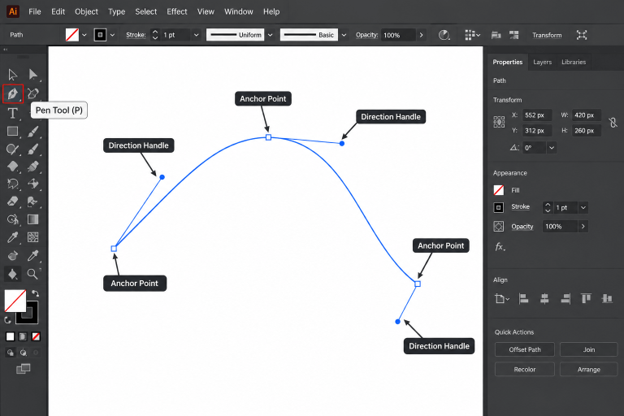
Anchor Points, Segments, and Handles Explained
Before you click anything, you need to understand the three building blocks of every path.
Image suggestion: an annotated diagram labeling an anchor point, a segment, and two direction handles.
Anchor Points
An anchor point is a small square that marks a position on the path. Think of it as a pin holding the line in place. Keep this image in mind through the rest of the Illustrator Pen Tool Guide.
There are two main types. A corner point creates a sharp angle. A smooth point creates a flowing curve.
Segments
A segment is the line between two anchor points. It can be straight or curved depending on the points at each end. Segments are central to the Illustrator Pen Tool Guide.
Direction Handles
Direction handles are the thin lines with round dots that appear when you drag. They control how a curve leaves and enters an anchor point.
The length of a handle controls how wide the curve is. The angle of a handle controls the direction of the curve. Handles are the most important concept in the Illustrator Pen Tool Guide.
Understanding these three parts is the foundation of this Illustrator Pen Tool Guide. Almost every mistake beginners make comes from not understanding what the handles are doing.
How to Draw Straight Lines
Straight lines are the easiest place to start. They teach you how clicks create points before you add the complexity of curves.
Step 1: Select the Pen Tool
Press P or click the Pen Tool in the toolbar. Step one of the Illustrator Pen Tool Guide is always selecting the right tool.
Step 2: Click to Place the First Point
Click once on the artboard. You will see a small anchor point appear. Every Illustrator Pen Tool Guide exercise begins with this single click.
Step 3: Click to Place the Second Point
Move your cursor and click again. Illustrator draws a straight segment between the two points. This simple action is the base of any Illustrator Pen Tool Guide.
Step 4: Hold Shift for Perfect Angles
Hold Shift while you click, and the line snaps to 45-degree angles. This is perfect for drawing exact horizontal, vertical, and diagonal lines.
Step 5: End the Path
To finish an open path, press Enter or click on the Pen Tool in the toolbar again. You can also hold Ctrl or Cmd and click on an empty area.
Practice drawing a zigzag, a star, and a simple house shape. Straight-line work builds the muscle memory you need for the next section of this Illustrator Pen Tool Guide.
How to Draw Curves

Curves are where most people get stuck. The secret is simple: click and drag instead of just clicking. This one idea unlocks the whole Illustrator Pen Tool Guide.
Step 1: Click and Drag the First Point
Click on the artboard to place the starting point, but do not release the mouse. Drag in the direction you want the curve to go, then release.
You will see two handles appear. They point in opposite directions from the anchor.
Step 2: Click and Drag the Second Point
Move your cursor to where the curve should end. Click and drag again, this time pulling in the direction the path should continue.
A smooth curve will appear between the two points.
Step 3: Adjust While You Draw
If the curve looks wrong, press Ctrl + Z or Cmd + Z and try again. Do not be afraid to redo it many times. Redoing is a normal part of any Illustrator Pen Tool Guide.
The Golden Rule of Curves
Place your anchor points at the extremes of the curve. These are the highest, lowest, leftmost, and rightmost points.
Use as few points as possible. Fewer points is the golden thread of the Illustrator Pen Tool Guide. A simple circle needs only four anchor points. Beginners often use ten or more, which makes the shape bumpy.
Handle Length Matters
Short handles create tight curves. Long handles create wide, gentle curves. Handle control is a signature skill from the Illustrator Pen Tool Guide. A good rule is to drag about one-third of the distance to the next anchor point.
This one habit improves almost every Illustrator Pen Tool Guide exercise. When your curves look lumpy, the handles are usually too long, too short, or pointing the wrong way.
Combining Corner and Curve Points
Real shapes use both sharp corners and smooth curves. A heart, a leaf, and a speech bubble all need both.
Going from a Curve to a Corner
After drawing a curve, you need to remove the outgoing handle before placing a sharp corner. Hold Alt on Windows or Option on Mac and click directly on the last anchor point.
This collapses the handle on one side. Your next segment will now start fresh instead of continuing the curve.
Going from a Corner to a Curve
This is simpler. Place a corner point with a normal click, then click and drag at the next point to start a curve. Mixing both is the real test of the Illustrator Pen Tool Guide.
Practice Shape: The Leaf
Draw a leaf with two curved sides that meet at sharp tips. Start at the bottom tip, curve up the left side, make a corner at the top, then curve down the right side and close the path.
This is one of the best exercises in the entire Illustrator Pen Tool Guide because it forces you to switch between point types.
Practice Shape: The Heart
A heart has two curved lobes, one sharp point at the bottom, and a dip at the top. Use four anchor points and adjust the handles until the shape feels balanced.
Do not worry if your first attempts look rough. Everyone’s early hearts are lopsided. Keep going with the Illustrator Pen Tool Guide and they will improve.
Closing Paths and Working with Open Paths

A path can be open or closed. An open path has two loose ends, like a line. A closed path forms a complete loop, like a circle.
How to Close a Path
Move your cursor over the first anchor point. A small circle appears next to the Pen icon. Click once, and the path closes.
Only closed paths can hold a fill color evenly. If your shape will not fill properly, check whether the path is really closed.
How to Continue an Open Path
Select the Pen Tool and hover over the end point of an open path. Click on it, and you can keep drawing from that point. This trick is a handy part of the Illustrator Pen Tool Guide.
How to Join Two Open Paths
Select both end points with the Direct Selection Tool, then press Ctrl + J on Windows or Cmd + J on Mac. Illustrator joins them into one path. Joining paths is a useful skill in any Illustrator Pen Tool Guide.
Understanding open and closed paths is a core lesson in this Illustrator Pen Tool Guide, because logos, icons, and lettering all depend on them.
Editing Paths After You Draw Them

Nobody draws a perfect path on the first try. Professional designers draw quickly and then refine. Editing is just as important as drawing in any Illustrator Pen Tool Guide.
The Direct Selection Tool
Press A to switch to the Direct Selection Tool. Click an anchor point to select it, then drag it to a new spot. Click and drag a handle to reshape the curve.
The Add Anchor Point Tool
Press + to add a point on a segment. Use it when a curve needs more control. Add points only where needed, because extra points create lumpy results.
The Delete Anchor Point Tool
Press – to remove a point. Illustrator will adjust the curve to flow smoothly through the remaining points. This is the best fix for overly complicated paths.
The Anchor Point Tool
Press Shift + C to switch to the Anchor Point Tool. Click a smooth point to turn it into a corner. Click and drag on a corner point to turn it into a smooth point.
This tool also lets you move one handle without moving the other, which is vital for shapes that have a curve on one side and a flat edge on the other.
Simplify a Messy Path
Choose Object > Path > Simplify. Illustrator reduces the number of anchor points while keeping the overall shape. Use the slider carefully so you do not lose important detail. Simplify is a favorite of those who master the Illustrator Pen Tool Guide.
A cleaner path is easier to edit, easier to animate, and easier to hand off to other designers. This is why every serious Illustrator Pen Tool Guide teaches editing along with drawing.
Essential Pen Tool Shortcuts

Shortcuts turn a slow workflow into a fast one. Learn these and you will work twice as quickly. Speed is a big benefit of the Illustrator Pen Tool Guide.
| Action | Windows | Mac |
| Pen Tool | P | P |
| Direct Selection Tool | A | A |
| Selection Tool | V | V |
| Anchor Point Tool | Shift + C | Shift + C |
| Add Anchor Point | + | + |
| Delete Anchor Point | – | – |
| Constrain to 45 degrees | Shift | Shift |
| Remove one handle | Alt + click | Option + click |
| Temporarily use Direct Selection | Ctrl | Cmd |
| Join paths | Ctrl + J | Cmd + J |
| Undo | Ctrl + Z | Cmd + Z |
You do not need to memorize everything today. Start with P, A, Shift, and Alt or Option, then add the rest over time. This is the fastest way to apply the Illustrator Pen Tool Guide.
Keep this table nearby while you work through the Illustrator Pen Tool Guide, and shortcuts will soon become second nature.
Pen Tool vs Curvature Tool
Illustrator also includes the Curvature Tool, shortcut Shift + `. Many beginners wonder whether it can replace the Pen Tool.
How the Curvature Tool Works
You click to place points, and Illustrator automatically creates smooth curves between them. There are no handles to manage. To make a corner, you double-click a point.
When to Use the Curvature Tool
It is excellent for quick, organic shapes and for beginners who feel overwhelmed by handles. It is a friendly way to build confidence.
When to Use the Pen Tool
The Pen Tool gives you far more control. For logos, technical illustrations, and precise tracing, it is the industry standard.
Which Should You Learn First?
Learn the Pen Tool. Once you understand it, the Curvature Tool becomes easy. The reverse is not true. Remember this advice from the Illustrator Pen Tool Guide.
That is why this Illustrator Pen Tool Guide focuses on the Pen Tool, while treating the Curvature Tool as a helpful bonus.
Tracing Images with the Pen Tool

Tracing is the best way to practice, and it is also a real professional skill. Every Illustrator Pen Tool Guide should include it. Designers trace sketches, photos, and old logos every day.
Step 1: Place Your Image
Choose File > Place and select your reference image. Resize it so it fills most of the artboard.
Step 2: Dim and Lock the Layer
Open the Layers panel and double-click the image layer. Set the opacity to about 40 percent, then click the lock icon. This stops you from moving the image by accident.
Step 3: Create a New Layer
Add a new layer above the image. Draw all your paths on this layer so your work stays organized.
Step 4: Trace the Main Shapes First
Start with large, simple shapes. Place anchor points at the extremes of each curve, as you learned earlier.
Step 5: Add Detail Last
After the main shapes are done, add smaller details such as eyes, highlights, and textures. Patience is the secret of the Illustrator Pen Tool Guide.
Step 6: Choose Colors
Once the outlines are clean, remove the strokes and apply fill colors. Use the Swatches panel to keep your palette consistent.
Tracing may feel slow at first. Within a few projects, you will notice that your speed and accuracy improve dramatically, which is the whole point of this Illustrator Pen Tool Guide.
Common Mistakes and How to Fix Them

Every learner makes the same handful of mistakes. Knowing them in advance saves a lot of frustration. Consider this list the practical heart of the Illustrator Pen Tool Guide.
Mistake 1: Using Too Many Anchor Points
Beginners add points everywhere. The result is a bumpy, hard-to-edit path. The Illustrator Pen Tool Guide solves this problem with a simple rule.
Fix: Use fewer points and place them at curve extremes. Delete extras with the Delete Anchor Point Tool.
Mistake 2: Handles That Are Too Long
Long handles create wide, floppy curves that overshoot the shape.
Fix: Shorten the handles to about one-third of the distance between points.
Mistake 3: Forgetting to Remove a Handle
You draw a curve, then click for a corner, and the next segment curves unexpectedly.
Fix: Hold Alt or Option and click the last anchor point to remove the outgoing handle before you continue.
Mistake 4: Not Closing the Path
The shape will not fill, or the stroke looks broken at the start point.
Fix: Hover over the first point until the small circle appears, then click.
Mistake 5: Working Without Zooming In
Tiny placement errors become obvious later. Zoom in with Ctrl and + or Cmd and + for detailed sections.
Mistake 6: Giving Up Too Early
The Pen Tool feels awkward for almost everyone at first. Progress comes from steady practice, not talent.
Fixing these six problems will improve your results more than any other change you make while following this Illustrator Pen Tool Guide.
Practice Exercises

Reading is not enough. You must practice with your own hands. The Illustrator Pen Tool Guide works best when you practice each step. Here is a simple plan you can follow. It fits the Illustrator Pen Tool Guide perfectly.
Week 1: Straight Lines and Corners
Draw a zigzag, a star, a triangle, and a house. Use Shift to keep angles exact.
Week 2: Basic Curves
Draw a wave, a circle with four points, an S-curve, and a spiral. Focus on handle length.
Week 3: Mixed Shapes
Draw a leaf, a heart, a cloud, and a teardrop. Practice switching between corner and curve points.
Week 4: Real Projects
Trace a simple logo, a hand-drawn sketch, and an icon. Compare your results with the original and fix any lumpy sections.
Spend 20 to 30 minutes a day. Short, regular practice beats one long weekend session every time. That is the best advice any Illustrator Pen Tool Guide can give. This schedule turns the Illustrator Pen Tool Guide into a real skill rather than just something you read.
Pro Tips for 2026

Once the basics feel comfortable, these tips will help you work like a professional. Treat them as the advanced chapter of the Illustrator Pen Tool Guide.
- Use the Contextual Taskbar. Recent versions of Illustrator show helpful options right next to your selection, saving you trips to the menus.
- Draw with a tablet. A pen tablet makes drawing curves feel more natural, though a mouse works fine.
- Name your layers. Clear names such as “outline” and “details” make complex files easy to manage.
- Use Outline Mode. Press Ctrl + Y or Cmd + Y to see only the paths. This reveals extra points and messy joins.
- Use Pathfinder wisely. Combine simple shapes with Pathfinder, and use the Pen Tool only for the custom parts.
- Save often. Illustrator files can grow large, so save frequently and keep backups.
- Study great work. Look at logos and illustrations by professionals and ask yourself where they placed their points.
Always check the latest Illustrator release notes, because Adobe regularly adds features that can speed up path work. Staying current is a quiet advantage that strengthens any Illustrator Pen Tool Guide.
Troubleshooting Pen Tool Problems
Sometimes the tool does not behave the way you expect. Here are the most common issues and quick solutions. Think of it as the support desk of the Illustrator Pen Tool Guide.
The Pen Tool Draws a Fill Instead of a Line
Your fill is turned on. Set the fill to none and the stroke to a visible color before drawing.
I Cannot See My Path
The stroke may be white or set to none. Select the path and change the stroke color.
Clicking Adds Points to the Wrong Path
If an existing path is selected, the Pen Tool may continue it. Deselect everything with Ctrl + Shift + A or Cmd + Shift + A before starting a new shape.
My Curves Look Jagged
Zoom in and check for too many points or mismatched handles. Use Simplify or delete extra anchors.
The Cursor Does Not Look Like a Pen
Caps Lock can change the cursor to a crosshair. Turn it off and the normal Pen icon returns.
Keep this list handy while you work through the Illustrator Pen Tool Guide, because these small issues cause most of the confusion new users face.
Using the Pen Tool for Logo Design

Logo design is where the Pen Tool earns its reputation. A logo must look perfect at every size, and only clean vector paths can do that.
This part of the Illustrator Pen Tool Guide shows a simple workflow you can reuse for any brand project.
Start with a Sketch
Draw rough ideas on paper first. Scan or photograph your best sketch and place it in Illustrator on a locked layer.
Build Shapes from Simple Parts
Look at the sketch and break it into basic forms such as circles, lines, and curves. Draw each form with as few points as possible.
Keep Curves Consistent
Good logos have a consistent feel. If one curve is tight and another is wide, the mark looks uneven. Compare handle lengths across the whole design.
Check the Design in Outline Mode
Press Ctrl + Y or Cmd + Y to see the raw paths. Look for stray points, overlapping segments, and tiny gaps.
Test at Small and Large Sizes
Zoom out to see how the logo looks at the size of a favicon. Then scale it up to check the details. Clean paths will hold up in both cases.
Save Multiple Versions
Export your logo as SVG, PNG, and PDF. SVG keeps the vector quality, which is the main benefit of everything you learn in this Illustrator Pen Tool Guide.
Many clients ask for a logo that works on websites, packaging, and signs. The Pen Tool makes that possible with a single file.
Quick Recap of the Whole Process

Here is a short summary you can save for later. It condenses the entire Illustrator Pen Tool Guide into a simple checklist.
- Set the fill to none and the stroke to a visible color.
- Press P to select the Pen Tool.
- Click to place corner points and hold Shift for exact angles.
- Click and drag to create smooth curve points.
- Place anchor points at the extremes of each curve.
- Keep handles about one-third the distance to the next point.
- Hold Alt or Option to remove a handle before a corner.
- Close the path by clicking the first anchor point.
- Refine with the Direct Selection and Anchor Point tools.
- Delete extra points and check your work in Outline Mode.
If you remember only these ten steps, you already understand the core of the Illustrator Pen Tool Guide.
Why This Method Works
Many tutorials throw dozens of tips at you at once. That approach feels productive, but it rarely sticks.
This Illustrator Pen Tool Guide works because it follows a clear order. You learn the parts, then the clicks, then the curves, then the editing, and finally the real projects.
Each step builds on the one before it. That is how the Illustrator Pen Tool Guide keeps you moving forward. When something goes wrong, you can look back and find exactly which step needs more practice.
The method also keeps your files clean. Fewer points, consistent handles, and organized layers mean you spend less time fixing and more time creating.
Designers who follow a structured Illustrator Pen Tool Guide tend to improve faster than those who learn by random experimentation. Structure removes the guesswork and keeps your motivation high.
Who Should Use This Guide
This tutorial is useful for several kinds of learners.
- Complete beginners who have never opened Illustrator.
- Graphic design students who need a reliable reference for assignments.
- Freelancers who want to offer logo and icon design services.
- Small business owners who want to create their own branding.
- Photoshop users who are moving into vector work.
No matter your background, the Illustrator Pen Tool Guide is designed to meet you at your level and carry you to confident, professional path work.
Frequently Asked Questions (FAQs)
What is the Pen Tool in Illustrator used for?
The Pen Tool is used to draw precise vector paths, including straight lines, curves, and complex custom shapes. Designers use it for logos, icons, illustrations, and tracing.
Is the Pen Tool hard to learn?
It feels difficult at first because of the handles. With a clear method and about a month of regular practice, most people become comfortable. A good Illustrator Pen Tool Guide makes the process much smoother.
What is the shortcut for the Pen Tool in Illustrator?
Press P to select the Pen Tool. Press Shift + C for the Anchor Point Tool and A for the Direct Selection Tool. These shortcuts appear throughout the Illustrator Pen Tool Guide.
How do I make a curve with the Pen Tool?
Click and drag instead of clicking once. The drag creates handles that control the curve. Place points at the extremes of each curve and keep handles about one-third of the distance to the next point.
How do I remove a handle while drawing?
Hold Alt on Windows or Option on Mac and click directly on the last anchor point. This removes the outgoing handle so you can draw a sharp corner next.
What is the difference between the Pen Tool and the Curvature Tool?
The Curvature Tool creates smooth curves automatically with no visible handles. The Pen Tool offers full manual control. Most professionals prefer the Pen Tool for precision work.
How many anchor points should a path have?
As few as possible. Fewer points create smoother curves and cleaner files. A circle needs only four points. This rule is the backbone of the Illustrator Pen Tool Guide.
Can I use the Pen Tool for logo design?
Yes. Most professional logos include custom paths drawn with the Pen Tool. Following a structured Illustrator Pen Tool Guide helps you build logos that look sharp at every size.
How long does it take to master the Pen Tool?
Most learners feel confident in two to four weeks of daily practice. True mastery comes with real projects over several months. The Illustrator Pen Tool Guide gives you a clear path to follow.
Is the Pen Tool the same in Photoshop?
The tools work in a very similar way, so skills transfer easily. Learning the Illustrator Pen Tool Guide helps with Photoshop too. Illustrator creates vector paths, while Photoshop uses them mainly for shapes and selections.
Conclusion
The Pen Tool rewards patience. Nothing in the Illustrator Pen Tool Guide is out of reach. Once the idea of anchor points, segments, and handles clicks into place, you will draw with confidence and speed.
Start with straight lines, move on to curves, and then combine both. Edit your paths carefully, use shortcuts, and practice a little every day.
Return to this Illustrator Pen Tool Guide whenever you feel stuck, and use the practice plan to keep improving. Every professional designer began with the same wobbly curves you are drawing today. Trust the Illustrator Pen Tool Guide and keep practicing.
Open Illustrator, press P, and draw your first shape right now. Your next logo, icon, or illustration is only a few clicks away. Bookmark this Illustrator Pen Tool Guide and share it with anyone who is learning vector design.
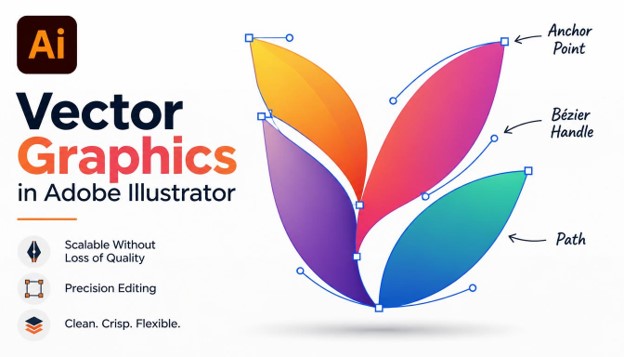
Vector Graphics in Adobe Illustrator: 15 Essential Techniques for Better Designs
Vector graphics in Adobe Illustrator power modern branding, icons, packaging, and illustration. Almost every professional logo you see today started life as a vector file.
If you have ever stretched a logo and watched it turn blurry, you already know why vector art matters. Vectors are built from math rather than pixels, so they stay sharp at any size, from a tiny favicon to a giant billboard.
This guide covers 15 essential techniques that will improve how you work. Each one is practical, easy to apply, and useful whether you are a complete beginner or a growing designer who wants cleaner results.
Learning vector graphics in Adobe Illustrator takes practice, but the right habits shorten the learning curve. These techniques will help you produce cleaner, faster, and more professional work.
What Are Vector Graphics in Adobe Illustrator?
Vector graphics are images made from points, lines, curves, and shapes. Each element is defined by a mathematical formula rather than a grid of colored pixels.
That is why vector artwork scales without losing quality. A business card logo and a billboard can come from the exact same file.
Vector graphics in Adobe Illustrator are built from paths. A path is a line or curve connected by anchor points, and the direction handles on those points control how the curve bends.
Raster programs like Photoshop work with pixels, which suits photos and detailed textures. Illustrator suits logos, icons, typography, and illustrations that need to stay crisp everywhere.

Understanding this difference makes every technique below easier to learn. It also helps you decide when Illustrator is the right tool and when it is not.
1. Master the Pen Tool
The Pen Tool (P) is the most important tool for vector graphics in Adobe Illustrator. Almost every custom shape begins with it.
Click to place a corner point. Click and drag to create a smooth curve with direction handles.
Beginners often struggle because they place too many points. Aim for the fewest points that still describe the shape.
A useful rule is to place anchor points at the extremes of a curve, where it changes direction. This gives you smoother and more predictable results.
Practice by tracing simple shapes like circles, hearts, and leaf outlines. Within a few sessions, the handles start to feel natural.
Hold Shift while clicking to constrain lines to 45-degree angles. Hold Alt (Option on Mac) to adjust one handle independently of the other.

Strong pen skills are the foundation of everything else in this list.
2. Use Anchor Points Sparingly
Fewer anchor points mean smoother curves and smaller files. This principle separates clean vector work from messy work.
Too many points create bumps and kinks that are hard to edit. They also make your artwork heavier and harder to share.
Select a path and use Object > Path > Simplify to reduce points automatically while keeping the shape. You can also use the Smooth tool, hidden under the Pencil tool, to clean up rough paths.
When you review your work, view it in Outline mode (Ctrl/Cmd + Y). This reveals messy paths and stray points right away.
Delete unneeded points with the Delete Anchor Point tool (minus key). Convert sharp corners to curves with the Anchor Point tool (Shift + C).

Clean paths are the mark of professional vector graphics in Adobe Illustrator.
3. Build Complex Shapes with the Shape Builder Tool
The Shape Builder Tool (Shift + M) lets you combine and subtract shapes by dragging across them. It is faster and more intuitive than drawing everything by hand.
Start by overlapping basic shapes like circles, rectangles, and triangles. Select them all, choose the tool, and drag across the areas you want to merge.
Hold Alt (Option on Mac) and click a region to delete it. This makes cutting holes and notches simple.
Many popular logos are built this way. A few circles and squares can become a bird, a flame, or a letterform.
This technique is one of the fastest ways to produce vector graphics in Adobe Illustrator without advanced pen skills. Combine it with grids and guides, covered later, for precise geometric designs.

Once you get comfortable, you will reach for this tool constantly.
4. Combine Shapes with the Pathfinder Panel
The Pathfinder panel (Window > Pathfinder) offers precise control over how shapes interact. It is a reliable companion to the Shape Builder Tool.
The main options are Unite, Minus Front, Intersect, and Exclude. Each produces a different result from the same overlapping shapes.
Unite merges shapes into one silhouette. Minus Front cuts the top shape out of the one beneath it.
Intersect keeps only the overlapping area. Exclude removes the overlap and keeps everything else.
Hold Alt (Option) when clicking these buttons to create compound shapes. Compound shapes stay editable, so you can move the original pieces later.
This non-destructive approach is helpful when working with vector graphics in Adobe Illustrator for clients who request revisions. Use Pathfinder for repeatable results and Shape Builder for fast, visual work.

Knowing both tools gives you flexibility on any project.
5. Organize with Layers and Clear Naming
Good organization saves hours. Complex artwork can contain hundreds of objects, and without structure it becomes unmanageable.
Open the Layers panel (F7) and create layers for logical groups, such as background, icons, text, and guides. Rename each layer with a clear label. “Layer 14” tells you nothing, but “Left wing” does.
Lock layers you are not editing to avoid accidental changes. Hide layers to focus on one area.
Use groups (Ctrl/Cmd + G) to combine related objects. Double-click a group to enter isolation mode and edit its contents safely.
Teams especially benefit from tidy files. Developers and other designers can open your vector graphics in Adobe Illustrator and understand them immediately.

An organized file is a faster and more professional file.
6. Work Precisely with Grids, Guides, and Smart Guides
Precision turns decent artwork into polished artwork. Illustrator offers several tools to keep elements aligned.
Turn on the grid with Ctrl/Cmd + “. Enable Snap to Grid under the View menu to lock points to grid intersections. Drag guides from the rulers (Ctrl/Cmd + R) to mark margins, centers, and alignment lines.
Smart Guides (Ctrl/Cmd + U) show helpful hints as you move objects. They reveal alignment, spacing, and angles in real time.
Many icon designers build on a pixel grid, such as 24 by 24 units. This keeps strokes crisp when the icon appears at small sizes.
Use the Align panel to distribute objects evenly. These habits make your vector graphics in Adobe Illustrator look balanced and intentional.

Precision is invisible when done well, but always noticed when missing.
7. Manage Color with Global Swatches and Color Groups
Color consistency defines brand identity. Illustrator’s swatches help you manage it efficiently.
Create a swatch by dragging a color into the Swatches panel. Check the Global option, and every object using that swatch updates when you edit it. Change one swatch, and the entire design follows.
Organize related colors into color groups. A brand palette might include primary, secondary, and neutral groups.
Use the Color Guide panel to explore harmonies like complementary, analogous, and triadic schemes.
Always choose the right color mode. Use RGB for screens and CMYK for print. Set it under File > Document Color Mode.
Smart color management is central to professional vector graphics in Adobe Illustrator, and it makes recoloring for different campaigns painless.

Plan your palette early and your design stays consistent.
8. Create Depth with Gradients and Freeform Gradients
Gradients add dimension, lighting, and mood. Illustrator offers several ways to apply them.
Linear and radial gradients are the basics. Open the Gradient panel (Ctrl/Cmd + F9), then click the gradient bar to add color stops. Press G to use the Gradient Tool directly on your artwork.
Freeform gradients let you place color points anywhere on an object. They create soft, organic blends without hard geometry. Use Points mode for scattered color spots, or Lines mode for blends that follow a path.
Subtle gradients often look better than dramatic ones. Keep color stops close in hue for a refined result.
Gradients can also apply to strokes, which opens creative options for lines and outlines in vector graphics in Adobe Illustrator.

Use gradients with restraint and your designs gain polish without losing clarity.
9. Handle Typography with Type on a Path and Outlines
Text is often the heart of a design. Illustrator treats type as vector, so it can be shaped creatively.
Use the Type on a Path tool to wrap text along a curve or circle. This is perfect for badges, seals, and emblems.
Before sending a logo or print file, convert text to outlines (Ctrl/Cmd + Shift + O). This turns letters into shapes and prevents font problems on other computers.
Outlined text can be edited like any other path. You can tweak individual letters, merge them, or cut them apart.
Pay attention to kerning and tracking. Spacing between letters affects readability and the overall feel of the design. Good type choices strengthen vector graphics in Adobe Illustrator, especially in logo work.

Treat letterforms as shapes and your typography becomes more distinctive.
10. Convert Raster to Vector with Image Trace
Image Trace converts bitmap images into editable vectors. It is useful for digitizing sketches, old logos, and scanned artwork.
Place your image, select it, and open Window > Image Trace. Choose a preset such as Black and White Logo, 3 Colors, or High Fidelity Photo.
Preview the result and adjust the threshold, paths, and corners. Fewer paths usually give cleaner output. Click Expand to turn the trace into editable paths.
Start with a high-contrast, high-resolution image for the best outcome. Blurry sources produce messy traces.
Always clean up after tracing. Remove stray points, smooth rough edges, and simplify where possible.
Image Trace is a fast bridge between hand-drawn sketches and finished vector graphics in Adobe Illustrator.

Use tracing as a starting point, then refine for quality.
11. Add Character with the Width Tool and Custom Brushes
Strokes do not have to be uniform. The Width Tool (Shift + W) lets you vary stroke thickness along a path.
Drag outward from any point on a stroke to make it thicker or thinner. Save a custom width profile from the Stroke panel to reuse it later.
Brushes expand your options further. Illustrator includes calligraphic, art, scatter, and pattern brushes.
The Blob Brush Tool (Shift + B) lets you paint filled vector shapes, much like drawing with a marker. Overlapping strokes of the same color merge automatically.
These tools bring warmth and personality to vector graphics in Adobe Illustrator, which can sometimes feel too rigid.

Variation in line weight adds energy and a human touch.
12. Save Time with Symbols and Graphic Styles
Repetition is common in design. Symbols and graphic styles let you reuse elements while keeping them linked.
Create a symbol by dragging artwork into the Symbols panel. Edit the original, and every instance updates. This is ideal for repeated icons and map markers.
Graphic styles save a set of appearance attributes, such as fills, strokes, and effects. Apply them to any object in one click.
The Appearance panel is where these attributes live. This non-destructive approach lets you change a drop shadow or stroke later without redrawing anything.
Teams that standardize styles keep their vector graphics in Adobe Illustrator consistent across large projects.

Reusable assets reduce errors and speed up revisions.
13. Use Clipping Masks and Opacity Masks
Masks let you hide parts of artwork without deleting them. This keeps your work editable and safe.
A clipping mask uses a shape to crop the objects beneath it. Place the shape on top, select both, and press Ctrl/Cmd + 7. Release it anytime with Ctrl/Cmd + Alt + 7.
Opacity masks give you softer control. Black hides, white reveals, and gray creates partial transparency. This is excellent for fades, reflections, and subtle lighting.
Using masks well makes your vector graphics in Adobe Illustrator flexible and easy to revise. Nothing is permanently lost.

Hide, do not delete, and you will always have options.
14. Experiment Quickly with Recolor Artwork
Recolor Artwork lets you change an entire palette in seconds. It is perfect for testing variations and client requests.
Select your artwork and choose Edit > Edit Colors > Recolor Artwork. A panel shows every color used in the selection. Drag color stops to shift hues, or apply colors from a library or color group.
Recolor works especially well when your artwork uses global swatches. Seasonal versions, dark mode versions, and print versions all become simple.
This feature shows how powerful vector graphics in Adobe Illustrator can be for rapid iteration. A single file can become dozens of variations.

Fast experimentation leads to better design decisions.
15. Export Correctly for Web, Print, and Development
A great design is only useful if it exports correctly. Different uses require different formats.
SVG is the standard for websites. It is lightweight, scalable, and styleable with code. Use PNG for transparent raster images, JPG for photos, and PDF for print. Keep the original AI file as your master.
The Export for Screens panel (Ctrl/Cmd + Alt + E) lets you export multiple artboards and sizes at once.
Before exporting, check for stray points, hidden layers, and unneeded objects. Convert text to outlines when fonts might be missing.
Proper export is the final step in working with vector graphics in Adobe Illustrator, and it protects the quality you worked to create.

Always test your exports on the real platform before delivery.
Why Vector Graphics in Adobe Illustrator Matter for Designers
Clients rarely ask for a single size. They want a logo on a website header, a mobile app icon, a printed brochure, a vehicle wrap, and a social media avatar.
A vector file handles all of these from one source. You do not need to rebuild the artwork for every use, which saves time and keeps the brand consistent.
Vector graphics in Adobe Illustrator also produce small file sizes for simple artwork. A clean icon can weigh only a few kilobytes, which helps websites load faster.
Editing is another major advantage. You can change a color, move a single point, or resize one shape without damaging the rest of the design.
Printers and sign makers prefer vector files too. They can cut, engrave, and print directly from your paths with perfect accuracy.
This is why agencies, freelancers, and in-house teams all rely on vector graphics in Adobe Illustrator for brand work. Learning it opens doors to logo design, packaging, apparel, and UI projects.

If you want a career in graphic design, strong vector skills are a clear advantage.
Setting Up Your Document for Vector Graphics in Adobe Illustrator
A good project starts with the right document settings. Mistakes here can cause problems later that are hard to fix.
Go to File > New and choose a preset that matches your output. Print, Web, and Mobile presets each set sensible defaults for size and color mode.
Pick the correct units. Use pixels for screens and millimeters or inches for print.
Add bleed to print documents, usually 3 mm, so artwork extends past the trim edge. This avoids white slivers after cutting.
Create separate artboards for variations such as a horizontal logo, a stacked logo, and an icon-only version. Multiple artboards keep everything in one file.
Turn on the preview options you need, such as Pixel Preview for screen work. This shows how vector graphics in Adobe Illustrator will appear when rasterized.

Five minutes of setup can save hours of rework.
Understanding Fills, Strokes, and Appearance
Every vector object has a fill and a stroke. The fill colors the inside, and the stroke outlines the edge.
Use the Stroke panel to control weight, caps, corners, and alignment. Rounded caps and corners give a friendly look, while sharp ones feel more technical.
You can align strokes to the center, inside, or outside of a path. Inside and outside alignment is useful for closed shapes like circles and rectangles.
Dashed lines and arrowheads are also available in the Stroke panel. They help with diagrams, maps, and technical illustration.
When you need a stroke to behave like a shape, use Object > Path > Outline Stroke. This converts it into a filled path you can combine and edit.
Mastering these basics makes all vector graphics in Adobe Illustrator more predictable. It also makes the later techniques in this guide easier to use.
Small details in stroke settings often separate amateur work from polished work.
Vector Graphics in Adobe Illustrator for Logo Design
Logos are the most common use of vector artwork. A good logo must look great at any size and in any color.
Start with sketches on paper. Choose the strongest idea, then rebuild it digitally using basic shapes and the Pen Tool.
Design in black and white first. If the logo works without color, it will be easier to adapt later.
Test your logo small. Shrink it to the size of a favicon and check whether it is still readable.
Provide a full set of files when you deliver. This should include AI, SVG, PDF, and PNG versions, plus color and monochrome variations.
Many designers build every logo as vector graphics in Adobe Illustrator because the format is trusted by printers, developers, and clients alike.
Simple, memorable shapes beat complicated ideas almost every time.
Vector Graphics in Adobe Illustrator for Icons and UI Design
Icons need consistency. The same stroke weight, corner radius, and visual style should appear across the whole set.
Build icons on a fixed grid, such as 24 by 24 pixels. Keep a safe area inside the grid so shapes do not touch the edges.
Use simple geometry. Circles, rounded rectangles, and straight lines are easy to align and easy to read.
Preview icons at actual size using Pixel Preview. Adjust points so lines land on whole pixels for sharp edges.
Export icons as SVG so developers can use them in code. Keep the markup clean by removing unused layers and hidden objects.
Teams building design systems rely on vector graphics in Adobe Illustrator to keep icon libraries organized. Naming each artboard clearly also makes batch exports easier.
Consistency is the secret to icon sets that feel professional.
Vector Graphics in Adobe Illustrator for Illustration and Packaging
Illustrators use vector tools to create flat art, character designs, posters, and editorial pieces. The clean look suits modern branding.
Packaging designers use Illustrator to create dielines, which show where a box folds and cuts. Artwork is then placed precisely within those lines.
Patterns are another strong use. Select artwork and choose Object > Pattern > Make to build seamless repeating tiles.
You can apply patterns to packaging, fabric, wallpaper, and websites. Because they are vectors, they stay sharp at any scale.
Textures can be added using vector shapes, noise effects, or clipped raster grain. Use them sparingly to keep files light.
These creative uses show how flexible vector graphics in Adobe Illustrator really are. One tool covers branding, print, and digital work.
Think of Illustrator as a complete toolbox for visual communication.
Best Practices for Beginners Learning Vector Graphics in Adobe Illustrator
Start small. Draw simple objects like a coffee cup, a house, or a leaf before attempting complex scenes.
Learn the Selection tool (V) and the Direct Selection tool (A) first. Knowing the difference saves a lot of confusion.
Use the Undo shortcut freely. Ctrl/Cmd + Z is your friend while learning.
Follow one tutorial at a time and recreate it from scratch afterward. Repetition builds muscle memory.
Save your work often and keep backups. Cloud storage or an external drive protects against crashes.
Join design communities to share work and get feedback. Honest critique speeds up improvement.
Be patient. Everyone finds vector graphics in Adobe Illustrator awkward in the first few weeks.
Consistent practice beats occasional long sessions.
Recommended Workflow from Idea to Final File
A repeatable workflow keeps projects on track. Here is a simple process that works for most jobs.
First, gather references and write a short brief. Know the audience, the use cases, and the style you want.
Second, sketch several ideas quickly. Do not worry about quality at this stage.
Third, build the chosen idea with basic shapes. Refine with the Pen Tool, Pathfinder, and Shape Builder.
Fourth, add color, type, and details. Check contrast and readability at small sizes.
Fifth, review in Outline mode, clean up paths, and organize layers. Then export the right formats.
Following this order keeps vector graphics in Adobe Illustrator projects efficient. It also reduces the number of revisions clients request.
A clear process turns creative work into reliable work.
Helpful Resources for Vector Graphics in Adobe Illustrator
Adobe’s built-in tutorials inside the Discover panel are a good starting point. They guide you step by step within the app.
YouTube has thousands of free lessons on every tool covered in this guide. Look for creators who show full projects from start to finish.
Design blogs and forums offer tips, templates, and critiques. Reading how others solve problems expands your toolkit.
Practice challenges, such as daily icon or logo prompts, keep your skills active. They also build a strong portfolio.
Finally, study great vector work. Collect examples you admire and analyze how they use shape, color, and spacing.
Combining these resources will accelerate your progress with vector graphics in Adobe Illustrator.
Keep learning, keep practicing, and keep building your portfolio.
Troubleshooting Common Illustrator Problems
Even with good habits, problems appear. Knowing the fixes keeps you moving instead of getting stuck.
Curves look lumpy. This almost always means too many anchor points or handles that are not aligned. Delete extra points, then adjust the remaining handles so they sit along the direction of the curve.
Strokes look thicker or thinner after resizing. Open Preferences and check the Scale Strokes & Effects option. Turn it on if you want line weights to resize with the artwork, or off if you want them to stay fixed.
Colors look dull in print. The document is probably in RGB. Switch to CMYK under File > Document Color Mode, then review the colors again, since bright screen colors often shift.
You cannot select an object. Check whether the layer is locked or the object is inside a group, clipping mask, or symbol. Unlock layers, use isolation mode, or choose Object > Unlock All.
The file is slow or huge. Look for unused swatches, extra brushes, embedded images, and thousands of tiny points. Use File > Save As, remove unused items, and simplify complex paths.
Text changes on another computer. The fonts are missing on that machine. Convert the text to outlines before sending, or package the file with its fonts through File > Package.
Exported SVG looks different in the browser. Effects such as blurs and some blend modes may not export cleanly. Expand effects first, keep shapes simple, and test the SVG in the browser before delivery.
Shapes will not merge. Open paths cannot be combined like closed shapes. Join the end points with Ctrl/Cmd + J, or redraw the shape as a closed path, then try Pathfinder again.
Solving these issues quickly builds confidence. It also shows clients that you understand the technical side of design, not only the creative side.
Keep a short checklist of these fixes near your desk until they become automatic.
Common Mistakes to Avoid
Even experienced designers make errors. Knowing the common ones helps you avoid them.
Using too many anchor points is the most frequent issue. It leads to lumpy curves and heavy files.
Ignoring color modes causes problems. A design made in RGB may print with dull colors.
Forgetting to outline strokes before scaling can distort line weights. Working without layers creates chaos on large projects.
Avoiding these habits will improve your vector graphics in Adobe Illustrator right away.
Tips to Improve Your Vector Workflow
Small changes in habit add up to big gains in speed and quality.
Learn keyboard shortcuts for your most-used tools. Selection (V), Direct Selection (A), Pen (P), and Shape Builder (Shift + M) cover most needs.
Practice by recreating existing logos and icons. Studying how others build shapes teaches proportion and structure.
Keep a library of reusable swatches, symbols, and brushes. Save versions frequently so you can return to earlier stages.
Consistent habits make your whole vector workflow feel faster and more enjoyable over time.
Frequently Asked Questions (FAQs)
What are vector graphics in Adobe Illustrator?
They are images made from mathematical paths, points, and curves instead of pixels. Because of this, they scale to any size without losing sharpness.
Is Adobe Illustrator good for beginners?
Yes. Start with basic shapes, the Shape Builder Tool, and simple Pen Tool practice. Free tutorials and templates help a lot.
What is the difference between vector and raster graphics?
Vector graphics use paths and stay sharp at any size. Raster graphics use pixels and become blurry when enlarged.
Which file format is best for vector graphics?
AI is best for editable master files. SVG is best for websites, and PDF or EPS works well for print.
How do I make my vector designs look more professional?
Use fewer anchor points, a consistent color palette, grids and guides, and organized layers.
Can I convert a photo or sketch into a vector?
Yes. Use Image Trace, then clean up the result afterward for the best quality.
How long does it take to learn vector graphics in Adobe Illustrator?
You can learn the basics in a few weeks with regular practice. Mastery takes longer.
Do I need a drawing tablet to work in Illustrator?
No. A mouse works fine for Pen Tool and shape-based work. A tablet is optional.
Conclusion
Strong vector skills come from understanding a handful of core techniques and using them consistently.
From the Pen Tool and Shape Builder to masks, gradients, and clean exports, each method adds precision and efficiency to your work.
Start with two or three techniques and practice them on small projects. With steady practice, vector graphics in Adobe Illustrator will become one of the most valuable skills in your design toolkit.
-

 Graphics Design3 years ago
7.Exploring the Importance of Color Theory Charts
-

 Graphics Design1 year ago
Top 10 Best Graphic Design Tools for Beginners in 2025 (Free & Paid)
-

 Graphics Design2 years ago
10 Stunning Gradient Design Trends You Need to Know in 2024
-

 Graphics Design1 year ago
15 Freelance Graphic Design Tips to Boost Your Career in 2025
-

 Graphics Design2 years ago
29.Retro Design Is Making a Comeback in Modern Spaces
-

 Graphics Design1 year ago
Best Laptops for Graphic Designers – 2025 Buying Guide
-

 Graphics Design2 years ago
2025 Logo Design Trends: What’s In, What’s Out?
-

 Graphics Design2 years ago
15.The Importance of Effective Flyer Design in Marketing
mail tm
September 23, 2024 at 10:17 pm
Hi, i think that i saw you visited my web site thus i came to ?eturn the favor텶 am attempting to find things to improve my web site!I suppose its ok to use some of your ideas!!
Kaye Morise
October 26, 2024 at 6:29 am
Greetings! I know this is somewhat off topic but I was wondering if you knew where I could get a captcha plugin for my comment form? I’m using the same blog platform as yours and I’m having problems finding one? Thanks a lot!
carbon tubes
November 4, 2024 at 9:15 am
You are a very smart person!